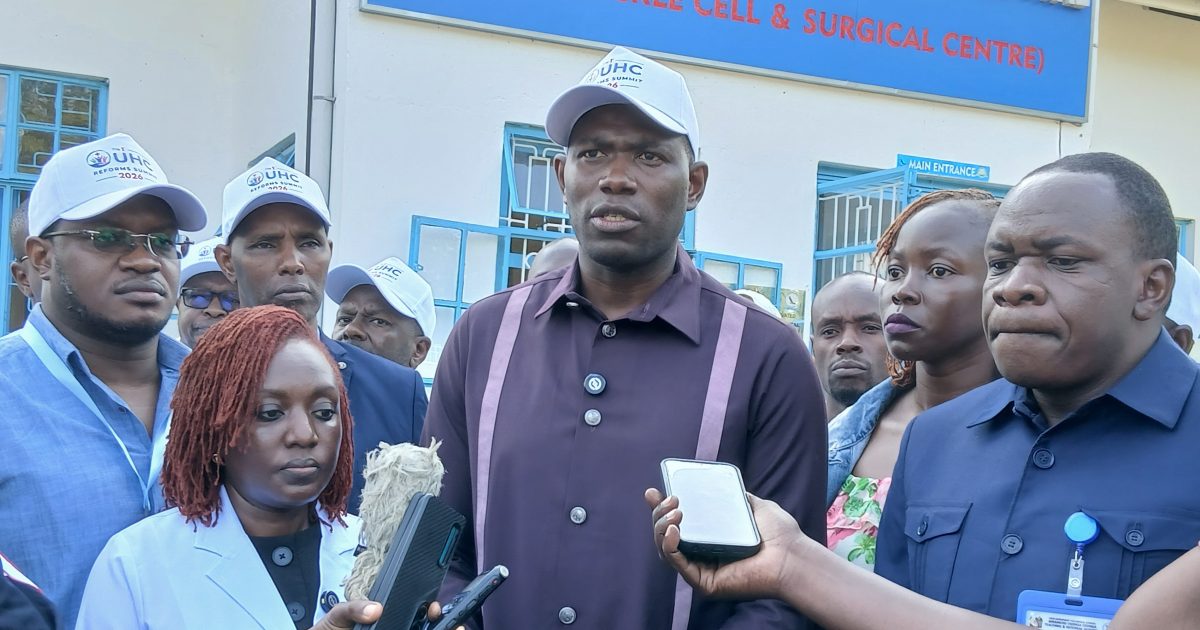
The government has designated the Jaramogi Oginga Odinga Teaching and Referral Hospital (JOOTRH) in Kisumu as Kenya’s first public centre for advanced sickle cell treatment, marking a major milestone in the implementation of Universal Health Coverage (UHC) reforms.
Medical Services Principal Secretary (PS) Dr. Ouma Oluga said the facility is now offering specialised red blood cell exchange therapy at its Victoria Annex Hospital, a procedure that significantly reduces painful crises, strokes and other life-threatening complications associated with sickle cell disease.
Speaking during a visit to the hospital alongside county chief officers for health, Dr. Oluga said the investment demonstrates how recent health reforms are beginning to translate into specialised services for patients.
“We are here to show how all the reforms in health financing, primary healthcare, facility improvement financing and digitization are interconnected and working together to improve patient care,” he said.
The visit comes ahead of World Sickle Cell Day on June 19 and World Blood Donor Day commemorations, both of which the Ministry of Health is using to intensify awareness on blood disorders and blood donation.
According to the PS, sickle cell disease remains a major public health burden, particularly in Nyanza, Western and Coastal regions, where nearly two per cent of the population is affected.
He said Kenya currently records relatively low life expectancy among sickle cell patients, with many surviving only into their forties, prompting the government to invest in interventions, aimed at improving both survival and quality of life.
“So far we only have patients who live longest up to around 47 years. We want to increase both the lifespan and the experiences of these patients,” he said.
Dr. Oluga revealed that the government is working with King’s College London to transform the Kisumu facility into a regional Centre of Excellence for sickle cell management, with specialists expected in the country next week to support training, equipment expansion and blood supply systems.
He urged counties to refer patients requiring specialised care to the facility, saying the service would help reduce complications that often leave patients disabled and dependent on lifelong care.
The red cell exchange procedure removes abnormal sickle-shaped red blood cells and replaces them with healthy donor cells, reducing the risk of stroke and severe pain episodes.
Dr. Brenda Misore, lead paediatrician at Victoria Annex Hospital, which hosts the sickle cell comprehensive care centre, said demand for the service has grown steadily since its introduction.
She said the procedure has transformed the lives of children living with the genetic disorder by reducing hospital visits, improving school attendance and preventing debilitating complications.
“These patients are always in pain. They get strokes and other severe complications. With this service, children are able to come in once every three months, go to school and live a better quality of life,” said Dr. Misore.
She warned that stroke remains one of the most devastating complications among children with sickle cell disease in the region, often leading to permanent disability and placing a heavy burden on families.
The paediatrician called for increased newborn screening, public awareness and genetic testing to help families make informed reproductive choices.
She also appealed for increased blood donation, saying the success of the programme depends heavily on a reliable blood supply.
“We need a strong blood donor registry because blood is the backbone of these services. Giving blood saves lives,” she said.
For 33-year-old Michelle Omulo, one of the beneficiaries of the programme, the treatment has been life-changing.
Omulo, who has lived with sickle cell disease for three decades and suffered two mild strokes that left her with weakness on her right side, became the first patient at the facility to undergo the red cell exchange procedure.
She said she experienced a dramatic improvement in her health after treatment.
Omulo urged other patients living with recurrent sickle cell crises, leg ulcers and other complications to seek assessment for the procedure.
Council of Governors Chief Officers Caucus chairman Dr. Kevin Osuri said many counties were unaware such a service existed in the public health system.
“This is a game changer. Many patients in Homa Bay, Siaya and other counties can benefit from it. What we need now is better referral systems and wider dissemination of information,” he said.
Dr. Osuri pledged support from county governments to strengthen the facility and ensure it develops into a fully-fledged centre of excellence.
The programme is being implemented in partnership with Terumo Blood and Cell Technologies, which supplied the technology used in the procedure.
Terumo’s East Africa Regional Manager Eric Mwenda said Kenya had become the only country in sub-Saharan Africa, where the Social Health Authority reimburses specialised sickle cell treatment.
He described the move as a significant achievement that could serve as a model for other African countries.
“The fact that this procedure is reimbursed under the Social Health Authority is a major milestone. It means patients can access advanced care without facing catastrophic costs,” said Mwenda.
He added that the technology is also used in cancer treatment and that the company would continue supporting Kenya through equipment, skills training and simulation-based learning for clinicians.
By Chris Mahandara