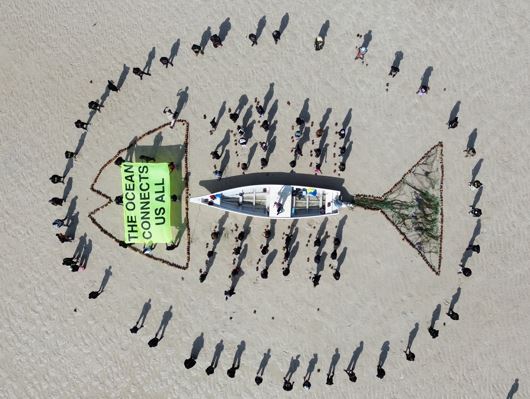
Environmental campaigners from Greenpeace Africa have called on African governments to take urgent and concrete action to protect the oceans from plastic pollution, illegal fishing, and industrial degradation, as world leaders gather in Mombasa for a major ocean conference this week.
Speaking at the Jomo Kenyatta Beach (Pirates) in Mombasa, Hellen Dena Kahaso, Project Lead for the Pan-African Plastics Project at Greenpeace Africa, said ocean justice cannot be achieved without first ending plastic pollution in all environments.
“There can be no ocean justice without ending plastic pollution. And ending plastic pollution means reducing plastic production,” Kahaso said.
She warned that the scale of plastic contamination had reached alarming levels, with marine creatures dying after mistaking plastic debris and microplastics for food. She added that abandoned fishing nets also pose an additional deadly threat to sea life.
Kahaso further cautioned that human health was equally at risk. Noting that out of approximately 16,000 chemicals used in plastic manufacturing, around 4,200 have been proven toxic, meaning communities consuming fish were inadvertently ingesting harmful substances.
“In a nutshell, we are consuming a lot of toxins,” she said, urging governments to enact strong policies to curb pollution both on land and at sea.
Nisha Nand, Project Lead for Ocean Justice Campaigns, who works with coastal communities across Thailand, Sri Lanka, Africa, and South America, said the communities bearing the greatest burden of ocean destruction were the very people who had done the most to protect it.
“Our oceans don’t mean just fish or species. It also means the people who rely on these oceans. We need to protect them because they have been working very hard to protect the ocean for us,” Nand said.
She called on governments to move beyond promises and deliver tangible measures to safeguard marine ecosystems and the livelihoods depending on them.
Dr. Aliou Ba, Oceans Lead for Greenpeace Africa, echoed the calls, describing the ocean as the lifeblood of the African continent.
“The ocean feeds us, gives us jobs, protects our climate, and provides income for our communities. Protecting the ocean is protecting our life,” he said.
He urged the governments to act decisively on conservation, end illegal, unreported and unregulated fishing, and eliminate all forms of marine pollution.
Coastal fishers voiced concerns that outside actors are undermining local conservation efforts. Athman Mwinyi Kigamba, a member of Pirates Beach Management Unit, said fishers from other regions were infiltrating their waters with undersized nets that scooped up juvenile fish and fish eggs, threatening fish populations.
“The problem is not our own fishers; it is those who come from areas they have already destroyed, now coming to destroy ours,” Kigamba said.
He noted that regular beach cleanup activities had helped maintain shoreline hygiene but urged vendors and traders to take personal responsibility for their waste rather than discarding it into the sea.
By Ramadhan Nassib