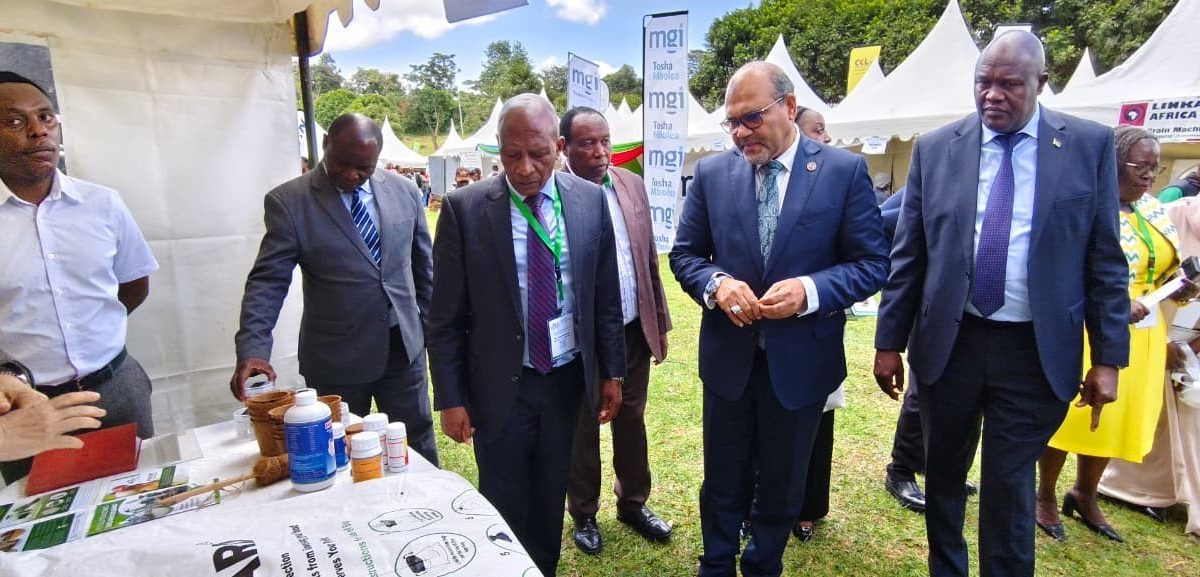
The government has pledged to increase annual funding for agricultural research and strengthen the dissemination of research findings to farmers to boost productivity and address emerging challenges in the sector.
Principal Secretary for Science, Research, and Innovation in the Office of the Prime Cabinet Secretary, Prof. Shaukat Abdulrazak, said the government plans to raise research funding to more than one percent of the country’s Gross Domestic Product (GDP), translating to over Sh1.2 billion annually.
Currently, funding for agricultural research stands at about 0.78 percent of GDP, a level that many researchers say has constrained the development of new technologies and the ability to respond effectively to emerging agricultural challenges.
Prof. Abdulrazak, who was speaking during the second day of the Kenya Agricultural and Livestock Research Organization (KALRO) Conference and Exhibition, commended Kenyan scientists for developing innovative technologies that are helping to unlock the sector’s potential and improve agricultural productivity.
“Funding for research will be increased to more than one percent of GDP, and under the government’s roadmap to revitalize the research subsector, funding is expected to exceed Sh1 trillion over the next 10 years,” he said.
The PS, who also launched the KALRO Commercialization Strategy (2026–2031), said returns on investment in research remain below one percent due to inadequate uptake of innovations.
However, Prof. Abdulrazak noted that enhanced extension services and wider dissemination of research outputs could increase returns to between 20 and 60 percent.
The PS emphasized the need to deploy modern technologies such as isotopic techniques, satellite monitoring, and artificial intelligence to improve water efficiency, early warning systems, and agricultural productivity.
“We cannot afford silos in research. We must build synergies across institutions and disciplines to solve real problems,” he said, urging stronger collaboration between researchers, government, and the private sector.
Abdulrazak noted that Kenya already has advanced research tools capable of improving farm output, including systems that determine precise water requirements for crops. However, he called for wider adoption and scaling of these innovations to reach more farmers.
He further challenged researchers to bridge the gap between laboratories and farmers by scaling up innovations such as improved livestock feeds, drought-resistant crops, and integrated farming systems.
“We must demonstrate the impact of research by changing lives,” the PS said, stressing the importance of improving weather forecasting and early warning systems to reduce recurring cycles of drought and floods that continue to strain national resources.
KALRO Director General Dr. Patrick Ketiem said adequate investment in research was critical to addressing food security and economic challenges facing the country.
Dr. Ketiem noted that while Kenya has made significant progress in agricultural research, funding constraints continue to limit the translation of scientific discoveries into practical solutions for farmers and other stakeholders.
“Science without investment is a wish. Investment without science is a gamble. We cannot afford either,” he said, calling for increased and predictable funding to strengthen innovation and accelerate the transformation of Kenya’s agriculture sector.
He highlighted KALRO’s extensive research portfolio, which covers 17 commodity programs and has produced innovations ranging from climate-smart crop varieties and integrated pest management technologies to value-addition solutions and livestock genomics.
Despite these achievements, Dr. Ketiem observed that many national agricultural research institutions across Africa remain underfunded despite the magnitude of food production and economic challenges they are expected to address.
The Director General further emphasized that long-term agricultural research requires sustained and predictable financing, noting that annual budget cycles are often incompatible with the lengthy processes involved in crop development and technology adoption.
Dr. Ketiem urged policymakers to consider reforms that would create a more supportive funding framework for research institutions.
The 2nd KALRO Scientific Conference and Innovation Expo, June 2026, is taking place at the KALRO offices in Nairobi for five days and running under the theme: Innovations for Sustainable Agri-food Systems, Climate Change Resilience, and Improved Livelihoods.
By Wangari Ndirangu