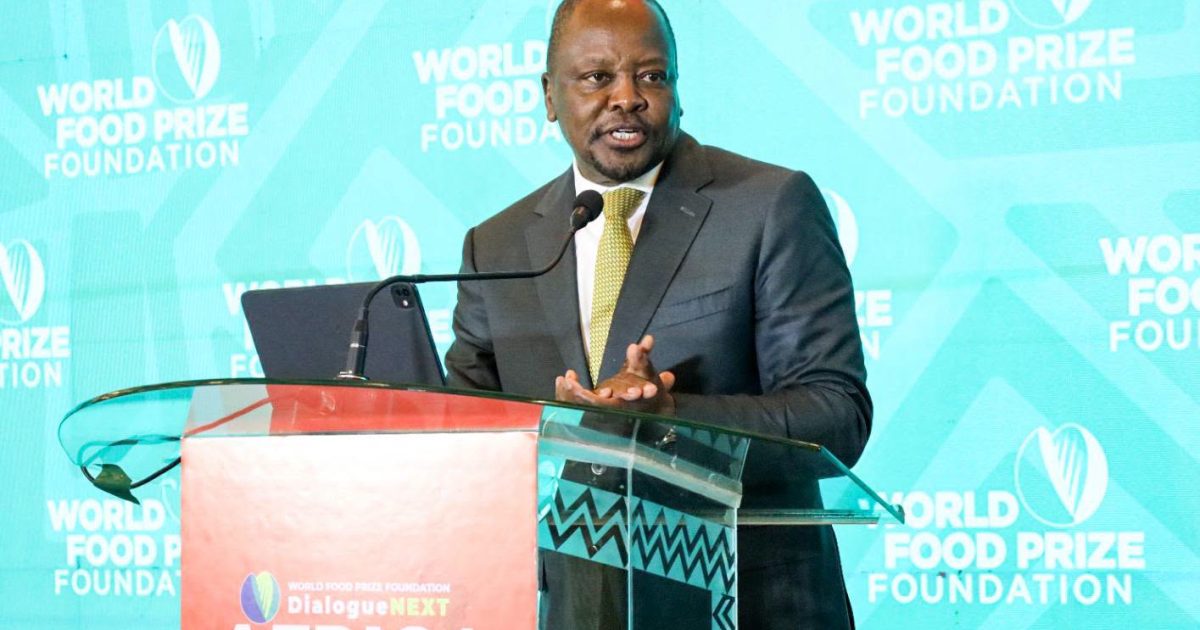
Agriculture Cabinet Secretary (CS) Mutahi Kagwe has called on African nations to confront the unfair global practice of tariff escalation, where developed markets allow raw agricultural commodities to enter at low or zero duty but impose significantly higher tariffs once they are processed.
Speaking in Nairobi on Tuesday at the World Food Prize Foundation’s DialogueNext Forum, Kagwe said the practice has for decades discouraged industrialisation across Africa, locking farmers into exporting cheap raw materials while jobs, wealth and manufacturing opportunities are created abroad.
“It is difficult to explain to an African farmer why it is acceptable to export raw coffee but prohibitively expensive to export roasted coffee,” he said.
The CS urged African countries to prioritise local value addition before export, citing Kenya’s ban on raw in-shell macadamia exports as an example of the direction the continent should take.
He added that the same approach should increasingly guide the coffee and tea sectors so that processing, branding and packaging are undertaken where the crops are grown.
“Every stage of processing completed within Africa creates jobs, increases farmers’ incomes and strengthens rural economies,” he said, adding that value addition should create employment for young people in manufacturing, logistics and agricultural technology.
Kagwe criticised policies that tax agro-processing machinery while governments simultaneously claim to support agricultural transformation, saying such contradictions discourage investment.
He further called for financing models tailored to farming cycles through flexible repayments, affordable long-term credit and weather-indexed insurance.
He maintained that reforming global trade rules, expanding local value addition and improving agricultural financing are essential to making farming more profitable, competitive and attractive to the next generation.
“If we truly believe in equitable global development, international trade rules must reward value addition, not punish it,” Kagwe said.
This year’s World Food Prize Foundation’s DialogueNext Forum is being held under the theme “Born to Feed the Future,” bringing together agriculture ministers, policymakers, scientists, development partners, private sector leaders and farmer organisations from across Africa and beyond.
“It is an honor to hold this conference in Africa, four decades after Dr. Borlaug made his first major visit to the continent in 1984,” said Mashal Husain, President, World Food Prize Foundation.
“Borlaug came with a simple but powerful conviction: that science in the hands of farmers could defeat hunger. That mission is unfinished and more urgent than ever as Africa’s food systems must feed a young, growing and increasingly urban population,” he observed.
The convening in Nairobi underscores the urgency of backing Africa’s most promising agri-food innovations and accelerating the collective response to feeding a rapidly growing population in an era of intensifying climate risk.
With El Niño now developing and forecast to be one of the strongest on record including a near 90 per cent probability of continuing into the southern hemisphere summer, DialogueNEXT in Africa arrives at a critical moment for the continent’s food systems. The stakes could not be higher: with just 2°C of warming, crop yields across sub-Saharan Africa are projected to fall by 10 per cent, and warming beyond that mark could see yields drop by as much as 20 percent.
“Hosting this conversation in Africa is not just symbolic, but necessary. This continent is home to some of the world’s most dynamic agricultural systems and most resilient farmers, yet it remains chronically underinvested in,” said Akinwumi Adesina, 2017 World Food Prize Laureate; Member, World Food Prize Foundation Council of Advisors; and Former President of the African Development Bank Group.
“The challenges, climate shocks, fragile supply chains, growing populations are real, but so are the solutions, which are increasingly being developed by African scientists, farmers and entrepreneurs. The insights that emerge from Nairobi will help shape the global agenda.” He noted.
By Joseph Ng’ang’a