

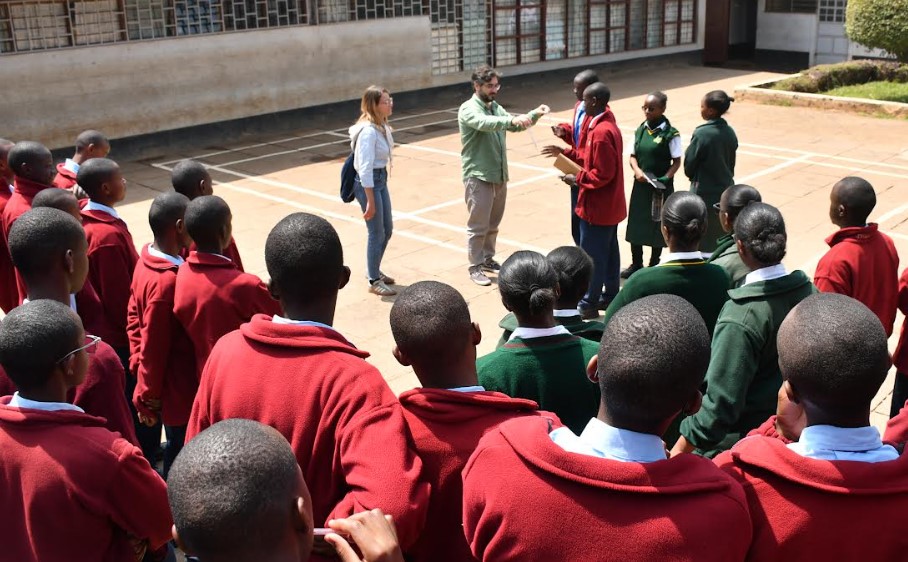
Kiambu High School played host to a vibrant STEM outreach programme that ignited passion for physics and broader sciences among students.
The event was organized by the Centre for Mathematics, Science and Technology Education in Africa (CEMASTEA) in partnership with the University of Nairobi and the African School of Physics (ASP).
CEMASTEA, a State Corporation under Kenya’s Ministry of Education, State Department for Basic Education, is tasked with strengthening mathematics, science, and technology education through teacher training, mentorship, and outreach activities aimed at improving learning outcomes nationwide.
The programme formed part of a week-long teacher training initiative, offering both students and educators practical, hands-on experience in laboratory techniques ranging from elementary to advanced levels. Its main objective was to spark interest in sciences, with a strong focus on physics as the foundation of engineering and technological innovation.
More than 150 students from Kiambu High School and neighboring institutions, including Mangu High School and Senior Chief Koinange School, participated in the event.
Joseph Kuria, Coordinator for Outreach Programmes at CEMASTEA, said the initiative seeks to guide young learners early. “The idea is to inspire young learners, prepare them on what to expect, have them consider physics in their choices, and popularize science subjects in schools,” he stated.
Christine Darve, Coordinator for the African School of Physics (ASP), noted that the organization was established in 2010 after students from various universities in Europe came together to bring physics closer to Africa.
“Most innovations occur outside the continent, making imported technology costly,” she said. Kenya is the 9th country to benefit from the programme. Darve added that ASP supports trainees by providing open-source learning materials on platforms such as http://cdarve.cern.ch and through virtual laboratories, including simulations like “visiting the sun.”
Prof. Kenneth Kaduki, a Physics lecturer at the University of Nairobi, emphasized the value of the exposure for students. “These events are important as young learners get to know the variety of courses they can take and build interest by showing them what to expect,” he said. Prof. Kaduki further noted that the partnership helps encourage students to take up science courses, which are among university faculties with relatively few students. He urged the government to allocate more resources, pointing out that scientific equipment remains expensive with high running costs.
Sharon Kemunto, a Physics teacher at Pangani Girls, described the programme as transformative. “This is an eye-opener as teachers and learners get to experience what they may not be able to do in their labs,” she said.
Teachers at the event expressed deep appreciation for the opportunity, noting that such practical experiences are rare and often impossible to conduct in their respective schools due to resource limitations.
The collaborative outreach programme is expected to significantly boost enrolment and performance in science subjects across the region.
By Kipkorir Felix and Grace Naishoo
