Kenya Electricity Generating Company (KenGen) has onboarded its fifth investor at its green energy park in geothermal-rich Olkaria fields in Naivasha, ushering in a new investment portfolio worth billions of shillings.
The multi-billion shilling investments are ushered in by high confidence in the company’s capacity to power production through sustainability and by harnessing clean energy sources, especially geothermal.
This comes after the company said they had embarked on a new strategy that would help generate 5,500 MW of power from green energy sources to meet the rising electricity demand due to increased investments in the country.
The move is driven by high investor confidence that has seen new companies set up shop in the country, seeking to tap sustainable, steady and clean energy sources, especially geothermal power.
The company had embarked on a multi-billion shilling investment plan to double geothermal power production from the current 754 MW to 1,500 MW by 2034 through public-private partnerships.
However, with the electricity demand hitting the peak demand of 2550 MW, the highest recorded, the company now targets exploring more power sources, especially from geothermal sources.
According to KenGen CEO Eng. Peter Njenga, the company seeks to tap more green power by rehabilitating old power stations and exploring new geothermal fields at the power-rich rift valley areas.
He said the company will pump an extra 63 MW from the rehabilitation of its old Olkaria 1 power plant and tap extra megawatts from its Olkaria fields, Eburru, Suswa, and Longonot that hold huge potential in green energy production.
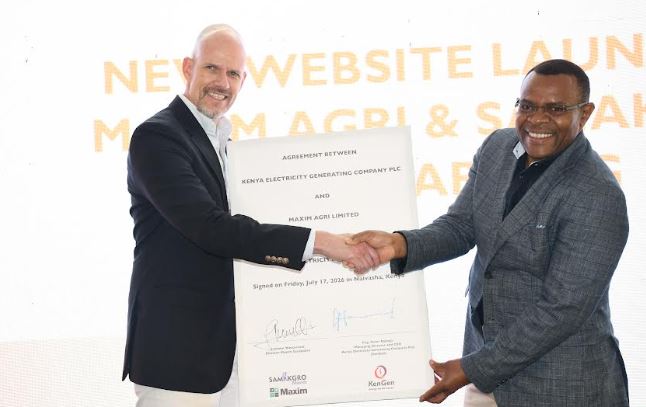
Speaking on Friday during the signing ceremony with the new investor in Olkaria Naivasha, Njenga said the company had onboarded its fifth investor, Maxim Agri and Samakgro Limited, in a Sh2.6 billion fish feed production facility at its green energy park in Olkaria Naivasha.
He said the park, which spans over 8,000 acres, has so far attracted numerous investments in the sectors of data centres, electric mobility, green fertilizer, steel production and the latest, fish feed production.
Njenga said the park, which will be operationalised fully on geothermal energy has already been declared a customs-controlled area under special economic zone status, ushering in new tax incentives for investors.
The CEO added that all the investors will tap 100 percent steady green energy and an adequate water supply with critical infrastructure already established at the park, adding that the zone was ready for business.
Njenga said the noble, multi-billion shilling initiative will be achieved through public-private partnerships and will accelerate the country’s journey towards 100 percent power sourced from green energy sources.
He said already, the company’s decades of geothermal exploration had put Kenya first in Africa and seventh in the world in geothermal production, with its expertise now expanded to other countries.
In addition, the CEO welcomed the new online platform where investors would access crucial investment portfolios on the green park globally all-time round.
On his part, the Director of Maxim Agri and Samakgro limited Joachim Wersterveld said they had committed USD 8million in the first phase and an extra USD 12M (total approx. 2.6B) in production of fish feeds powered by clean energy sources.
Wersterveld said the plant will be operational in the next five months and will produce 65 metric tonnes of fish feeds, the largest in the region and feed the growing demand in the country and in Uganda, Tanzania and Rwanda
He noted that the company chose the green park due to its reliable power supply, access to water and its skilled workforce
KenGen Commercial Services Manager Kibet Ronoh welcomed the investors in the expansive park, noting that geothermal energy offered a more resilient and steady power supply to drive their investments.
“Geothermal has shown to be a key driver to power economies, households and industries through clean energy sources, providing sustainable jobs and livelihoods,” said Kibet. Currently, KenGen has an installed generation capacity of 1,786 MW, mostly from renewable sources including hydro (826 MW), geothermal (754 MW), and wind (25.5 MW).
By Erastus Gichohi and Orpah Gesare