By C, KNA
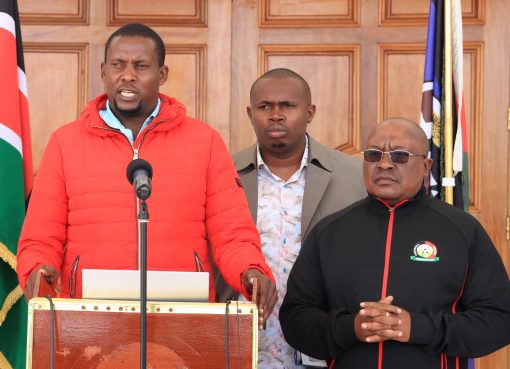
The Kenya Navy Commander, Major General Paul Otieno, has underscored the importance of unity and shared commitment to regional maritime security and cooperation.
He assured that Kenya’s naval forces, operating under a constitutional and strategic mandate, are committed to protecting maritime sovereignty and safeguarding the safety of sea lines of communication that serve as lifelines for regional and global trade.
Major General Otieno commended the initiatives that seeks to translate policy into coordinated action at sea, to combat transnational maritime threats such as piracy, smuggling, illegal fishing, and environmental crimes.
The Navy Commander made the remarks during the official opening of the inaugural Djibouti Code of Conduct, Jeddah Amendments (DCoC/JA) Working Group III meeting on Operational Cooperation and Coordination at Sea, held at the Serena Beach Resort in Mombasa.
The four-day conference, running from September 1st to 4th at, is jointly organized by the International Maritime Organization (IMO) and facilitated by the Kenya Navy.
The event marks a significant step in strengthening maritime security in the Western Indian Ocean region.
It brings together a wide spectrum of maritime actors, including representatives of DCoC/JA Member States, regional navies, coast guards, and international partners such as the Indian Ocean Commission (IOC) and the United Nations Institute for Training and Research (UNITAR).
The Djibouti Code of Conduct was first adopted in 2009 as a regional response to escalating piracy in the Gulf of Aden and Western Indian Ocean.
It was amended in 2017 under the Jeddah Amendments to broaden its scope beyond piracy, to include wider transnational crimes such as human trafficking, arms smuggling, and illegal exploitation of marine resources.
Major General Otieno highlighted that Working Group III as an operational mechanism to give life to the code’s objectives.
“The Djibouti Code of Conduct provides us with a strong framework for information sharing, maritime law enforcement, and capacity building. This working group is where those commitments are transformed into real-world cooperation at sea,” he said.
Major General Otieno noted that no single nation can secure the seas alone, stressing that collaboration, interoperability, and mutual trust is critical in confronting contemporary complex maritime threats.
The Officer In-Charge, General Secretariate, at the Indian Ocean Commission (IOC) based in Mauritious, Raj Mohabeer, urged participants to embrace the spirit of joint action.
“Working together is a force multiplier. No country, however strong, can tackle maritime issues alone,” he said, stressing the need for coordinated patrols, cross-border intelligence sharing, and harmonized legal frameworks.
The meeting has drawn a diverse range of delegations from across Africa, the Middle East, and across the globe.
Among the countries represented are Kenya, India, Somalia, South Africa, the United Kingdom, Tanzania, Ethiopia, and Egypt.
Their participation underscores the recognition that maritime security in the Indian Ocean is a shared responsibility with global trade, security, and environmental implications.
The Western Indian Ocean region is a critical maritime corridor, hosting some of the world’s busiest sea lanes that connect Africa, the Middle East, and Asia. Ensuring safe passage along these routes is vital not only for regional economies, but also for international commerce.
With the resurgence of piracy threats, continued cases of illegal fishing, and increasing incidents of maritime smuggling, experts say operational cooperation is urgently needed.
By focusing on practical mechanisms such as coordinated patrols, joint training, and shared situational awareness, the Working Group aims to close security gaps that individual states cannot address on their own.
The outcomes of the Mombasa meeting are expected to guide future joint operations, capacity-building initiatives, and the development of a harmonized regional maritime security strategy under the DCoC/JA framework.