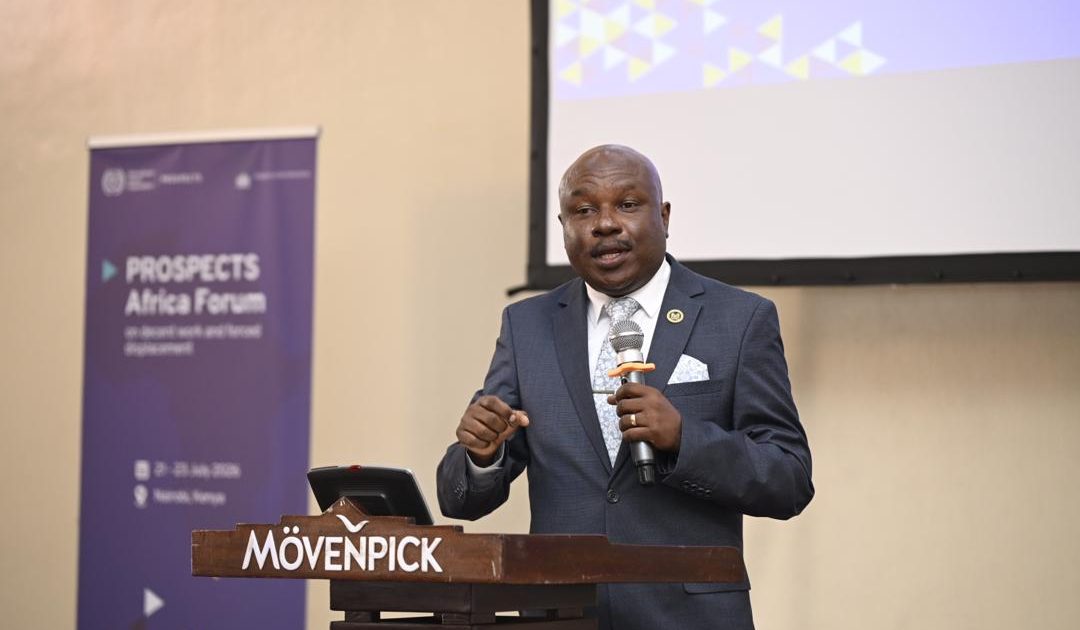
Principal Secretary (PS) for Labour and Skills Development Shadrack Mwadime has highlighted Africa’s youth demography—where 65 percent of the population is aged 35 and below—as the continent’s primary economic resource when he officially opened the PROSPECTS Africa Forum on Decent Work and Forced Displacement in Nairobi.
PS Mwadime stressed that governments must re-evaluate academic curricula in collaboration with employers to ensure graduates meet real-world job requirements.
“If the future is in Africa, then we need to impart proper skills on our young people. The first thing that we need to do in Africa is to sit with employers, do an analysis of the kind of jobs that are obtained as it is currently,” Mwadime stated.
Highlighting government efforts to formalize practical skills gained outside traditional classrooms, the PS announced significant progress under Kenya’s Recognition of Prior Learning (RPL) framework.
“For the last six months or so, the Ministry has been able to assess about 20,000 young people with experience that they have obtained over time, and hopefully in the next two or three weeks we should be able to issue about 5,000 certificates to these young people,” he revealed.
Mwadime added that forcibly displaced persons bring vital skills to host nations, citing his personal experience learning from Ugandan educators and medical professionals who strengthened Kenya’s public service sector in earlier years.
Delivering remarks on behalf of the Netherlands Embassy in Nairobi, Ms. Lilian Obiye, Policy Officer for Displacement and Durable Solutions, emphasized that forced displacement must no longer serve as a barrier to regional economic productivity.
“The challenge for us is not simply to respond to displacement or particularly post-displacement, but it is to ensure that displacement does not become a barrier to opportunities and productivity, but that we also take the opportunity to grow it, to increase economic growth for all countries,” Obiye noted.
Further, she disclosed that the Netherlands has invested over $500 million globally in the PROSPECTS initiative since 2019, allocating $67 million specifically to Kenya for its second phase ending in December 2027.
The Officer commended Kenya’s practical inclusion policies, citing the Shirika Plan as an exemplary model for developmental refugee management, while reiterating the Kingdom’s commitment to collaborating with regional blocs such as IGAD, EAC, and SADC.
Representing the International Labour Organization (ILO), Dr. Coffi Agossou, Deputy Regional Director for Africa, underscored the urgent need to align youth labor supply with sustainable market opportunities.
“In Africa, everyone knows that Africa is the youngest continent in the world. But at the same time, these young people are not getting the rights just as they need because the labour market doesn’t provide them enough opportunity to have a quality job,” Dr. Agossou established.
According to the Deputy Director, ILO estimates show over 86 percent of employment across Africa remains informal, with less than 20 percent of the population covered by social protection benefits and over 117.8 million people forcibly displaced worldwide.
To address these challenges, he urged regional delegates to implement whole-of-government pro-employment policies, expand social protection coverage, align technical training with market demand, and leverage digital transformation.
Meanwhile, the PROSPECTS Partnership—a joint initiative bringing together the ILO, UNHCR, UNICEF, the World Bank, and the International Finance Corporation (IFC)—convenes government, labor, and employer representatives from Kenya, Uganda, Ethiopia, Sudan, and Egypt to establish long-term policy solutions for refugee and host community economic inclusion.
By Lilian Gichohi