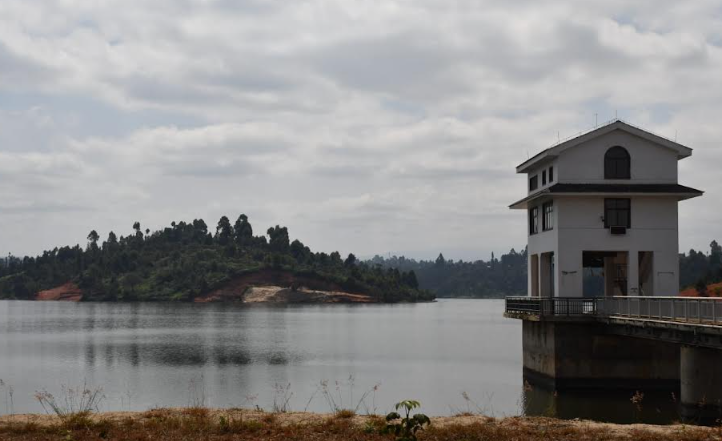
The Karimenu II Dam in Gatundu North, Kiambu County, has brought changes to its host community beyond its primary role of supplying water, with residents pointing to improved roads, public facilities, security, and economic opportunities.
The dam forms part of the Karimenu II bulk water supply system, comprising a water treatment plant and about 55 kilometers of bulk transfer lines.
Engineer Vincent Rono, Assistant Director, Bulk Water Operations and Maintenance at the Athi Water Works Development Agency (AWWDA), said the clay-core rock-fill structure stands about 59 meters at its tallest point and can hold up to 26 million cubic meters of water.
“The purpose of the project was for this storage, especially for the transmission of the water for treatment to be supplied in the areas of Gatundu, Ruiru, Juja, and also in Nairobi,” he said.
Beyond its wider water-supply role, the infrastructure has also brought services closer to the host community. (AWWDA) has supported Gatundu Water and Sewerage Company with water reticulation lines and technical assistance, while boreholes have also been provided in the area.
Buchana Primary School was also constructed as part of the community interventions, while local residents secured employment during the construction period.
The benefits have extended beyond water and social amenities to movement and trade. Kiambu County Commissioner George Matundura said roads constructed around the facility have made it easier for residents to transport farm produce to markets.
Local residents have also participated in the economic activities generated by the facility by supplying farm produce and other goods used during its construction and operation.
“The locals are the ones who are supplying most of the goods that they use, be it farm produce or whatever things that they are using in this project,” Matundura said.
The community has also gained access to additional water facilities. A borehole at Kiriko Secondary School has improved access to water for learners and the surrounding community, according to Matundura.
The project has also supported environmental conservation through tree planting, with local chiefs participating in activities around the facility.
Security around the area has similarly received attention, with a Critical Infrastructure Protection Unit stationed at the dam to protect the facility.
The officers also respond to distress calls from residents, according to Matundura, who said the security presence had benefited the surrounding community.
Joseph Njuguna, who has lived in the area for years, said the road linking the dam to the main road had previously become difficult to use during rainy seasons but is now passable.
“Even during the rainy season, the road is passable. So we do appreciate the work that the Athi Water did for us,” he said.
Away from public infrastructure, the dam has also had a direct bearing on some families whose land was acquired for its construction.
One of the affected landowners, Herman Mburu Mwangi, said compensation enabled him to purchase a larger farm elsewhere, where he now grows coffee.
“This dam has brought good things. Before, it was just bushes, but now we are better than before,” he said.
The environmental impact has also been considered in the design of the facility, with the spillway helping to control excess water and mitigate flooding downstream along the Karimenu River, according to Rono.
For residents, the changes around the dam represent a shift from what the area was before construction to what it has become, with new infrastructure and services now forming part of everyday life.
By Michele Kiptoo and Grace Naishoo