The expansion of specialised services at Kenyatta University Teaching, Referral, and Research Hospital (KUTRRH) highlights Kenya’s growing capacity to provide advanced medical care locally.
The development comes as the country begins the Beyond 2030 National Conversation at the Kenyatta International Convention Centre (KICC), bringing together Kenyans to deliberate on a long-term development framework towards 2060.
KUTRRH has expanded its specialised services in cancer, renal, and cardiac care as part of its mandate as a Level Six teaching, referral, and research facility.
The hospital’s development of cancer care illustrates how investment in specialised infrastructure and technology can bring different stages of treatment closer to patients.
Dr. Kerama Onyimbo, Deputy Director of Clinical Services at KUTRRH, said the availability of pathology services had strengthened the hospital’s capacity to manage cancer cases.
“KUTRRH, as a Level Six hospital, now can do pathology services, particularly histology. And that’s a big, big plus,” he said.
From diagnosis, patients requiring further assessment can access specialised imaging, with the hospital providing CT and MRI services alongside other diagnostic facilities.
The expansion has also opened opportunities for more specialised cancer management through molecular imaging.
KUTRRH’s Integrated Molecular Imaging Centre provides PET/CT and other nuclear medicine services, supported by a cyclotron and radiopharmacy for the production of radiopharmaceuticals used in specialised imaging. KUTRRH currently lists PET/CT and CyberKnife among its specialised imaging services.
The availability of the technology has helped shift some specialised procedures that previously required patients to travel outside the country to local facilities.
“Kenyans used to go to India to do this procedure,” Dr. Onyimbo said, referring to PET scanning.
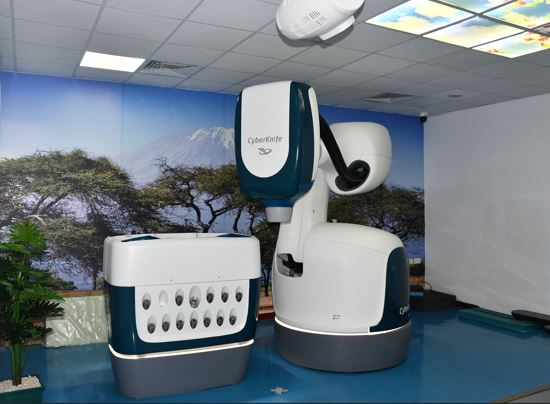
The hospital has similarly expanded treatment options through technologies such as CyberKnife, which enables highly precise radiotherapy for selected tumours.
KUTRRH became the first facility in Sub-Saharan Africa to commission the technology in 2023, with the service intended to increase access to advanced cancer treatment locally.
Beyond cancer care, the hospital has expanded services for other conditions requiring long-term and complex treatment.
Its renal services include dialysis and kidney transplantation, while cardiac care encompasses specialised consultations, echocardiography, and procedures performed through a catheterisation laboratory.
The expansion of renal care has, in particular, been accompanied by increased dialysis capacity.
In 2023, the hospital said the addition of 20 dialysis machines had increased its capacity from 100 sessions per day to more than 200 sessions daily.
For Dr. Onyimbo, however, expanding infrastructure alone is not enough to increase access to specialised care.
He said hospitals also need to find ways of maximising the use of available equipment and human resources.
At KUTRRH, he cited the use of shifts in radiotherapy as one example of how the hospital seeks to increase equipment utilisation.
“We start one at 6 in the morning. A second one starts at around 2 o’clock. And the third one starts around 6 p.m. Those are three shifts,” he said.
The approach, he added, demonstrates the importance of combining investment with management and innovation to ensure expensive medical equipment serves as many patients as possible.
“The productivity per equipment has tripled because of innovation and management decisions,” said Dr. Onyimbo.
Such investments have also strengthened the role of public referral hospitals in providing services that require specialised equipment and expertise, while creating opportunities for training and medical research.
KUTRRH has eight operating theatres and continues to serve as a teaching, referral, and research institution, bringing together specialised clinical services with training and research.
Dr. Onyimbo said the progress made at the facility demonstrated the potential of continued investment in Kenya’s health sector.
“As a country, to have a Level Six hospital deliberately built, not to have any colonial history, and to have all the equipment that we have, for me is testimony that we have enough human resource to do one of the best healthcare systems in the world,” he said.
As the country looks beyond 2030, KUTRRH’s growth reflects a broader shift in Kenya’s health sector, with specialised services that previously drove some patients to seek treatment abroad becoming increasingly available locally.
Maintaining that momentum will be key to expanding Kenya’s capacity to provide advanced healthcare.
By Annrita Mutembei and Grace Naishoo