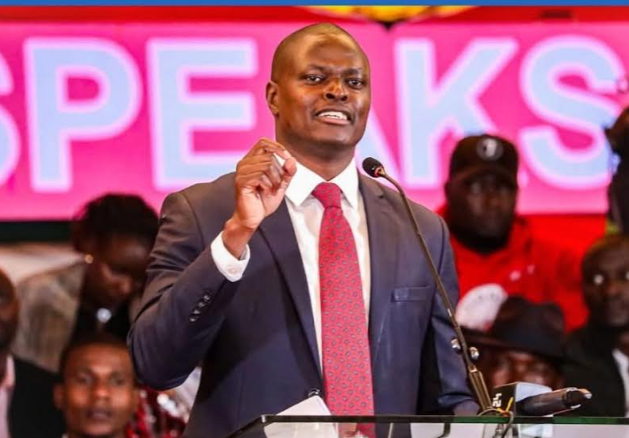
Kiharu Member of Parliament (MP) Ndindi Nyoro has officially severed ties with the ruling United Democratic Alliance (UDA) party, crossing over to join the opposition under the People’s Party of Kenya banner.
Addressing a packed press briefing held at the Safari Park Hotel in Nairobi, the lawmaker announced a major political shift alongside an expansive socioeconomic policy blueprint aimed at recalibrating the nation’s governance, education, healthcare, and financial sectors ahead of the 2028 General Election.
Nyoro revealed that his political transition follows nearly a year of high-level consultations with key opposition figures, including former Vice President Kalonzo Musyoka, former Deputy President Rigathi Gachagua, Siaya Governor James Orengo, Narc-Kenya Leader Martha Karua, former Cabinet Secretaries Peter Munya and Dr. Fred Matiang’i, and Nairobi Senator Edwin Sifuna.
“I have been carrying a heavy burden, and I have to say this to my compatriots and the people of Kenya, because I believe even as I make a political decision, it is that these are the kind of decisions we have made previously and there are some lessons we have gained out of that,” expressed Nyoro.
Further, the Kiharu legislator outlined comprehensive reforms across several core sectors. In education, he proposed integrating Early Childhood Development (ECD) trainers into the Teachers Service Commission (TSC) and rolling out fully free senior secondary education for 3.5 million learners starting January 2028.
The proposed Sh35 billion funding structure relies on Sh10 billion from the National Government Constituencies Development Fund (NG-CDF), Sh10 billion from County Equitable Shares, and Sh15 billion from the national government.
On the other hand, the MP’s healthcare initiatives focus on reducing National Social Security Fund (NSSF) retirement contributions by 50 percent starting in 2028, diverting an estimated Sh40 billion annually toward medical coverage for chronic illnesses and emergencies. The plan also advocates establishing a dedicated Health Care Workers Commission to centralize staffing, transfers, and personnel welfare.
According to Nyoro, the economic and industrial strategy proposals call for the full liberalization of power generation alongside the sale of a 35 percent stake in KenGen to raise Sh150 billion for energy infrastructure expansion and lower manufacturing tariffs.
To protect the domestic financial sector, the plan introduces regulatory barriers to restrict foreign takeovers of local commercial banks, aiming instead to scale domestic banks across the region.
It further recommends creating a state holding firm, the Kenya Development Holding Company (KDSS), to manage public assets with a 51 percent government stake listed on the Nairobi Securities Exchange (NSE).
On governance and integrity, he maintained that the blueprint pushes to criminalize proxy investments, enforce mandatory public asset declarations for presidential candidates, and prohibit asset transfers to associated entities for 25 years post-presidency. It also advocates doubling the Judiciary’s operational capacity and guaranteeing at least 1.5 percent of annual national revenue for the judicial arm.
In this regard, Nyoro highlighted his development record in Kiharu Constituency as practical evidence of these proposals, citing tiled classrooms across all 120 public primary schools, cabro-paved grounds in 75 schools, and capped day secondary school fees of Sh500 per term under the flagship Kiharu Masomo Bora program.
Meanwhile, opposition leaders present welcomed the MP into their coalition, with Siaya Governor James Orengo commending Nyoro’s economic focus, comparing his early political emergence to 18th-century British Prime Minister William Pitt the Younger.
“I consider my brother and my younger brother or son Ndindi Nyoro to be one of the greatest political minds we have in the country,” Orengo remarked.
By Lilian Gichohi and Nancy Omondi