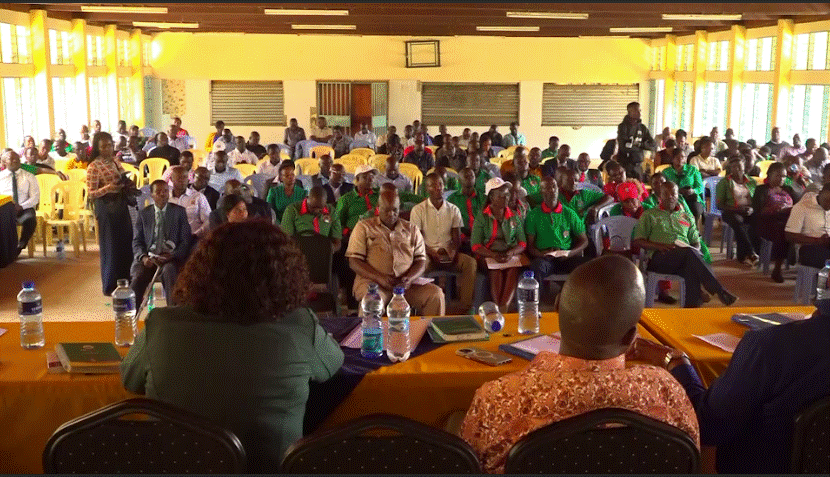
The Parliamentary Committee on Education has held a public participation forum at Migori Teachers Training College (TTC) to gather stakeholder views on proposed education bills and amendments regarding school funding and administration.
Addressing participants at the Migori Teachers’ Training College, Committee Chair and Tinderet Member of Parliament (MP) Julius Meli confirmed that all the views will be considered and carefully weighted to give opportunities to the proposed amendments.
“This is the second-to-last county we are visiting, with Nyamira County as our final stop. We assure all stakeholders that every submission made across the country will be carefully considered,” said Meli.
Six education bills seeking to be introduced to reform the education sector includes The Tertiary Education, Placement and Funding Bill, the Basic Education Bill, the Kenya National Educational Assessment Bill, among others.
The forum highlighted divisions between the primary and secondary teachers’ unions over the operational independence of Junior Secondary Schools (JSS).
Representatives from both unions disagreed on whether JSS should be autonomous, citing operational bottlenecks and underfunding under the current model.
Speaking in favour of separation, KUPPET Branch Organising Secretary Migori branch Henry Otunga pushed for administrative independence of the Junior Secondary School section.
“We need full autonomy for junior secondary schools. Running them jointly under the current framework has compromised operations, and the capitation provided is simply not enough to cover both levels effectively,” Otunga stated.
He also noted that the bill suggests that teachers are not required to picket or hold demonstrations during the national exam period, stating they have a right to picket as enshrined in the 2010 constitution.
Conversely, KNUT chairlady Migori branch Roseline Wandigi opposed the move, warning against separating administrative structures and placing JSS under secondary school management.
“Autonomy for junior secondary schools is not viable. Everything should not be domiciled under secondary schools, as this disrupts the seamless transition and shared management of basic education,” Wandigi argued.
Stakeholders also jointly rejected a proposal in the bill to have County Education Boards (CEB) chaired by County Commissioners (CC’s), objecting to the perceived militarization of academic institutions.
“A school is an educational environment, not a military camp. Governance of education bodies should remain under professional education administrators rather than administrative security officers,” stakeholders noted.
Secretary of the Tertiary Institution Migori branch Philip Nyonjalo, raised concerns regarding teacher training institutions.
Nyonjalo urged the committee to remove teacher training from the basic education framework, advocating for trainees to access Higher Education Loans Board (HELB) funding and for tutors to be reclassified under the Teachers Service Commission (TSC) as public servants.
Representatives from key educational stakeholders, including the Kenya National Union of Teachers (KNUT), the Kenya Post Primary Education Teachers (KUPPET), and Kenya Primary School Education Assessment (KPSEA) leadership, attended the session.
by Lydia Adhiambo/Beryl Akinyi