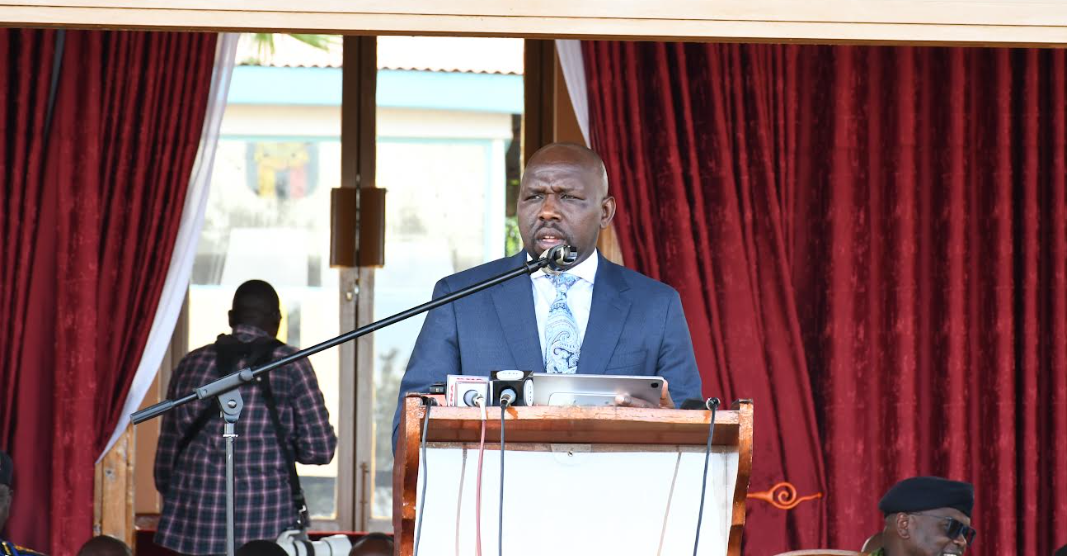
Interior Cabinet Secretary Kipchumba Murkomen has revealed plans by the government to deploy 1,200 electric vehicles to police stations across the country as part of ongoing efforts to modernise the National Police Service (NPS) and improve their operational capacity.
Speaking at the Kenya Police Training College in Kiganjo in Nyeri, Murkomen revealed that the procurement process for the vehicles was underway, adding that by the end of the year, all police stations across the country will be resourced with the vehicles.
“If there is a challenge that Kenyans are facing now, it is the lack of vehicles for police stations, and we want to ask them to be patient with us. We are undertaking a procurement process, and for the first time we will have 1,200 electric vehicles that are going to be supplied to our security teams across the country,” said CS.
He revealed that through the modernisation programme, the NPS had successfully procured modern protection gear for police officers and vehicles, as well as tactical equipment that is currently helping them to adequately deal with security threats.
He also hailed the modernisation programme for its role in the fight against banditry, noting that the officers had successfully eradicated 75 per cent of the menace, particularly in Kerio Valley.
“Thanks to that effort, children are back to school, farmers are back to their farms, and our country is safe. Our borders are also safe from Kiunga to Elwak, from Kibish to Konyau and all the way to Lwakhakha, Malaba and Isibania, and it is as a result of that investment you put through this program. We are dealing with the remaining 25 per cent of the banditry issue, especially in Isiolo, Samburu, Laikipia and Marsabit,” noted the CS.
Murkomen said that the NPS had equally carried out a robust digitisation programme that had ensured a significant improvement in realising the police service charter as well as easing the acquisition of the critical police clearance documents by Kenyans.
“Thanks to the President’s support, the NPS has carried out a robust digitisation programme that has ensured that the Police Clearance Certificate that used to take months can now be processed instantly and can be obtained within a day,” said Murkomen.
He said that the NPS is currently in the process of establishing Integrated Command Control and Communication centres in six counties that will see the NPS get its first digital Occurrence Book (OB) and have CCTV cameras installed in all stations in the country.
“There has been a phenomenon where sometimes people who have been arrested have faced challenges within the police station, and the installation of CCTV cameras in the 1200 police stations is going to become a game changer,” he said.
“We are also going to have command centres in six counties, including Nairobi, Mombasa, Nyeri, Nakuru, Eldoret and Kisumu, to start with. These communication centres are going to be accompanied by having a digital OB that will enable all Kenyans to report crime at the places where they witness a crime, and it will enable us to have data analytics that we will even apply AI to be able to know which officers are going to be deployed in which corner in our country,” he added.
On the new police uniform, Murkomen noted that the change in attire was part of the recommendations made by the National Taskforce on Police Reforms. He also warned naysayers that they should not overlook other efforts made to improve police welfare, including the enhanced salaries and improved access to health services, as well as the ongoing efforts to improve their living conditions.
“I have seen some people equate the police reforms to only the uniform. The reforms cannot even cover one hour if I were to speak about them, but the uniform is a representation of the image that the police officers wanted to be seen among themselves. Contrary to the propaganda out there, the change from the old to the new will continue progressively with these officers that are graduating today and will progressively cover all officers until everyone gets the new uniform,” he said.
The CS spoke during the passing-out parade of over 4000 police cadets at the college after completing their 9-month training. While expressing confidence that the new officers will improve the security sector, Murkomen said that the training curriculum that was used on the cadets had been improved to capture modern challenges, including digital challenges.
“The curriculum that we have and that has been used to train these officers is modern and has been improved, and we believe that the officers that are going to graduate today are better trained to serve this nation under the challenges that we face now. That includes dealing with issues of digital or online crimes, crowd management, and dealing with situations of public order, and we believe that through that training we are going to have better officers,” he said.
He also underscored the significance of continuous training in improving delivery of service. Murkomen noted that training programmes had resumed in a majority of the regional police institutions, noting that all Officers Commanding Stations across the country have undergone leadership training.
“When we went around under Jukwaa la Usalama, we established that the NPS has gone backwards in terms of training. The many regional police training institutions had been closed, and the continuous training of officers was not being adhered to,” he said.
“We have worked to reopen our regional police training centres across the country so that there will be continuous police training. Therefore, training is going to be the cornerstone of reforming the police service because that is extremely important. We would like our police officers to combat the challenges that they face but at the same time to be friendly and work with the members of the public to combat the challenges of our time,” he said.
He also reiterated the government’s commitment to increasing the number of police training centres across the country to ensure continuous police training.
Similarly, he said the government had increased the training grounds, adding that in addition to the Magado field training camp in Igembe South, plans are underway to establish new field training camps in Kerio Valley, the northern and coastal parts of the country, in an effort to enhance police training.
By Wangari Mwangi and Samuel Maina