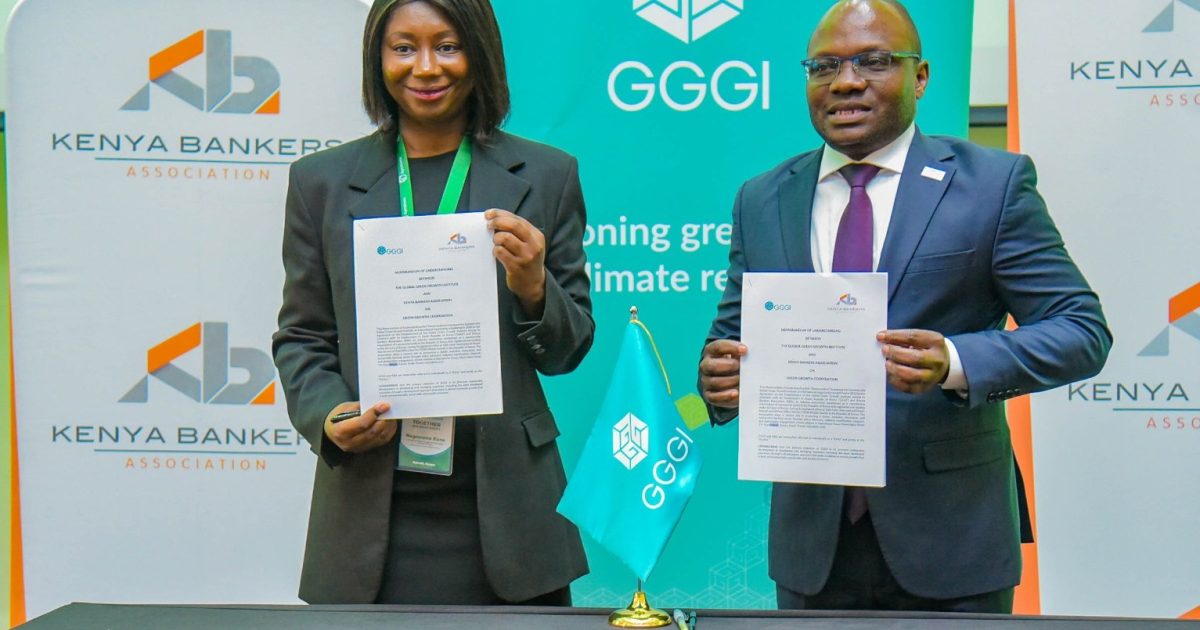
Kenyan banks are set to play a bigger role in financing green and sustainable investments following a five-year partnership between the Global Green Growth Institute (GGGI) and the Kenya Bankers Association (KBA).
The two institutions signed a Memorandum of Understanding (MoU) to strengthen sustainable finance, promote green investment, and mobilize public and private capital for sustainable development.
The partnership seeks to address challenges that have continued to limit access to finance for green enterprises, particularly small and medium enterprises (SMEs), by helping businesses develop bankable projects while enabling financial institutions to better assess and finance sustainable investments.
Speaking during the signing ceremony in Nairobi yesterday, GGGI Manager for Africa Strategy and Partnerships and Head of Kenya Office Nagnouma Kone said the agreement would help bridge the gap between entrepreneurs seeking financing and banks looking for investment-ready projects.
“For too long, entrepreneurs have said banks are not lending, while banks have said there are not enough bankable green projects. This partnership is about closing that gap,” Kone said.
She added that the collaboration would focus on de-risking green lending, improving understanding of nature-positive investments, and helping businesses meet bankability requirements.
The partners will also explore financing instruments, including sustainability-linked bonds and green loans, to channel more capital towards sustainable and biodiversity-positive investments.
KBA Chief Executive Officer Raimond Molenje said the banking industry had a critical role in financing Kenya’s sustainable development ambitions.
He noted the partnership would strengthen market readiness, build institutional capacity, and support practical financing solutions capable of unlocking investment in green growth opportunities.
Under the agreement, GGGI and KBA will work on sustainable finance policies and market practices, promote green investment, build the capacity of financial institutions, and support the development of bankable investment opportunities.
The partnership will further facilitate technical assistance, training, research, knowledge sharing, and investment facilitation as Kenya seeks to transition to a resilient, low-carbon, and inclusive economy.
The MoU was signed during the launch of the International Climate Initiative (IKI)-funded SYMBIOTIC Project that will support biodiversity planning, financing, private-sector investment, and restoration.
By Wangari Ndirangu