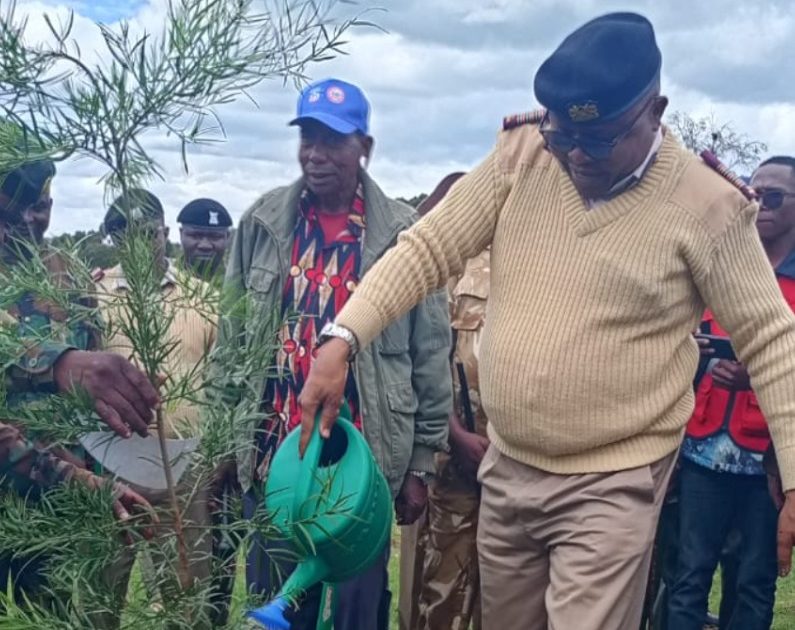
The government has warned individuals encroaching on forests and wetlands that they will face the full force of the law as Kenya intensifies efforts to restore degraded ecosystems and increase national tree cover.
Narok County Commissioner Kipkech Lotiatia said authorities would not tolerate illegal activities, including grazing livestock in forests, logging, lighting fires and destroying vegetation, warning that offenders would face legal action.
Speaking at Olposimoru Forest in Narok North Sub-County during this year’s Mazingira Day celebrations, Lotiatia urged residents to protect newly planted trees and support the government’s ambitious target of growing 15 billion trees by 2032.
More than 25,000 trees were planted during the exercise, which brought together government officials and conservation stakeholders to promote environmental protection and ecosystem restoration.
“We are going to be hard on people taking advantage of forests by taking their livestock there and those engaging in prohibited activities. We cannot sit and watch people derail the government’s agenda of improving forest cover,” Lotiatia said.
He called on Kenyans to take personal responsibility for environmental conservation, stressing that the national tree-growing campaign could not succeed if citizens left the responsibility entirely to the government.
“This campaign is a collective effort, and every Kenyan should support the government so that we can attain the target,” he said.
Lotiatia noted that tree planting and agroforestry could provide economic opportunities for communities while helping restore agricultural areas affected by climate change.
He attributed environmental degradation to human activities, including clearing forests for farming and settlement, saying these practices had contributed to declining water resources and reduced agricultural productivity.
“Let us take care of our environment by growing and nurturing trees,” he said.
The commissioner observed that climate change had affected water catchments and undermined agricultural production in the region, underscoring the need to protect forests and wetlands that sustain livelihoods.
He urged communities living near forests to work closely with authorities, noting that their participation was essential to the success of conservation programmes.
“I know we won’t succeed without collaboration and good relations with communities. We must collaborate. You are our eyes. You are the owners of the environment,” he said.
Lotiatia said the government had intensified a crackdown on illegal logging and other prohibited activities in the Mau Forest Complex, adding that similar enforcement measures would be extended to other forest ecosystems across Narok County.
Narok County Forest Conservator Patrick Wasike said the government could not continue deploying more forest rangers while illegal activities persisted.
“People who imagine that our forests are available for encroachment should forget it,” Wasike said.
He said the ongoing fencing programme in the Mau Forest Complex was expected to strengthen biodiversity conservation by creating a more secure environment for natural forest regeneration and protecting essential ecosystem services.
According to Wasike, the initiative would also improve the protection of water catchments, support carbon sequestration and maintain soil stability, all of which are vital for climate resilience and sustainable livelihoods.
“The initiative will strengthen biodiversity conservation, support natural regeneration and protect vital ecosystem services, including water catchments, carbon sequestration and soil stability,” he said.
Wasike urged residents living near forest areas to help prevent illegal activities and safeguard forest resources for future generations.
He described local communities as critical partners in conservation, saying physical barriers alone could not guarantee the long-term protection of forests.
The conservator encouraged residents to act as “social fences” by reporting illegal activities and discouraging encroachment, while supporting tree planting and the protection of existing seedlings.
He also urged Kenyans to take advantage of the ongoing rains to plant trees and ensure they survive through proper care.
Narok County Forest Association Chairman James Sopia said strategic fencing, community participation and reforestation programmes would be essential in restoring degraded landscapes and maintaining ecological balance.
Sopia commended the government for introducing stricter regulations to protect wetlands, warning that encroachment and destruction of these ecosystems threatened water security, biodiversity and community livelihoods.
He said wetlands were vital to human well-being and the health of the environment because they store water, regulate river flows and support ecosystems.
Wetlands hold water during periods of heavy rainfall and release it gradually, helping maintain river levels and reduce the effects of flooding. An acre of wetland can store up to 1.5 million gallons of floodwater, highlighting their importance in managing excess water.
However, Sopia expressed concern that wetlands were increasingly being lost to agricultural activities, human settlements, industrial development and infrastructure projects.
He said the growing pressure on wetlands made stronger enforcement and greater public awareness necessary to prevent further degradation.
In Kenya, wetlands cover an estimated three to four per cent of the country’s land surface, equivalent to approximately 14,000 square kilometres.
Sopia stressed that water and wetlands were inseparable and essential to life, noting that freshwater was being consumed faster than natural systems could replenish it in some areas.
He warned that individuals involved in illegal tree cutting, theft of forest resources and destruction of vegetation would face the full force of the law.
The association chairman said conservation efforts would continue despite criticism or resistance until the country made significant progress towards its tree-growing and forest-cover targets.
He added that protecting trees already planted was just as important as planting new ones, announcing plans for increased patrols and unannounced inspections in forests to deter illegal activities.
“We want to assure all our partners that all the trees they have planted will be well guarded. We have strategies to ensure their growth and the security of our forests,” Sopia said.
He commended President William Ruto’s administration for addressing the shortage of forest rangers previously faced by the Kenya Forest Service (KFS).
Sopia also praised Community Forest Association members for helping protect forests, plant seedlings and care for young trees, saying their involvement was crucial to achieving the government’s environmental goals.
He called for a participatory approach to forest and wetland management, urging residents, community organisations and other stakeholders to share responsibility for protecting natural resources.
Sopia further emphasised the importance of educating young people about environmental conservation, saying environmental awareness should be instilled early to encourage responsible practices among future generations.
“It is essential to instil environmental consciousness in our young people,” he said.
The government has also strengthened community training on Forest Management Agreements as Kenya pursues its target of achieving 30 per cent tree cover by 2032.
By Emily Kadzo