Artificial Intelligence emerged as a central pillar at the Africa Forward Summit in Nairobi, with France and African leaders calling for stronger partnerships to develop homegrown technological solutions tailored to local needs.
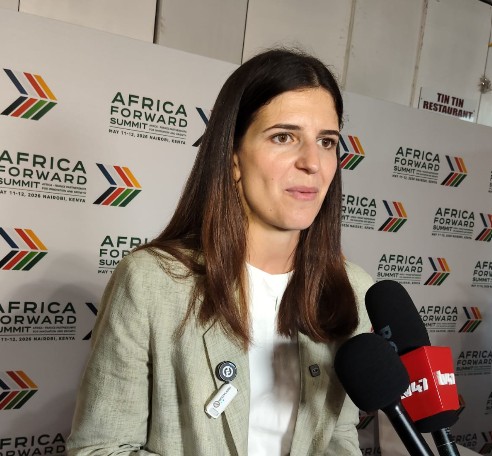
Speaking to the media during the summit at the Kenyatta International Convention Centre (KICC), French Ambassador for Digital Affairs and Artificial Intelligence (AI) Clara Chappaz said French President Emmanuel Macron deliberately chose Kenya to host the Africa Forward Summit because of the country’s growing potential in innovation, technology, and youth-driven digital transformation.
The expert said discussions focused on how Africa and France can strengthen partnerships, invest jointly in technology, and create solutions that address common economic and social challenges.
“President Macron and President Ruto held discussions with young people on the opportunities we can build together because this summit is about reinforcing partnerships and building more together,” said the envoy.
Clara said the Artificial Intelligence (AI) was prominently discussed throughout the summit and was officially adopted as one of the conference’s key themes, saying it was the first time AI had taken such a central role in a summit of this nature.
Envoy said AI presents major opportunities across sectors, including healthcare, education, agriculture, creativity, and public services.
“AI can help solve many of the major challenges and opportunities we face today. That is something extremely exciting for young people in both Europe and Africa,” she divulged.
The summit also addressed growing concerns over global technological dependency, particularly reliance on the digital infrastructure and AI systems from global partners.
Alluding to the remarks made by President William Ruto, the ambassador stressed that the summit focuses on “looking forward”.
“One thing President William Ruto said in the meeting was, ‘We are not looking East or West; we are looking forward,’” the AI expert said.
She said the concept aligns well with President Macron’s push for “strategic autonomy”, which seeks to build stronger partnerships capable of developing independent and locally relevant technological ecosystems.
Clara said, “And that’s exactly what President Macron has been pushing for when he talks about strategic autonomy. Strategic autonomy doesn’t mean isolation; it means how do we come together with our partners to build alternatives, and it is extremely important in the field of technology, and that’s why AI is such an important point of the summit.”
She said when we are thinking forward, we are empowering companies to build solutions together for our markets.
As part of efforts to develop local AI ecosystems, several partnerships were unveiled during the summit.
Clara also emphasized child safety and ethical technology governance, noting that the governments and technology companies must ensure AI systems are developed with safeguards that protect children from cyberbullying, online exploitation, harmful content, and mental health risks linked to digital platforms.
“Technology offers enormous opportunities, but we must ensure safety is built into systems,” the AI expert said.
She further outlined its broader policy approach to AI cooperation with Africa, emphasizing joint innovation, local partnerships, talent development, and inclusive participation in shaping the future of technology.
Clara added that the summit helped advance this agenda through partnerships in four major areas: connectivity, infrastructure, talent development, and financing.
In connectivity, satellite company Eutelsat announced plans to expand internet access to remote regions, targeting an estimated 23 million people.
On infrastructure, several companies committed investments toward data centers, cloud systems, and digital infrastructure across Africa.
She said talent development also emerged as a key priority, with universities and research institutions agreeing to establish AI clusters and academic partnerships.
She elaborated that Africa and Europe both possess significant technological talent that must be nurtured locally rather than exported.
“Because there is no such thing as AI if we don’t invest in talent. We have amazing talents in Europe and in Africa. Not all talents are located elsewhere,” said Envoy.
The envoy said the broader objective is not merely adopting AI technologies developed elsewhere but ensuring Africa actively participates in building them.
“The real cost is not failing to use AI but failing to ensure it solves our own challenges,” the envoy said.
He concluded by saying that global leaders agreed AI must become a tool for addressing universal challenges, including food security, healthcare access, education, climate resilience, and economic inclusion.
By Ian Chepkuto