The Architects’ Alliance has opposed the proposed Architectural and Quantity Surveying Practitioners Bill, 2026, calling for separate legislation to regulate architects and other professionals in the built environment.
The alliance, led by its President, Senator Sylvia Kasanga, said the proposed law failed to adequately recognise the distinct technical responsibilities of different professions and address systemic challenges affecting the construction industry.
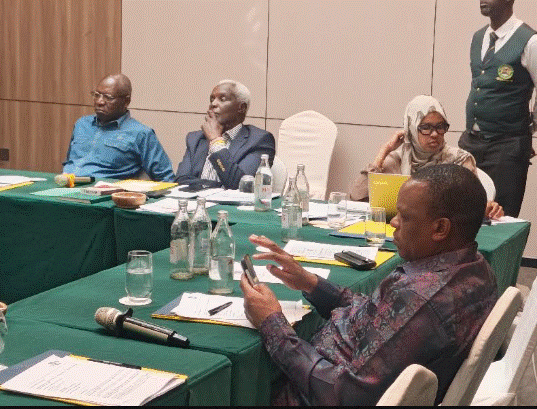
Kasanga, who presented the alliance’s proposals to the National Assembly Housing, Urban Planning and Public Works Committee in Nairobi on Saturday, said architects required an independent regulatory framework because of their responsibility for public safety.
She argued that architects, quantity surveyors, landscape architects, interior designers and construction project managers had different professional roles and obligations that could not be adequately addressed through a single regulatory structure.
“We maintain that the architect has the duty of care for public safety and therefore requires their own separate regulation,” Kasanga said.
She proposed the establishment of an overarching Built Environment Council to coordinate matters affecting the various professions, while allowing each profession to operate under its own legislation and regulatory framework.
The alliance expressed concern over the proposed establishment of a common council bringing together architects, quantity surveyors and other built environment professionals, questioning how the different technical disciplines would effectively address profession-specific issues under one board.
Kasanga said Kenya should review the existing regulatory arrangements, which she noted were established during the colonial era, to reflect current industry needs and international standards.
She argued that the continued regulation of architects and quantity surveyors under the same framework did not adequately reflect the differences in their professional mandates.
The alliance called on Parliament to reconsider the structure of the proposed legislation and adopt an approach that would promote professional accountability, public safety and effective coordination across the built environment sector.
“If it must continue, then the structure of the Bill has to change,” Kasanga said, adding that the alliance would submit further proposals to the committee.
She recommended that the proposed legislation be restructured into a Built Environment Council Bill, with individual professions subsequently operating under separate statutes that would provide for their regulation while maintaining coordination through the overarching council.
The Architectural and Quantity Surveying Practitioners Bill (National Assembly Bill No. 47 of 2026) seeks to repeal and replace the Architects and Quantity Surveyors Act, Cap. 525, and establish a comprehensive framework for the training, registration, enrolment, licensing and regulation of professionals in the built environment.
The proposed law seeks to extend the existing regulatory framework beyond architects and quantity surveyors to include landscape architects, interior designers, construction project managers and their respective technicians.
It also proposes to modernise professional regulation by addressing emerging developments in the sector, including green building technologies, climate change mitigation, artificial intelligence and design-and-build arrangements.
Susan Elisha, Head of Partnerships at the Association of Designers of Kenya and a founding member of Buy Africa, Build Africa, supported the Bill but called for amendments to make it more inclusive.
Elisha said the Association of Designers of Kenya was advocating for the formal recognition of interior design as a profession, noting that interior designers contribute to spatial planning, safety, accessibility, functionality and human well-being, beyond the selection of colours and finishes.
She said Buy Africa, Build Africa was also pushing for the recognition, training and competence assessment of technicians and artisans, commonly referred to as “fundis”, who play a significant role in the construction process.
“Kenya needs stronger professional accountability across the entire construction value chain,” Elisha said, warning that inadequate training and weak supervision could compromise public safety.
She cited the recent collapse of a building during demolition in Nairobi’s Central Business District, which injured workers, as a reminder of the need for proper supervision, training and accountability across construction sites.
Elisha said architects and engineers prepare designs and provide professional oversight, but much of the day-to-day work is carried out by technicians and artisans.
“These are people working hard to earn their daily bread, and we must help them earn this daily bread safely, professionally and with dignity,” she said.
She proposed a three-part approach involving legislation, industry dialogue and implementation through practical skills training, recognition, mentorship and collaboration.
Elisha said the Bill should not focus only on architects and quantity surveyors but should also recognise interior designers and artisans as important contributors to the creation of safe buildings.
She urged developers, contractors and other stakeholders to support efforts to improve training and regulation in the sector, including site-based training for artisans who may lack access to formal education.
“We support this Bill, but with amendments that professionalise the sector and create an all-inclusive framework,” she said.
Cecilia Mbati, Chairperson of the Interior Designers of Kenya, also called for amendments to protect professional competence without creating artificial boundaries between related professions.
Mbati said the legislation should address ethics and discipline, regulations, university programmes, accreditation, registration and competency requirements while ensuring that the proposed board did not make decisions that would undermine established education and professional pathways.
She proposed a regulatory structure with one overarching board and distinct professional chapters to represent the different disciplines within the built environment.
Mbati said construction management should be recognised as an established discipline, with graduates holding accredited degrees provided with a direct statutory pathway to professional registration.
She called for the title of construction manager to be expressly recognised and protected in the Bill, and for construction management education to be assessed by persons with relevant academic and professional expertise.
She further urged Parliament to provide meaningful representation for construction managers and other professions on the proposed board and establish clear pathways from accredited education to professional registration.
Mbati said the proposed legislation presented an opportunity to strengthen professional regulation while recognising the evolution of Kenya’s built environment professions and the academic disciplines supporting them.
She urged Parliament to ensure that the common regulatory framework recognised the professions as distinct but collaborative disciplines, preserved the integrity of university programmes and provided equitable professional governance.
The alliance’s submission adds to the considerations facing the parliamentary committee as it examines proposed reforms to the regulation of Kenya’s built environment professions.
by Aron Kinyamasyo