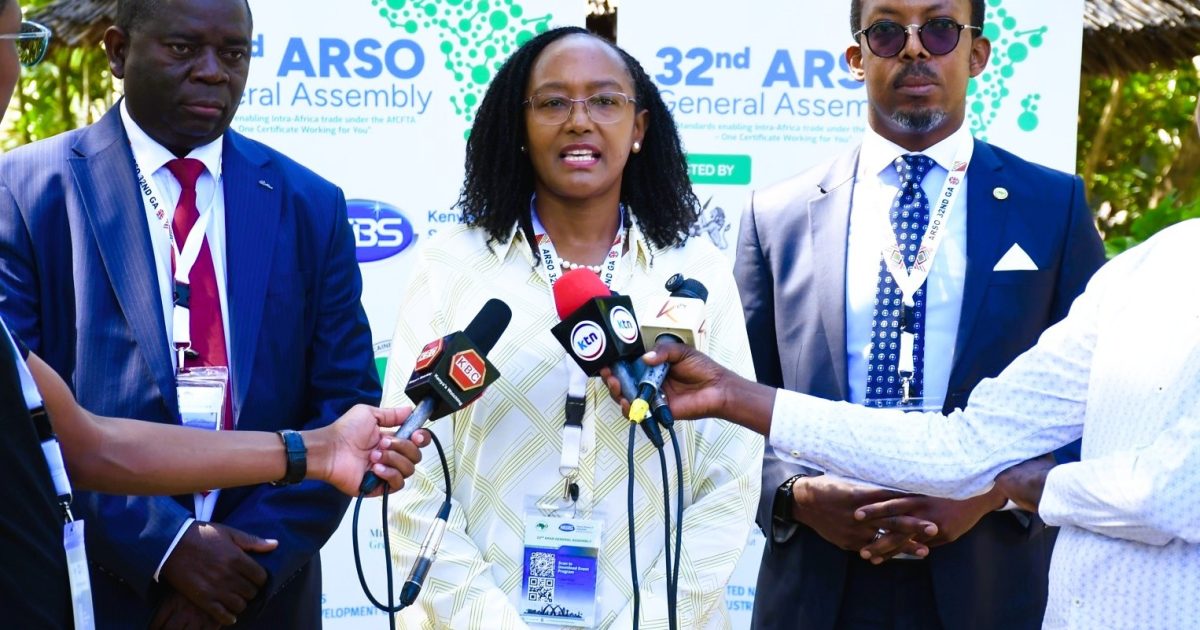
African countries have been urged to harmonise product standards and quality control systems to remove trade barriers and boost intra-African trade under the African Continental Free Trade Area (AfCFTA).
The call was made Monday during the opening of the 32nd General Assembly of the African Organization for Standardisation (ARSO) in Mombasa, where delegates from more than 40 countries gathered to discuss measures for strengthening standards and facilitating trade across the continent.
The four-day assembly, hosted by the Kenya Bureau of Standards (KEBS), is being held under the theme “Standards Enabling Intra-Africa under AfCFTA – One Certificate Working for You”.
The meeting is expected to advance efforts to establish a common certification framework and launch the Africa Quality Mark, also known as the ARSO Dual Mark, aimed at authenticating the quality of products traded within the African market.
KEBS Managing Director Esther Ngari said harmonised standards were critical to supporting AfCFTA by eliminating costly and unnecessary trade barriers that make it difficult for products to move across borders.
Ngari said the continental free-trade initiative sought to reduce tariffs and increase business among African countries, but noted that intra-African trade remained low at about 16 per cent compared with other regions such as Europe and Asia.
She said a common standardisation system would improve product quality, consumer safety and the competitiveness of African goods, while strengthening confidence among consumers and markets.
“A unified continental standardization system will, in the long run, boost economic development, industrial productivity and consumer confidence,” she said.
Ngari said ARSO was harmonising standards across key economic sectors, with priority areas under AfCFTA including agriculture, pharmaceuticals, textiles, automotive, mining and tourism.
She said quality certification would enhance the competitiveness of African products and assure consumers and markets that goods met agreed requirements.
The KEBS chief said Africa could no longer afford to remain fragmented in its standards and certification systems, urging countries to embrace a common approach that would facilitate seamless movement of goods.
“We need to ensure that once a certificate is issued in one country, then the products can be able to cross the borders without having to be retested again,” she said.
Ngari added that Kenya, as a signatory to AfCFTA, recognised the critical role of standards in enabling trade and ensuring that the agreement delivered greater economic opportunities for businesses.
ARSO Secretary General Dr Hermogene Nsengimana said harmonising more than 2,700 standards would make it easier for products to move across borders while reducing the cost of doing business for traders and manufacturers.
He said 28 per cent of the tariff lines submitted under AfCFTA had so far been covered, leaving 72 per cent requiring further work, including the provision of harmonised standards.
Nsengimana said the organisation’s goal was to achieve “one standard, one test, and one certificate accepted everywhere,” which would significantly reduce duplication in conformity assessment procedures.
He also called for stronger capacity in testing laboratories and other conformity assessment facilities to ensure that African countries could effectively implement and enforce the agreed standards.
The ARSO secretary general urged the 10 African countries that have not yet joined the organisation to become members, saying non-members risked continuing to apply different standards that could undermine continental trade integration.
“If those countries are not ARSO members, it means they are utilising other standards, while the agreement specifically mentions that African countries should utilise ARSO standards,” he said.
Executive Director of the Zambia Bureau of Standards and ARSO Champions Chairperson Nathan Sing’ambwa supported the call for wider adoption and implementation of ARSO standards by member states.
Sing’ambwa said membership alone was not sufficient, noting that countries needed to incorporate and apply agreed standards within their national systems to make them effective in facilitating trade.
“We want to encourage all member states, as ARSO Champions, to adopt these standards. Apart from adopting these standards, that means they have to apply these standards in their respective countries,” he said.
He said consistent application would make standards more universal and simplify trade between African countries by creating greater predictability for producers, exporters and consumers.
By Sadik Hassan and Hussein Abdullahi