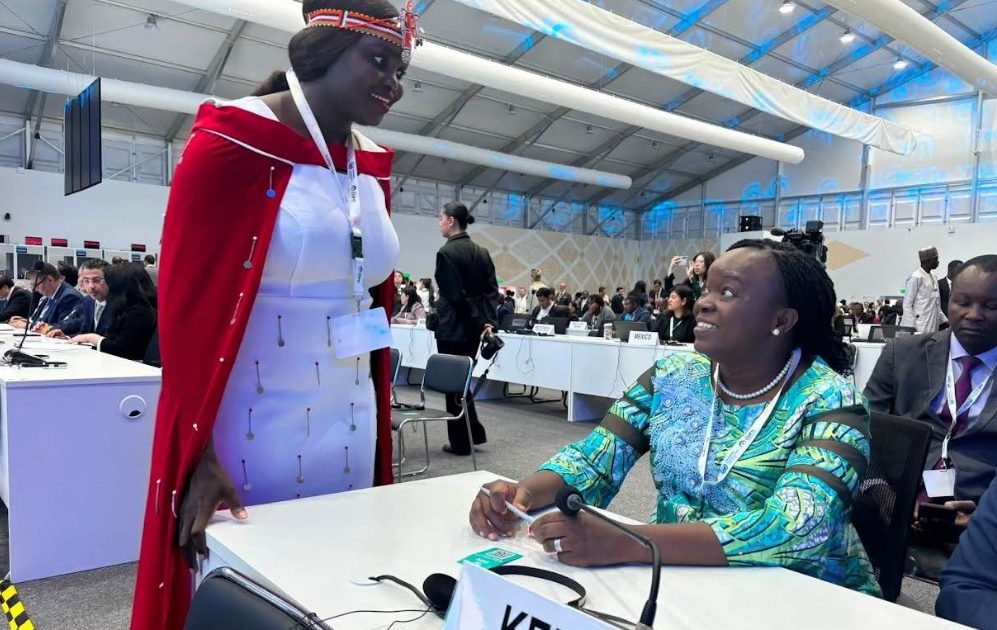
Kenya has called for stronger international collaboration, increased investment and collective action to accelerate land restoration and strengthen climate resilience as world leaders meet in Ulaanbaatar for COP17.
Speaking during the high-level opening of the conference, Cabinet Secretary for Environment, Climate Change and Forestry, Dr. Deborah Mlongo Barasa, joined global leaders, including, former President of South Korea Moon Jae-in and UNCCD Executive Secretary Yasmine Fouad, in highlighting the growing threat posed by land degradation.
Dr Barasa said the global community must move beyond commitments and translate restoration ambitions into practical action, sustainable investment and measurable results.
The discussions at COP17 have underscored the close link between land, food and water security, with land degradation emerging as a major threat to livelihoods, economies, climate resilience and future generations.
For Kenya, the challenge is particularly urgent. More than four-fifths of the country’s territory is classified as arid or semi-arid, while millions of people depend on healthy soils, rangelands, forests, wetlands and watersheds for their livelihoods.
Kenya has consequently placed landscape and ecosystem restoration at the heart of its national development agenda. The country is targeting the planting of 15 billion trees by 2032, restoration of 10.6 million hectares of degraded landscapes and increasing national tree cover to more than 30 per cent.
But Dr Barasa stressed that restoration should not be measured by planting numbers alone.
She called for country-led and investment-ready restoration programmes that can attract financing and deliver lasting benefits to communities and ecosystems.
Such initiatives, she said, should link financing directly to implementation while measuring tree survival, ecosystem recovery and improvements in livelihoods.
Kenya also highlighted the growing importance of technology and innovation in addressing land degradation and climate change.
The country welcomed the emphasis on artificial intelligence, women and young people as critical partners in designing and implementing solutions for a more resilient future.
However, Kenya emphasised that technological innovation must work alongside scientific research, indigenous knowledge and community leadership.
The contribution of pastoral communities was also highlighted, particularly their traditional approaches to managing rangelands and natural resources.
The view that mobility can be a solution rather than a problem for pastoralists is especially relevant to Kenya, where pastoral communities play an important role in conserving and managing fragile ecosystems.
Through the Riyadh to Ulaanbaatar Action Agenda, Kenya is seeking to forge stronger partnerships capable of transforming restoration commitments into investment opportunities, climate resilience, jobs and sustainable economic returns.
The country is urging governments, development partners, investors and communities to work together to ensure that restoration initiatives deliver tangible and lasting results.
Kenya’s message at COP17 is that restoring degraded land must be viewed as more than an environmental obligation. It is a strategic investment in food and water security, livelihoods, economic resilience and the future.
“Together, let us restore land, restore opportunity and restore hope,” Dr. Barasa said.
By Joseph Ng’ang’a