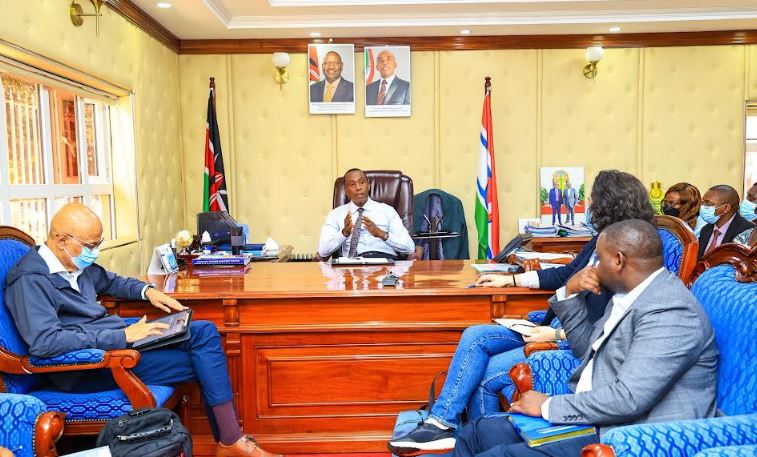
Kiambu Governor Kimani Wamatangi has held talks with a World Bank delegation to review progress in the implementation of urban infrastructure projects, aimed at improving living conditions in informal settlements and upgrading towns and shopping centres across the county.
The meeting focused on ongoing and completed projects under the Kenya Informal Settlements Improvement Program Phase Two (KISIP 2) and the second phase of the Kenya Urban Support Program (KUSP 2).
The World Bank delegation was led by Abhas Jha, Manager for Urban Development and Disaster Risk Management for Eastern and Southern Africa. Representatives from the Council of Governors and the State Department for Devolution also attended the meeting.
Wamatangi said the county was prioritising infrastructure development in urban centres and commercial areas to address challenges associated with rapid urbanisation and population growth.
“Our focus is to improve infrastructure in our towns and shopping centres to ensure residents and traders have access to better roads, proper drainage, improved sanitation and reliable street lighting,” said Wamatangi.

He said the planned interventions include tarmacking roads, installing cabro blocks on streets and walkways, constructing drainage systems, installing solar-powered streetlights and expanding sewerage networks.
The governor noted that the projects would improve accessibility and mobility while creating a more conducive environment for residents, traders and businesses.
“By investing in roads, drainage, sewerage and public lighting, we are working towards making our urban centres safer, cleaner and more accessible for everyone,” he said.
Improved drainage systems are expected to help mitigate flooding during heavy rains and reduce damage to roads, while expanded sewerage infrastructure will address sanitation challenges in densely populated settlements.
The installation of solar-powered streetlights is also expected to improve visibility in public spaces after dark and support business activities in the county’s growing commercial centres.
The engagement provided an opportunity for the county government and its development partners to assess progress under the programmes, identify infrastructure gaps and strengthen coordination in the implementation of ongoing and planned projects.
KISIP 2 and KUSP 2 support urban infrastructure development through collaboration between the national government, county governments and development partners.
Kiambu County, which has experienced significant urban growth due to residential expansion, commercial activity and its proximity to Nairobi, continues to face increasing demand for roads, drainage, sanitation and other essential services.
Wamatangi said the county would continue collaborating with the national government and development partners to advance urban renewal initiatives and improve the delivery of essential services.
“We remain committed to working with our partners to ensure that the planned projects are implemented and that our towns and shopping centres have the infrastructure needed to support growth and improve the quality of life for our people,” he said.
The long-term impact of the interventions will depend on the timely completion and quality of the works, as well as the maintenance of the infrastructure after completion.
By Grace Naishoo