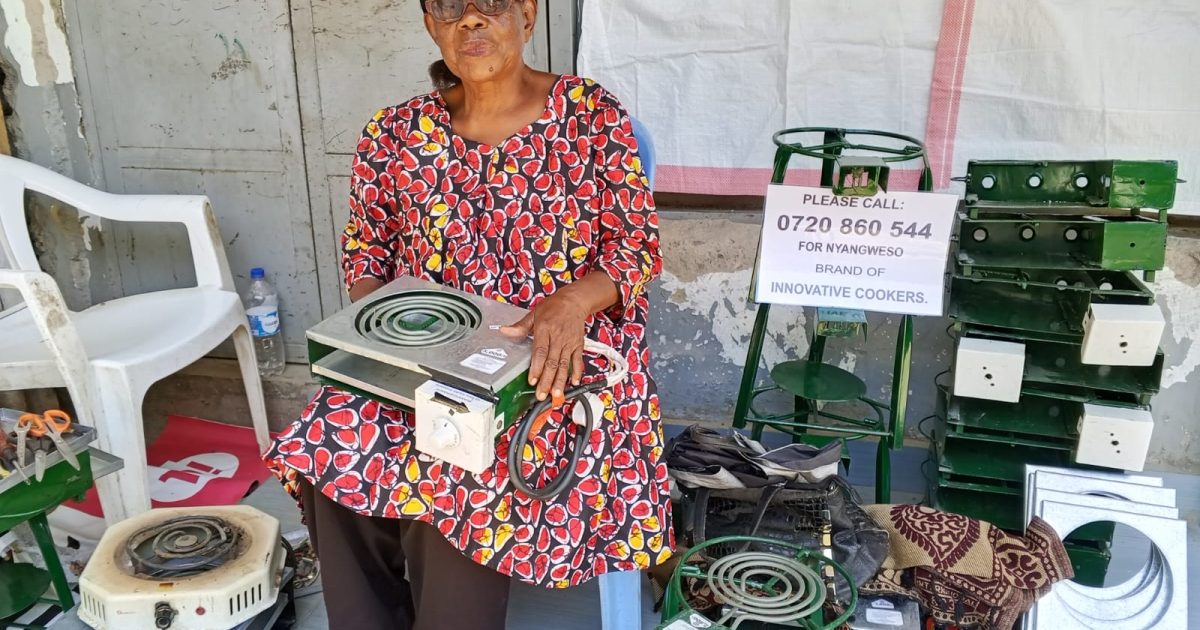
When Grace Kasera quit her job in the NGO sector, many saw it as a risky move.
Leaving behind stable employment after years of professional work appeared, to some, like a step backward. But for Kasera, the decision was driven by a deeper calling, family, purpose and a vision to transform how ordinary households cook.
The graduate of Kenyatta University, where she earned a Bachelor of Education Science in 1985, began her career as a teacher at Kisumu Polytechnic.
However, her path would later shift, blending education, engineering and entrepreneurship in an unlikely but impactful journey.
After her teaching stint, Kasera joined a non-governmental organisation, working in refugee camps as an education supervisor.
She later returned to Kisumu and became involved in her family’s electrical business-Nyangweso Electric Coils—an experience that sparked her interest in electrical innovation.
To deepen her technical expertise, she enrolled at the National Industrial Training Authority (NITA), where she studied electrical engineering. This marked the beginning of her journey into fabrication.
“I was always interested in creating something of my own,” she said.
Her curiosity would soon yield results. Kasera discovered a way to modify an ordinary 1,800-watt coil to consume significantly less electricity without compromising performance—a breakthrough that now defines her products.
Working from her workshop, she fabricates four types of energy-efficient electric cookers designed with affordability, safety and efficiency in mind.
Despite differences in design, all her cookers are engineered to operate safely on standard household sockets.
“We use the same size of wire, the same plug and a special technical formula so that the cookers don’t burn the socket,” she explained.
Her most affordable model, the stool-type cooker, retails at Sh2,800, while a box-type automatic version goes for Sh3,800.
A box-type cooker fitted with a switch costs between Sh4,500 and Sh5,000, with the largest model a double box-type selling at Sh7,800.
Kasera carefully selects materials for durability and performance, using metal plates of varying gauges, aluminium tops and heat-resistant electrical cables.
Some models also feature switches, depending on customer needs.
For 18 years, she has built a loyal customer base across professions, including teachers, doctors, police officers, students and nurses.
“At first, most of my customers were family people, especially men. But later, I realised I also had many clients in the security sector,” she said.
According to Kasera, the appeal of her products lies in their energy efficiency and ease of maintenance.
“The reason my customers are happy is because our cookers don’t waste energy. We discovered how to make coils that are both efficient and user-friendly,” she said.
She noted that many imported cookers are either too costly or difficult to maintain, while her locally made alternatives rely on readily available components.
“Some imported coils can cost up to USD3,500, but ours are available in local electrical shops at a fraction of that cost,” she said.
Kasera credits her background in science for shaping her technical path and is now a vocal advocate for vocational training as a solution to youth unemployment.
“Professional courses are important, but they often lead you to seek employment. Technical skills allow you to create your own opportunities,” she said.
She has employed several young people in her workshop, engaging them in metal work, welding and assembly. She encourages youth and career changers not to give up.
“I started metal fabrication at 48 years. Many young people give up too early. Get the information you need and start,” she urged.
Kasera said her journey has not been hindered by gender or age.
“In technical work, performance is what matters. It doesn’t matter whether you are a woman or a man,” she said.
However, she acknowledged that visibility has played a key role in expanding her business, citing a feature in a local newspaper that boosted public awareness of her work.
Now 66, Kasera hopes to scale up production and reach more households.
“This is a product with energy-saving and user-friendly properties. I hope to expand and serve more people,” she said.
She started with just two cookers due to limited capital but has steadily grown her enterprise over the years.
Her customers, she said, have reported significant savings on electricity.
“Some households use tokens worth Sh50 to cook hard cereals, while others have reduced monthly cooking costs from about Sh3,000 on charcoal to roughly Sh800 using these cookers,” she said.
Kasera is now urging Kenyans to embrace locally manufactured products, noting their durability and ease of maintenance.
“Some imported products do not meet our needs. We should focus on what we can produce locally,” she said.
By Dorothy Pamella