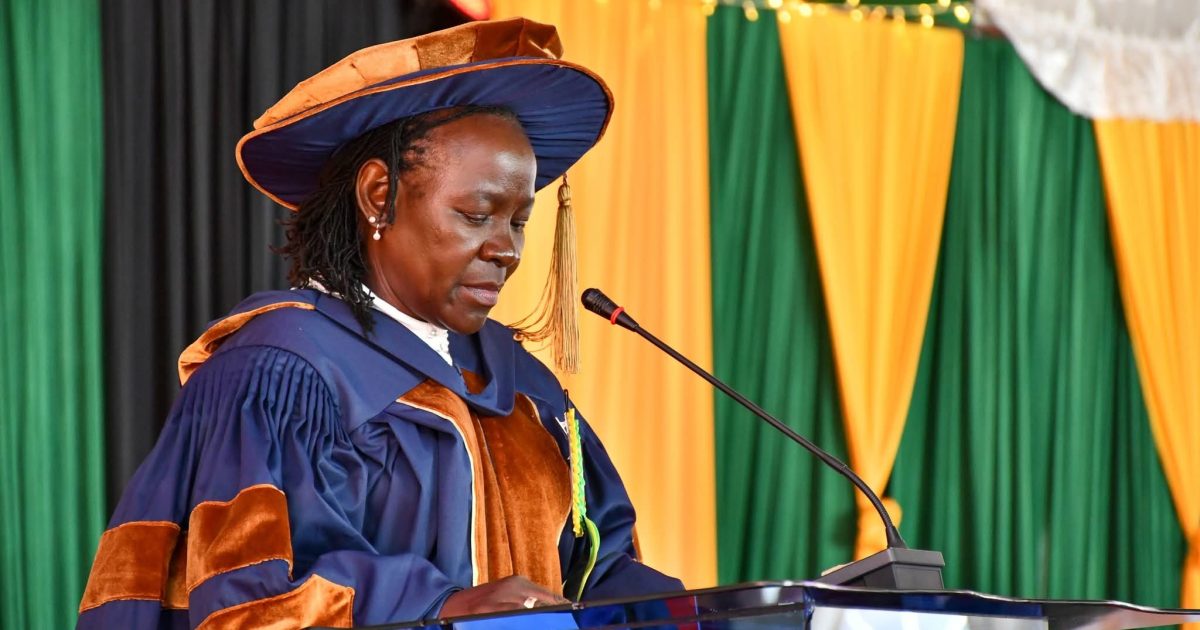
Trainees graduating from Technical and Vocational Education and Training (TVETs) institutions will no longer be required to wear academic robes during graduation.
This follows a directive by Principal Secretary (PS) in the State Department for TVETs Dr Esther Muoria, instructing all TVETs to design appropriate academic attire that matches each of technical disciplines offered in the respective institutions.
Dr Muoria said that this will ensure that those graduating are identifiable by their area of training.
Traditionally, TVET graduates have been donning the conventional robe and stash during graduation, a scenario the PS noted was not doing much to promote the skills and expertise acquired by the trainees.
She also said that the attire which is heavily borrowed from universities was misrepresenting the spirit of TVETs, which focuses on technical and vocational skills rather than academic achievements.
“Going forward we are not going to be graduating our graduates in gowns like we have been doing. Gowns are academic, and we are technical, so graduands in the different technical departments will henceforth graduate in their respective work attire; Mechanics will wear overalls, chefs will wear the chef’s uniform,” she said.
“We want to communicate to the world that we are doing the right thing. We are not only doing the right thing, but we want to communicate by lining-up for graduation in the correct attire.
As it is right now, nobody can tell what specialty we are graduating from because they are all dressed the same,” added Dr Muoria.
The PS spoke during the 6th graduation ceremony of the Nyeri National Polytechnic where a total of 2,500 grandaunds were awarded certificates and diplomas in various technical and artisan courses.
She reaffirmed the government’s commitment to supporting the growth of the TVET sector. Among the plans lined up include modernisation of the infrastructure and equipping the institutions with the latest training tools.
To match the tremendous growth in student population from 350,000 in 2022 to the current 850,000 students, Dr Muoria said that the State will this year recruit 1,000 additional trainers.
Similarly, the PS said that the retooling of TVET trainers to ensure their skills align with the Competency-Based Education and Training was on-going at the Kenya School of TVETs.
“The Kenya School of TVETs has had an overflow of application of trainers who want to train CBET and because they cannot all fit at the Kenya School of TVET, what we have allowed is for the trainers to go to any reputable institution so that we are able to bring all our TVET trainers up to speed so that they are able to train CBET in our TVETs,” she said.
The PS also called on TVETs to curb their dependence on government funding by devising alternative ways of generating revenue to sustain their operation.
She noted that government resources are limited and must be shared across other critical sectors and therefore institutions must explore additional income generating streams to complement government support.
She emphasised that the Ministry will not relent on its push to have all TVETs institutions adopt cost-saving measures including use of solar panels and rain water harvesting systems.
“I have always said that resources will never be enough. The ones that are available at the National Treasury belong to all of us, Health, Education you mention it. So as institutions we can come-up with more resources to even augment what the government is able to do,” she said.
Additionally, the PS urged TVETs to embrace their role as centres of technical expertise. She challenged TVETs to lead by example by utilising their expertise and training. According to her, it is unnecessary for the institutions to outsource skills and products which they themselves can produce internally, significantly reducing costs for the institutions.
“We have already directed that the buildings that are coming up in our institutions be done by the staff and the students in the Civil and Building departments. There is no reason why we should bring other people from outside to come and build our space, yet we are the builders. We should be the consumers of our own knowledge and training even before it goes out there,” she said.
“In the process of doing that, when we don’t bring a contractor from outside to come and do our buildings, then we do the savings. It is not a question of looking for alternatives, it is a question of taking the requisite space as should be the case,” she emphasized.
By Wangari Mwangi