Every Saturday at dawn, while most of Kisumu is still asleep, a different kind of activity begins on the waters of Lake Victoria.
Instead of casting fishing nets, a group of young men and women steers small boats across the lake, collecting plastic bottles, worn-out tyres, water hyacinth and other floating waste.
What they gather is not destined for a dumpsite but for a workshop where it is transformed into furniture, home décor and a dependable source of livelihood.
For the past decade, 34-year-old Raymond Odhiambo has led this transformation through Wolf Arts World Community-Based Organisation (CBO), a Kisumu-based environmental enterprise tackling pollution in Africa’s largest freshwater lake while creating jobs for women and youth.
What many consider worthless rubbish has become the raw material that sustains the organisation, supports dozens of families and demonstrates that environmental conservation can also be a profitable venture.
Each Saturday, Odhiambo and his team head into the lake equipped with boats, pangas, knives and protective gear to harvest invasive water hyacinth and reeds while removing plastic bottles, polythene bags, discarded clothes, tyres, jerrycans and other floating waste that clogs the lake and threatens aquatic life.
The collected materials are ferried back to the organisation’s workshop, where they are sorted, cleaned and processed before being transformed into marketable products displayed in its Kisumu showroom.
“Every Saturday, we harvest water hyacinth and reeds and collect floating solid waste from the lake. We then process the materials into different products before displaying them in our showroom,” says Odhiambo.
The journey began in 2015 when Odhiambo established Wolf Arts Kisumu as a small social enterprise driven by his passion for environmental conservation.
Over the years, it has grown into Wolf Arts World CBO, a registered community organisation whose activities now extend beyond Kisumu into neighbouring Siaya County. With a background in social work and community development, Odhiambo says the organisation was founded to address pollution while creating dignified economic opportunities for communities living around Lake Victoria.
“We work with women and youth around the lake who previously depended on odd jobs to survive. Today they earn an income while helping conserve the environment,” he explains.
The clean-up exercises have steadily attracted women engaged in fish trading and young people from informal settlements such as Nyalenda, Obunga and Manyatta.
According to Odhiambo, harvesting water hyacinth requires determination more than specialised skills, making it accessible to many.
“People only need guidance. Many women who trade in fish now join us during clean-up exercises,” he says.
The conservation message is gradually spreading through the communities, with some residents now collecting recyclable materials independently before notifying the organisation to pick them up.
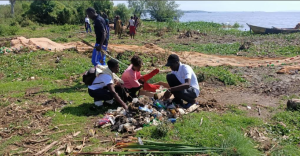
In return, they receive a small stipend, creating both environmental awareness and an additional income stream.
Safety remains central to every clean-up operation. Participants wear gumboots, gloves, overalls, masks and reflector jackets, while trained lifeguards accompany every team on the lake.
The organisation also works closely with the Beach Management Unit (BMU) to ensure all activities are conducted safely and in compliance with local regulations.
At times, the clean-up reveals the devastating effects of pollution on aquatic ecosystems.
“You find dead fish trapped inside some of the plastic waste. We remove them because they are affecting aquatic life,” Odhiambo notes.
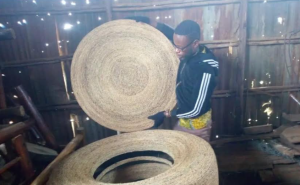
Inside the organisation’s workshop, discarded waste is given a completely new identity. Water hyacinth, long regarded as one of Lake Victoria’s most persistent environmental challenges, is woven into elegant coffee tables, chairs, baskets, doormats and house mats.
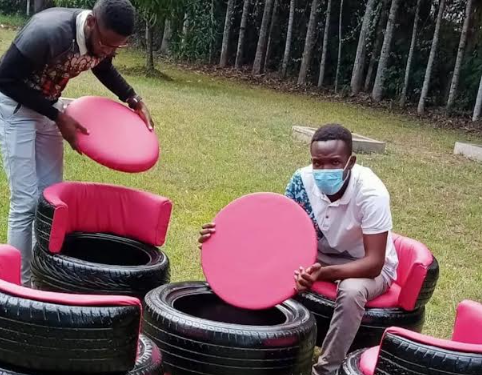
Old vehicle tyres are repurposed into seats, wardrobes, stools and office furniture, while discarded oil drums are converted into chairs, wall clocks and decorative household items.
Plastic bottles are transformed into bulb holders, menu holders and office organisers, while worn-out clothes become decorative flower vases.
Even broken tree branches are incorporated into creative furniture designs, ensuring that almost every piece of collected waste is put to productive use.
“Instead of simply clearing water hyacinth and throwing it away, we process it into seats, baskets and other useful products,” says Odhiambo.
The finished products are marketed through the organisation’s showroom, social media platforms and customer networks, generating income that sustains operations and supports employees.
Over time, the enterprise has built a loyal customer base attracted by its unique blend of sustainability, craftsmanship and affordability.
Beyond environmental conservation, Wolf Arts World has evolved into a significant employer. The organisation currently has 11 permanent staff members—seven women and four men—who have been trained in production, marketing and customer relations.
Employees are encouraged to specialise according to their strengths, while those interested in starting their own businesses receive mentorship and support.
“We don’t believe in a scarcity mentality. If someone is ready to start their own workshop, we encourage them, provided they maintain quality,” Odhiambo explains.
Women who once relied on unpredictable income from casual jobs around the lake are now earning more stable livelihoods.
During peak business periods, some workers earn up to Sh20,000 per month, with sales increasing significantly during festive seasons.
The organisation has also broadened its impact beyond recycling into agriculture, reproductive health and entrepreneurship.
Through its urban farming programme, it promotes household food production by establishing small-scale corn gardens within the city.
Its reproductive health initiative distributes reusable sanitary towels to adolescent girls and reusable diapers to mothers as part of its corporate social responsibility efforts.
“We believe in giving back to society by supporting women and girls using proceeds from our business,” Odhiambo says.
Wolf Arts World’s efforts have not gone unnoticed. In 2021, the organisation was recognised as the Kisumu County Youth Enterprise of the Year and later secured a showroom at Kisumu City Square through support from the county government.
Partnerships with organisations such as Voice for Climate Justice, GIZ and Mungano Foundation have further strengthened its environmental conservation, innovation and financial management programmes.
These collaborations have enabled the organisation to expand its activities, including the development of household waste segregation bins and improved recycling systems.
Media exposure has also played a role in increasing its visibility, enabling it to secure its first export order to South Carolina in the United States, with plans underway to establish a showroom there.
Despite these achievements, Odhiambo says limited funding remains a key challenge slowing the organisation’s growth.
The enterprise requires additional machinery such as plastic crushers, stronger marketing support and asset financing to scale up production.
The long-term vision is to establish a fully-fledged recycling industry capable of processing waste into finished products on a much larger scale.
Plans are already underway to explore converting water hyacinth into paper and books, a move that could significantly expand the value chain while creating more employment opportunities.
For Odhiambo, however, success is measured not just by profits but by the number of lives transformed.
“What keeps us going is the passion and commitment to support our communities. Environmental conservation is not just about cleaning the environment.
It is a profession capable of creating jobs, restoring ecosystems and giving young people an alternative source of income,” he says.
As plastic pollution and invasive water hyacinth continue to threaten Lake Victoria, Wolf Arts World is proving that innovative local solutions can turn environmental challenges into sustainable opportunities.
By transforming waste into valuable products, the organisation is not only restoring one of Africa’s greatest natural resources but also building a model for community-driven conservation and economic empowerment.
By Dorothy Pamella