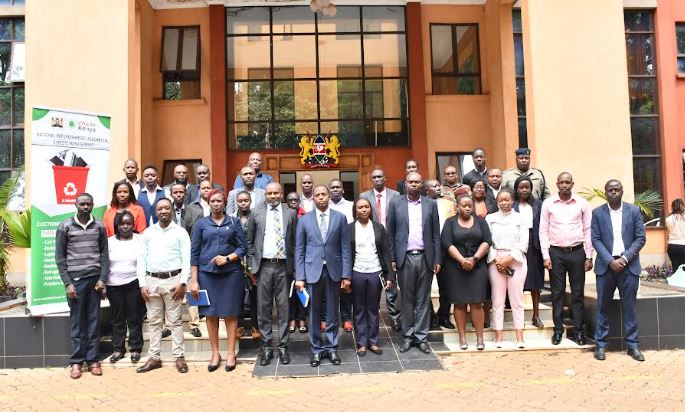
The ICT Authority has reaffirmed its commitment to efficient, safe and environmentally sustainable disposal of electrical and electronic waste through a sensitization meeting held at the County Commissioner’s office in Kiambu Town.
According to the ICT Authority, about 62 metric tonnes of e-waste are generated globally every year, with only 17 per cent being recycled, while Kenya produces approximately 51 million kilograms annually, translating to nearly 4 kilograms per household.
Experts warn that children are particularly vulnerable, with exposure affecting them nearly three times faster than adults and interfering with brain development, noting that e-waste contains harmful metals such as lead, mercury, and cadmium, which can damage the brain, kidneys, and nervous system.
The meeting brought together public servants and representatives from government entities, including the County Commissioner’s office, National Environment Management Authority (NEMA), National Government Administrative Officers, County officials and other departmental stakeholders.
The forum aimed at raising awareness on the dangers posed by electronic waste and its effects on the environment, human health and to adopt sustainable practices such as reusing, repairing, recycling, and reducing e-waste, as part of broader efforts to transform counties into smart villages.
Thika Deputy County Commissioner, Titus Macharia, observed that rapid technological advancement had increased the rate at which people dispose of electronic gadgets, exposing communities to growing environmental and health risks.
Macharia called on the County Assembly to adopt e-waste regulations to enable the Kiambu county government to implement proper waste management systems and provide the necessary infrastructure, saying the challenge required urgent intervention.
ICT officer Kevin Njeru noted that although the effects of electronic waste may not be immediate, toxic substances from improperly disposed devices eventually contaminate soil and water sources, posing serious risks to human beings and the environment.
“Let us establish e-waste collection centres in Kiambu because electronic waste is becoming a serious challenge that requires urgent intervention,” he said.
Participants were taken through the classification of electrical and electronic waste and trained on proper disposal procedures, with officials emphasizing that government departments are prohibited from disposing of e-waste independently and must work with licensed organizations equipped to handle hazardous materials.
NEMA Senior Environment Officer, Susan Mwangi said more needed to be done at the policy level, noting that the organization was still drafting regulations on e-waste management.
Mwangi encouraged heads of departments and members of the public to participate in upcoming public participation forums to help develop lasting solutions through partnerships and collaboration.
“Many people are unaware that discarded items such as SIM cards also constitute electronic waste and require proper disposal. It is upon us to continue creating awareness on proper e-waste management,” she said.
ICT officer Jeremiah Wakamu noted that e-waste disposal centres operate under the coordination of the ICT Authority in collaboration with NEMA and private organisations such as WEEE Centres, emphasising the need for departments to separate electronic waste from ordinary waste and promptly engage licensed organisations mandated to handle such materials safely.
“Let us not keep electronic waste in our working spaces because it poses health risks to our colleagues and us. Departments should dispose of the waste as soon as possible.”
The meeting also highlighted that e-waste management can create employment opportunities in waste collection, sorting, recycling, refurbishment, and manufacturing of recycled products.
The ICT Authority reaffirmed its role in creating awareness, supporting policy development, promoting sound disposal practices and coordinating stakeholders, urging the public to embrace responsible waste management to conserve the environment.
By Kevin Karanja