The Kenya Agricultural and Livestock Research Organization (KALRO) has launched a new initiative to boost the production of African Indigenous Vegetables (AIVs) among urban farmers in Nairobi and its environs.
The project, Establishment and Scaling-Out of Nutrition-Sensitive African Indigenous Vegetable Urban Farming Technologies, Innovations and Management Practices (TIMPs), is funded by the National Agricultural Value Chain Development Project (NAVCDP).
It seeks to expand community gardens, train more farmers in urban vegetable production, reduce post-harvest losses and improve household nutrition. In the long term, it aims to raise local incomes and widen access to nutritious indigenous vegetables among households in the capital.
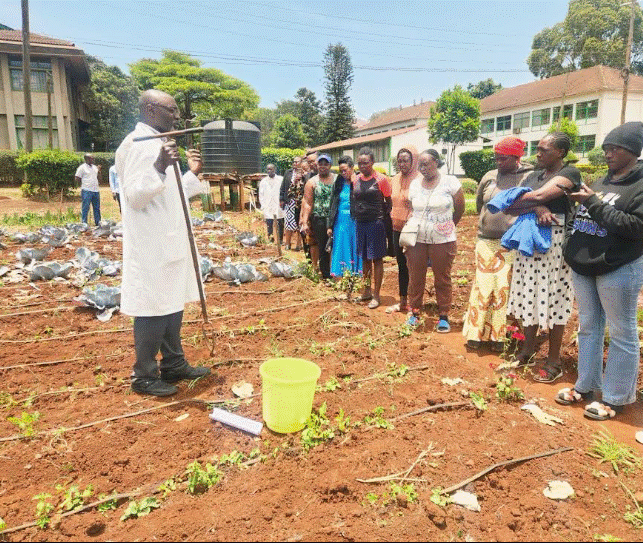
Speaking during an inception and sensitization meeting at KALRO Kabete Food Crops Research Centre, Centre Director Dr. Caroline Kundu said the collaboration would bring together agricultural research, public health expertise, private sector solutions and farmers to promote safe and sustainable urban farming.
“Through this effort, more farmers will be trained, community gardens will expand, and solar-dried vegetables will minimize post-harvest losses while raising local incomes, ultimately bringing nutritious indigenous vegetables to more family dining tables every day,” said Dr. Kundu.
The initiative responds to two main challenges facing urban vegetable growers, limited
farming space and the need for safe handling and preservation of produce. Indigenous vegetables such as managu, terere and sagaa are widely valued for their nutritional content, and growing them within towns can help households diversify their diets while earning an income from surplus produce.
Under the project, KALRO will provide agricultural research expertise and improved indigenous vegetable varieties to participating farmers.
Health and nutrition officers will guide farmers on food safety practices along the production chain, covering soil quality, water use, harvesting, handling, processing and value addition. This is aimed at ensuring that vegetables grown in urban settings are safe for consumption.
The private sector is also part of the partnership. Fred Kanyonyi and Monicah Mungai of Agri Plant Kenya Limited said their company would contribute urban farming solutions designed for farmers working with limited space, allowing more residents to grow vegetables even where land is scarce.
Participating farmers are expected to play a central role in the initiative by adopting the technologies and management practices and extending their use within their communities.
This approach is expected to help the technologies reach more households beyond those directly involved in the project.
The project also promotes solar drying as a preservation method. The technique allows farmers to dry surplus vegetables and stores them for later use, instead of losing them when supply exceeds demand.
However, the project’s impact on post-harvest losses and farmers’ incomes is yet to be established.
The inception meeting was meant to sensitise stakeholders on the project’s objectives and to agree on their respective roles as implementation begins.
by Winjoy Makena and Grace Naishoo