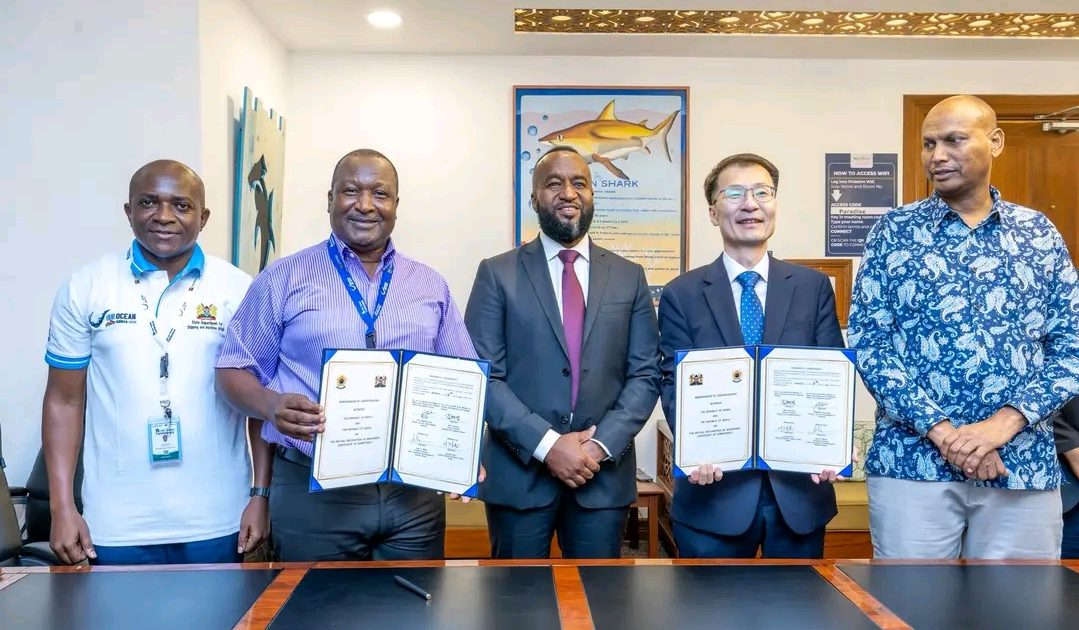
Kenya and the Republic of Korea have signed a landmark Memorandum of Understanding (MOU) on the mutual recognition of seafarers’ Certificates of Competency, a move expected to significantly expand employment opportunities for Kenyan seafarers and strengthen bilateral cooperation in maritime training and shipping.
The agreement, signed in Mombasa during the ongoing 11th Our Ocean Conference, establishes a framework for the mutual recognition of maritime education, training, and certification standards in accordance with the International Convention on Standards of Training, Certification, and Watchkeeping for Seafarers (STCW).
The pact will enable qualified Kenyan seafarers to serve aboard Korean-flagged vessels while allowing Korean seafarers to work on Kenyan-registered ships.
The agreement was signed on behalf of Kenya by Kenya Maritime Authority Director General CPA Omae Nyarandi and witnessed by Principal Secretary for Shipping and Maritime Affairs Aden Millah.
On the Korean side, it was signed by Director General Kim Hye-jung of the Shipping and Logistics Bureau and witnessed by Deputy Minister Jeongho Seo.
Cabinet Secretary for Mining, Blue Economy, and Maritime Affairs Ali Hassan Joho hailed the agreement as a transformative step in Kenya’s quest to position itself as a leading maritime nation in Africa.
“This agreement marks a new chapter in Kenya-Korea maritime relations. It demonstrates international confidence in the quality of Kenya’s maritime training institutions and certification systems. More importantly, it opens doors for Kenyan seafarers to access opportunities in one of the world’s most advanced maritime economies, creating jobs, building skills, and enhancing Kenya’s competitiveness in the global shipping industry,” said CS Joho.
The Cabinet Secretary noted that the partnership aligns with the government’s broader agenda of harnessing the Blue Economy as a key driver of economic growth, youth employment, and international trade.
Principal Secretary for Shipping and Maritime Affairs Aden Millah described the MoU as a major milestone in Kenya’s efforts to develop a globally recognized maritime workforce.
“The mutual recognition of certificates means that Kenyan seafarers will have greater access to international labor markets while benefiting from enhanced professional mobility. It also strengthens cooperation in maritime education, training, certification, and knowledge exchange between our two countries,” said Millah.
He added that the agreement will contribute to the government’s strategy of increasing the number of Kenyan seafarers serving aboard international vessels, thereby boosting remittances and creating sustainable careers for young professionals in the maritime sector.
Principal Secretary for the State Department for Blue Economy and Fisheries Betsy Njagi welcomed the partnership, saying it reflects Kenya’s growing stature as a regional maritime hub.
“The Blue Economy thrives on partnerships, innovation, and human capital development. This agreement enhances our capacity to develop internationally competitive maritime professionals while strengthening Kenya’s position within the global ocean economy. It is a significant investment in our people and our future,” said PS Betsy Njagi.
Under the MoU, both countries have committed to recognising each other’s maritime education, training, and certification systems and to maintaining compliance with international standards set by the International Maritime Organization.
The agreement also provides for the exchange of information, cooperation in training and assessment programmes, and verification mechanisms to ensure the authenticity and validity of seafarers’ certificates.
Industry stakeholders have welcomed the agreement, noting that Korea is among the world’s leading maritime nations, with a strong shipping, shipbuilding, and logistics sector.
Access to such a market is expected to create new pathways for Kenyan seafarers seeking employment on international vessels while elevating standards across Kenya’s maritime training institutions.
The signing comes as Kenya continues to implement reforms aimed at strengthening maritime governance, expanding seafarer training opportunities, and positioning the country as a gateway for maritime trade and investment in the Western Indian Ocean region.
Analysts say the agreement could accelerate Kenya’s ambition of becoming a premier maritime hub by enhancing skills development, facilitating technology transfer, and creating stronger links with global shipping networks.
For Kenya’s maritime sector, the pact represents more than a diplomatic achievement; it is a strategic investment in human capital, international recognition, and the future growth of the country’s Blue Economy.
By Justus Anzaya (PCO)