TradeMark Africa has committed to strengthening its partnership with the Kenya Ports Authority (KPA) in a move aimed at boosting operational efficiency, upgrading port infrastructure and easing regional trade.
TradeMark Africa was formerly known as TradeMark East Africa (TMA) before rebranding in January 2023 to reflect its expansion from East Africa into West and Southern Africa, supporting continent-wide trade.
The pledge came during a visit by a delegation from TradeMark Netherlands to the Port of Mombasa, where the team assessed infrastructure projects carried out under the KPA- Trademark Africa partnership with support from the Government of Netherlands.
The delegation was led by Simone van den Broek, Second Secretary for Trade and Investment, and Janieke Scholten, First Secretary for Political Affairs from the embassy of Netherlands. They were accompanied by Job Wanjohi, TradeMark Africa’s Country Director for Kenya.
The Port of Mombasa is the premier maritime gateway to East and Central Africa serving as a critical trade lifeline that connects over 80 global ports to a vast landlocked hinterland.
The port serves a wide and rapidly growing hinterland consisting of Uganda, Rwanda, Burundi, South Sudan, Northern Tanzania, Democratic Republic of Congo and Ethiopia.
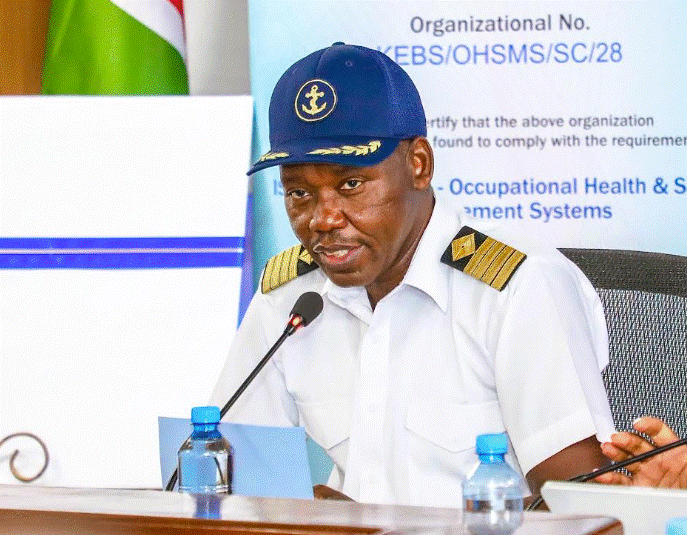
KPA Chief Executive Officer (CEO) Capt. William Ruto credited development partners for their role in initiatives designed to improve port operations and customer experience.
He said KPA is embracing development partnerships through the sustained modernization and rehabilitation of its port infrastructure to make Kenya a ‘gateway and destination of choice for regional maritime trade’.
The top KPA official said the Authority is pursuing an aggressive programme of investment in the expansion and modernization of port infrastructure to meet the demands of facilitating growing regional and international trade.
He said KPA is rolling out major automation and digital modernization projects to streamline maritime operations.
It includes areas such as Smart Gates Project where KPA and the Kenya Revenue Authority (KRA) are rolling out and scaling automated “Smart Gates” at the Port of Mombasa and the Nairobi Inland Container Depot (ICD) to streamline vehicle entry, exit, and truck turnaround times.
The Smart Gates Project by KPA is a technology-driven initiative designed to automate cargo and vehicle access, curb manual processes, and speed up truck turn-around times at facilities like the Port of Mombasa and the Nairobi Inland Container Depot.
Others are Digital Systems and Vessel Tracking where KPA commissioned a digital vessel traffic management and information system (operated from the Port Vessel Traffic Services Control Tower, Ras Serani Signal Station, and Shimanzi Oil Terminal) to monitor ship movements in real time and the Terminal and Payment Automation where payments are increasingly integrated through digital platforms like eCitizen.
Ruto pointed to the Green Port Policy, as part of the authority’s push for sustainable operations and better regional connectivity.
KPA Green Port Policy (2024–2028) is a strategic framework designed to integrate Environmental, Social, and Governance (ESG) principles into the country’s maritime sector and align with the United Nations Sustainable Development Goals (SDGs).
Ruto said the efficiency, accessibility and competitiveness of the Mombasa, Lamu and Kisumu ports have direct implications for stakeholders including importers, exporters and logistics operators.
He also named the new Terminal Operating System and Smart Gates project as key digital transformation projects meant to sharpen operational efficiency, speed up cargo processing and improve visibility across port operations.
“Visibility is key to us, and reliability is equally important. A customer sitting in Rwanda or Uganda should have full visibility of what is happening at the Port of Mombasa,” Capt. Ruto said, stressing the value of accessible and dependable information for cargo owners and other players in the regional supply chain.
The visiting delegation also noted improvements in cargo scanning technology and the introduction of a green channel for fresh produce, an initiative designed to speed up clearance and cut delays for time-sensitive agricultural exports.
Capt. Ruto said KPA will actively be forging partnerships with maritime stakeholders in a bid to upgrade port infrastructure and boost operational efficiency.
Job Wanjohi, TradeMark Africa’s Country Director core mission is to grow intra-African trade, reduce trade barriers, and improve business competitiveness.
Wanjohi stated that the efficiency of the Port of Mombasa has a major impact on the economies of the countries it serves and can unlock the region’s growth potential if operated efficiently and developed in step with growing global trade demands.
Mombasa port spans natural deep-water inlets including Kilindini Harbour, Port Reitz, the old port, port Tudor, Mbaraki and the whole of the tidal waters encircling Mombasa Island and has a capacity of 2.65 million (Twenty-foot Equivalent Unit) TEUs.
According to KPA the port of Mombasa handled a record 45.45 million metric tonnes of cargo in 2025, marking a 10.9 percent increase (up 4.46 million tonnes) compared to the 40.99 million tonnes processed in 2024.
The KPA CEO at the same time invited TradeMark Africa to explore investment opportunities at the Port of Lamu, calling the facility a “game changer” with strong potential to reshape maritime trade along the Eastern African seaboard and ease congestion at the Mombasa port.
Capt. Ruto said the port of Lamu is a deep-water transshipment and maritime trade hub located in the Lamu archipelago serving as the anchor project of the LAPSSET Corridor Program.
The Lamu port features a natural depth of 17 to 17.5 meters along the channel and up to 60 meters within the bay, allowing it to host mega-sized and Super Post-Panamax vessels that cannot dock at shallower ports.
The LAPSSET Corridor Program is a regional flagship project intended to provide transport and logistics infrastructure aimed at creating seamless connectivity between Kenya, Ethiopia and South Sudan.
The project connects a population of 160 million people in the three countries and additionally, the LAPSSET Corridor is part of the larger land bridge that will ultimately connect the East African coast from Lamu Port to the West coast of Africa at Douala Port in Cameroon.
The KPA partnership with its development partners continues to support infrastructure development, digital transformation and trade facilitation efforts aimed at improving port performance and strengthening the competitiveness of regional trade corridors.
Meanwhile the Port of Mombasa is expected to handle a total of 34 vessels in the next two weeks.
Capt. Ruto says KPA has a 14 days’ list also known as the (shipping movements or expected vessels list) showing ships scheduled to dock at the ports of Mombasa and Lamu over the next two weeks.
“We have something known as 14 days’ list which gives as an arrival date for vessels 14 days in advance before the consignment arrives and processes everything digitally,” he said, adding that it allows customers to monitor movement of their consignments at any given time.
During the same period, the Port of Lamu is expected to handle 11 vessels, comprising nine container vessels, one anchorage ship and one conventional vessel.
Overall, the two ports are expected to handle 45 vessels over the next 14 days.
by Hussein Abdullahi