Climate change is now a concern for every government and community in general in modern times, due to severe devastation witnessed not just in one country but in the entire world.
Climate change has been brought about by unsustainable destruction of the environment through pollution, industrial emissions, and cutting down of trees, and the negative impact of this destruction has had devastating effects not only on human lives but also on flora and fauna.
But what is climate change?
This refers to a long-term shift or variation in weather patterns and temperatures. This is according to the Kenya Meteorological Department.
For several years now, Kenya has continued to experience unprecedented drought, floods, heat waves, or extreme cold weather with devastating effects on humans, livestock, crops, and our wildlife.
Sample this. Floods and related landslides in Kenya killed at least 47 people in 2025. This includes 26 people who died in a devastating landslide in the Kerio Valley in November and 21 individuals who lost their lives to floods during the March-to-May long rains season.
The country’s official national databases do not report exact mass casualty numbers for humans, human fatalities from drought that also occurred in 2025, but what is clear is that the drought created severe food insecurity that affected over 1.5 million people.
This is according to data from the Kenya Red Cross, which is always one of the key first responders during disasters.
Come 2026, at least 128 people were killed by floods and landslides in Kenya so far during the severe seasonal downpours of March and April 2026.
Government authorities and police confirmed 110 fatalities from the initial widespread flooding that peaked in late March, followed by an additional 18 deaths from localized floods and mudslides during a subsequent storm surge in early May.
Although no exact official figures exist for human fatalities caused directly by drought in Kenya in early 2026. However, data from the Kenya Red Cross show between 2.1 and 3.3 million people faced acute hunger and starvation, with hundreds of thousands of children and pregnant women suffering from acute malnutrition. Hundreds of livestock also succumbed to the drought, especially in January and February before rains set in with fury.
Kenya has experienced the wrath of Mother Nature when furious floods swept various parts of the country, killing scores of people, sweeping away homesteads, and destroying crops and animals, leaving thousands of people homeless and without a means of livelihood.
It’s worth noting that these floods have been happening just when the country was smarting from a devastating drought that took away the livelihoods of people, especially in arid and semi-arid counties.
The government, having noted the effects of this climate change, has come up with an ambitious plan to plant 15 billion trees in the country by 2030 in order to mitigate the effects of the climate change.
As the effects of climate change continue to be felt across Kenya and the world through rising temperatures, unpredictable rainfall, and environmental degradation, trees are increasingly being seen as an important solution in restoring the environment and protecting the future.
Against this backdrop, data from the Kenya Forest Service (KFS) show Kenya’s national forest cover stands at 8.8 per cent, and total tree cover is at 12.13 percent.
Although the country has made strides, the forest cover remains below the 10 per cent constitutional target and is aggressively battling deforestation and biomass loss across its critical water catchments.
In an effort to combat climate change, the government has continued to encourage tree planting across the country, including its plan to plant billions of trees by the year 2030.
In November 2022, just after his ascension to power, President Ruto launched a national tree planting campaign during his 56th birthday and announced that his government has an ambitious plan to plant over 15 billion trees in the country by 2030 to ensure the country’s tree cover, which now stands at 12 per cent, moves to over 30 per cent in order to overcome the effects of climate change.
This initiative has also created opportunities for individuals involved in tree nursery businesses, whose work supports environmental conservation while providing a source of income.
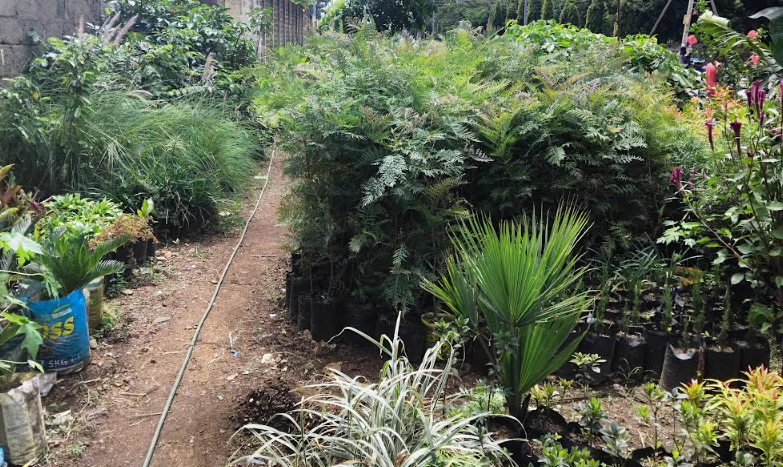
In the busy streets of Kisumu, where businesses of all kinds line the roadsides, one man has quietly turned his passion for plants into a thriving source of livelihood. Alfred Mahonga, a 48-year-old tree nursery operator, has spent nearly 20 years building his business through dedication, patience, and hard work.
Mahonga also recalls how he first entered the tree nursery business. He said he was initially hired to take care of someone else’s nursery before later deciding to start his own business of managing and taking care of nurseries.
Mahonga says he normally sells his trees at Sh300 when they are fully grown. He explained that he buys them at Sh30 when they are young from the Kenya Forest Service and other sources.
Mahonga sells different types of trees and flowers, including palm trees, eugenia, azaleas, and many more.
His seedlings are usually in high demand during the rainy seasons and can earn up to Sh5,000 on a good day, enough to take care of his family and buy more seedlings.
But due to the maintenance and care he gives them, he is forced to raise the price a little bit more. He notes that taking care of the nursery requires commitment and daily attention to ensure the trees grow well and remain healthy.
He further explains that he normally arrives at work at around 5.00 am every morning, a routine he says he is already adapted to.
Before starting his nursery business, Mahonga used to work at a public park in the town where he did cleaning duties, and by 6:30 am they were expected to have completed their work. Today, he continues to maintain the same discipline in his daily schedule and closes his business at around 5.30 pm.
Like many small business operators, Mahonga faces several challenges along the way. He says theft was once a major problem because there were no lights in the area.
However, he noted that cases of theft are no longer common since there is now enough light, and he also hired someone to patrol and look after the nursery.
Apart from theft, he mentions that excessive sunlight and heavy rainfall have also been major challenges because they destroy the nursery and affect the growth of the plants.
Despite these difficulties, Mahonga says the business continues to motivate him because the profits he earns enable him to take care of and provide for his family.
Mahonga urges people to take care of their trees and plant beautiful trees and flowers in their homes, saying that trees not only beautify the environment but also create opportunities for livelihoods.
With such small efforts from every Kenyan, we will slowly but surely beat climate change.
By Mabel Keya-Shikuku and Yuri Ochieng`