In the arid sun baked expanses of West Pokot County, education has long been a luxury deferred by geography, poverty, and conflict. For generations, children of pastoralist communities walked long miles across rugged terrains, their futures frequently disrupted by cross-border cattle rustling.
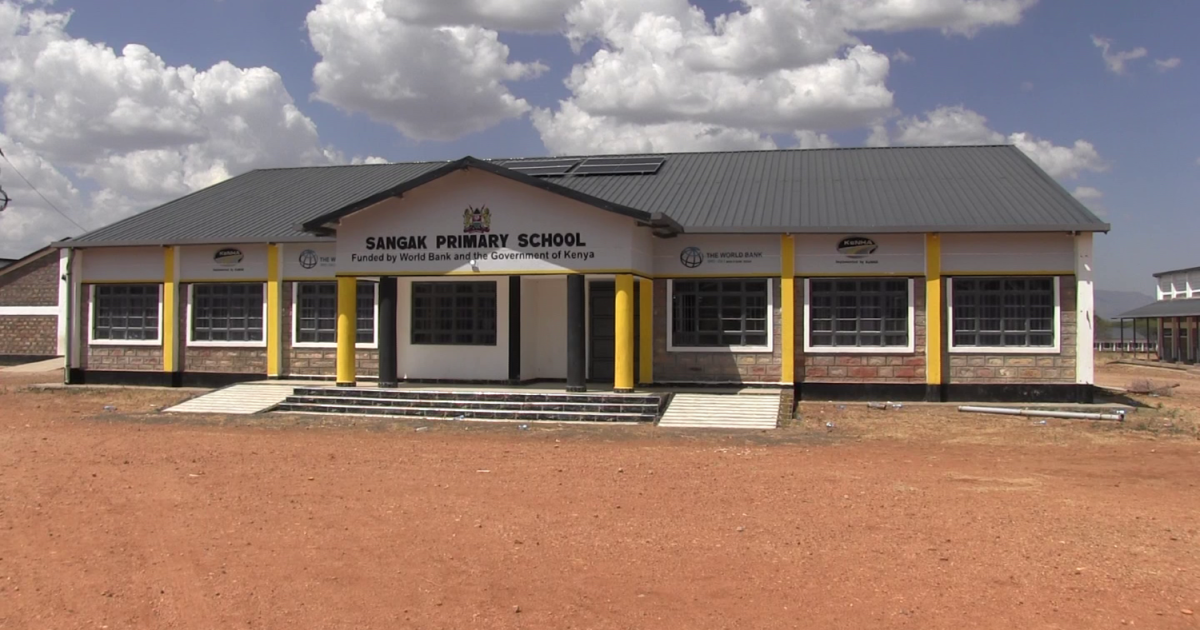
Yet today, against the backdrop of these historical struggles, an architectural marvel rises from the dusty landscape. Sangak Primary School stands out as a beacon of modern educational infrastructure, setting a bold new benchmark for primary learning institutions in the region and across Kenya.
Built by the Kenya National Highways Authority (KeNHA) as part of its strategic corporate social responsibility (CSR) and community integration initiatives tied to major road corridor developments, this ultra-modern facility represents a tangible realization of the Social Pillar of Kenya Vision 2030.
The social pillar aims to build a just, cohesive, and equitable society by expanding access to quality education. Sangak is proof that state-of-the-art facilities can thrive in marginalized areas.
Monica Chepchumba, an ECDE teacher who has been in the school since it was started says the school situated along the West Pokot-Turkana border has the remarkable ability to attract and retain students who would otherwise be left out of the formal education system.
She says the institution currently accommodates 600 pupils, serving children from Early Childhood Development Education (ECDE) up to Grade 6 and functions under a flexible learning model as both a day and boarding school thus offering safe residential options that cushion pupils from long daily commutes through volatile territory.
She says for the learners, the school is more than just an academic center as it is a haven of peace noting that the institution was intentionally established to bring together children from rival, warring cross-border communities.
“By introducing them to shared classrooms and shared dormitories at an early age, Sangak is systematically dismantling deep-seated historical animosities,” she said.
She says the secure dormitories, spacious permanent classrooms and teachers’ quarters, the school surpasses the facilities of many standard public primary schools across Kenya but called on partners to assist the ECDE section with essential equipment which can be used by the children both inside and outside the classroom.
She adds that by integrating boarding infrastructure with modern early-grade learning spaces, the school has successfully boosted local enrollment and enhanced pupil retention.
However, Chepchumba says despite these stellar infrastructural milestones, Sangak Primary School is fighting a quiet, desperate battle to keep its doors open due to the socio-economic hardships experienced in the area.
“The area is completely unproductive, and parents depend solely on small-scale gold mining to eke out a living,” Chepchumba explains. “When parents cannot provide food at home, most children simply do not turn up for classes,” she said
To keep the children fed and focused, she said, parents initially resolved to contribute a modest levy of sh4,000 per child to finance a daily school meals program, however, this fund is stretched far beyond nutrition.
Chepchumba says the fund is inadequate as the school relies on the same pool of money to pay Board of Management (BOM/PTA) teachers and cover the wages of support staff.
“As a result, little room remains for consistent feeding operations, and that is why we are appealing for integration into the national school feeding programme to stabilize attendance,” she said.
She added that while they have a modern dining facility equipped with commercial electric cookers, the school relies entirely on a localized solar power grid which cannot generate the high voltage required to run heavy heating appliances.
Consequently, the teacher said they are forced to cook meals outside using firewood and during the heavy rain season outdoor cooking becomes impossible, forcing vulnerable pupils to go without food.
She added that water presents another cruel irony at Sangak because while a borehole was successfully drilled to provide a dedicated water source, its output is excessively saline and therefore it cannot be consumed or used for cooking, rendering it useful solely for basic cleaning.
Chepchumba said to provide potable water, the school must purchase expensive water supplies delivered by commercial bowsers and because the school lacks a centralized storage tank, the administration relies on an improvised system with teachers donating their personal jerry cans to store drinking water for hundreds of pupils.
She continued that sanitation poses another parallel challenge. The school was built with indoor pit latrines inside the dormitories, a design meant to maximize safety at night.
“However, the young pupils struggle to use the unfamiliar latrines resulting in constant blockages that teachers and staff must manually unblock daily. We are appealing for assistance to build traditional, reliable outdoor pit latrines better suited to the rural environment,” she said.
Beyond basic utilities, security remains a looming concern given the volatile nature of the border corridor where rival communities clash as the school still lacks a secure perimeter wall, leaving pupils and staff vulnerable to external security threats.
“Furthermore, the absence of a school transport system prevents hundreds of children living in far-flung, remote settlements from enrolling, despite a massive local demand for education,” she said.
The success story of KeNHA’s infrastructural investment shows that changing lives through education is possible even in remote regions. However, to sustain this transformation requires a multisectoral approach from various institutions.
Investing in water purification systems, a dedicated storage tank, perimeter fencing, and sustained food aid will preserve this vital peace-building institution. Only then can the modern classrooms of Sangak primary school truly fulfill their promise of turning a historical conflict zone into a permanent cradle of equity, learning, and national unity.
By Alice Wanjiru