Kenyans living in the diaspora have been encouraged to complement government efforts in improving access to quality, affordable, and accessible healthcare services through investments in community health facilities.
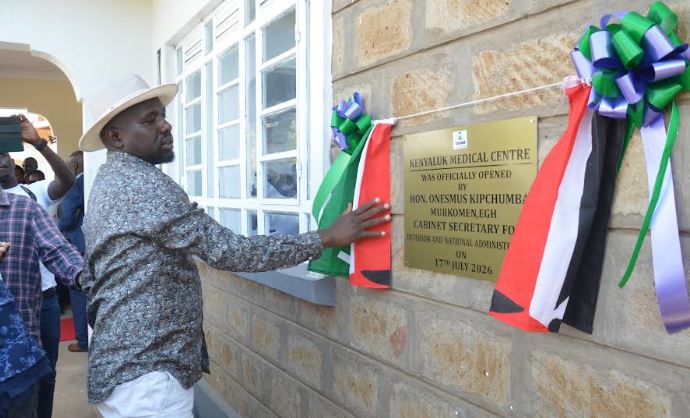
Interior Cabinet Secretary Kipchumba Murkomen made the appeal on Friday when he presided over the official opening of Kenyaluk Medical Centre in Salawa Division, Baringo Central Constituency.
Murkomen said the diaspora community, alongside professionals in the country, plays a significant role in strengthening the health sector by supporting the establishment of modern medical facilities that serve local communities.
The CS, who was accompanied by Housing Principal Secretary Charles Hinga, recognized the efforts of the family of Wilfred Kandie, a son of Kipsoit village based in the United States, for constructing the Level 3A medical facility.
Murkomen said the hospital is a major investment that will benefit residents of Salawa, Baringo County, and neighbouring Elgeyo Marakwet County.
“I have looked at the facility; it is a proper use of money. You can see the space and the modern equipment, and we need more of such facilities,” he said.
The CS pledged to support the medical centre in acquiring additional facilities, including a theatre and inpatient services, to enable it to be upgraded to a Level 4 hospital and qualify for funding under the Social Health Authority (SHA).
He encouraged more professionals to invest in similar projects, noting that even small initiatives can grow into important community assets in the future.
Baringo Central Member of Parliament Joshua Kandie commended Kenyaluk Foundation for giving back to the community through the investment in healthcare.
Kandie said the facility demonstrates the positive impact of diaspora contributions in transforming lives and accelerating development at the grassroots level.
The founder of the medical centre said the project was inspired by a personal tragedy involving his late father, Mzee Kanyeluk Komen, who died eight years ago from an avoidable lifestyle disease.
Kandie said the experience exposed the challenges faced by many residents, particularly men, who often delay seeking medical attention until their conditions become severe.
“Most of our community members are seeking medical attention when it is too late, and that is the reality we cannot ignore,” Kandie said.
He explained that the project was initiated in partnership with the Kenya Pipeline Foundation and other stakeholders to promote preventive healthcare and encourage early access to medical services.
The facility will provide routine medical check-ups for residents while strengthening maternal and child health services within the area.
Kandie said the medical centre would reduce the financial burden faced by patients suffering from lifestyle diseases who previously travelled long distances to seek treatment in Kabarnet, Iten, and Eldoret City.
He added that plans are underway to expand medical outreach programmes to reach more residents within the surrounding communities.
Murkomen said such investments are critical in supporting government efforts to improve healthcare delivery, especially in rural areas where access to specialized services remains a challenge.
He urged more Kenyans, both locally and abroad, to consider investing in projects that directly improve the lives of communities.
By Benson Kelio