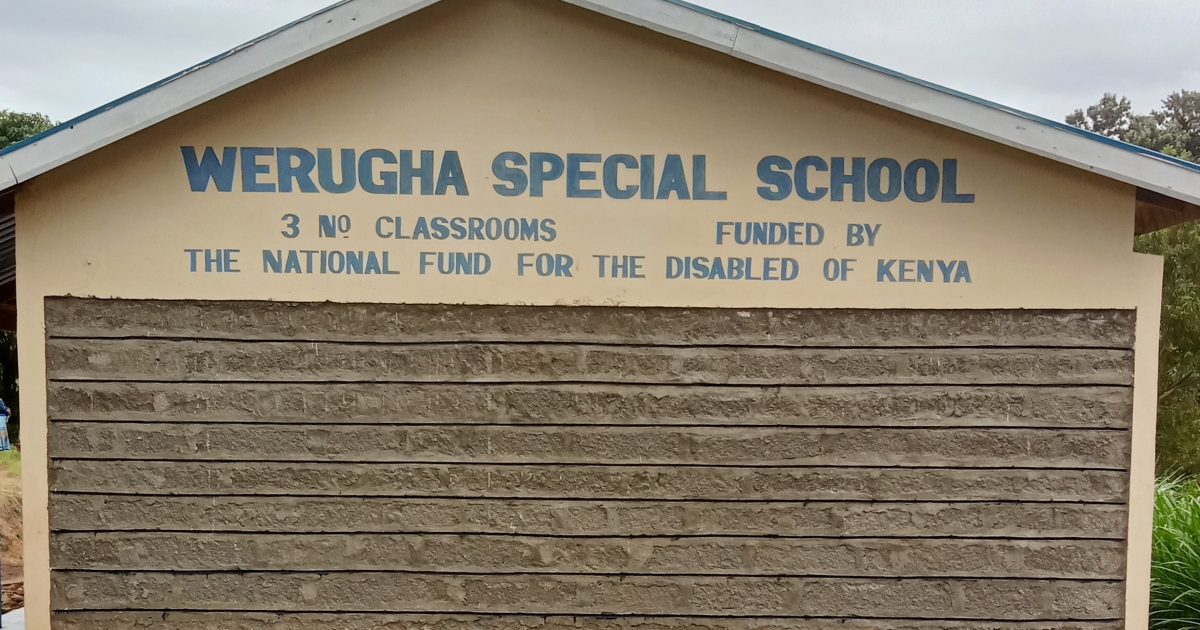
In the quiet hills of Taita Sub-County, Taita Taveta County, where distance and disability have long combined to keep some children on the margins of education, a modest but transformative milestone unfolded at Werugha Primary School and Special Unit.
Three newly constructed and fully furnished classrooms, bright, accessible, and purpose-built, were officially handed over, signaling more than just infrastructure. They marked a deliberate shift toward dignity, inclusion, and equal opportunity.
Funded by the National Fund for the Disabled of Kenya (NFDK) at a total cost of Sh3 million, the project is part of the Fund’s flagship programme focused on creating spaces where limitation is not defined by physical barriers but by the absence of opportunity for learners with disabilities.
Leading the handover were NFDK Trustees Major (Rtd.) Marsden Madoka and Dr. Mike Kiswili, whose presence underscored the national significance of what might otherwise seem like a local event.
“This is not just about putting up classrooms,” said Madoka, adding, “It is about restoring dignity to our children and giving them an environment that tells them they matter, that they belong, and that they can achieve just like any other learner.”
On his part, Dr. Kiswili emphasized the broader vision behind the investment, saying, “Inclusive education is not optional; it is a right.”
When we invest in infrastructure like this, we are investing in the future productivity and independence of these learners. No society can progress if it leaves part of its population behind, he added.
But beyond policy and infrastructure, the real impact is felt at the household level. For Sophilina Wangusha, a grandparent to one of the learners at the special unit, the new classrooms represent relief and renewed hope.
“Previously, the learning conditions were very difficult for these children,” she said. “Now, when I see these classrooms, I feel hopeful. My grandchild can learn in a better place, and that gives me peace,” she said.
Her voice reflects the quiet struggles many families in rural Kenya face, where access to specialized learning environments often determines whether a child thrives or falls through the cracks.
Yet, this story did not begin today. For over a decade, NFDK has been quietly reshaping the educational landscape of Taita Taveta.
From a 36-bed twin dormitory at Taveta Primary School’s Special Unit for the Deaf in 2012/13 to classrooms in Voi, a dining hall at Mwanyambo Special School for the Deaf, and a dormitory at Maktau Primary School, each project has been a deliberate investment in children too often overlooked.
These are not isolated interventions. They are part of a broader, nationwide commitment by the organization. Across Kenya, NFDK has funded more than 400 facilities, including classrooms, libraries, laboratories, and dormitories, each one a brick in the foundation of inclusive education.
Through its Small Grants Programme, the Fund also supports approximately 200 institutions with targeted funding for renovations, therapy equipment, water, and sanitation—all critical elements that determine whether a child with a disability can learn comfortably, safely, and consistently.
Back in Werugha School, the significance of the new classrooms is already evident. For learners in the special unit, this is not just a change of space; it is a transformation of experience. Properly designed classrooms mean improved mobility, better concentration, and a sense of belonging that many have historically been denied.
In a country steadily aligning its development agenda with inclusion and equity, projects like this mirror the broader goals of Kenya’s education and social protection frameworks, ensuring that no child is left behind, not in policy and, crucially, not in practice.
What stands at Werugha today is more than mere blocks, cement, and furniture. It is a quiet assertion that disability does not diminish potential but that with the right investment, even the most remote classrooms can become gateways to possibility.
By Arnold Linga Masila