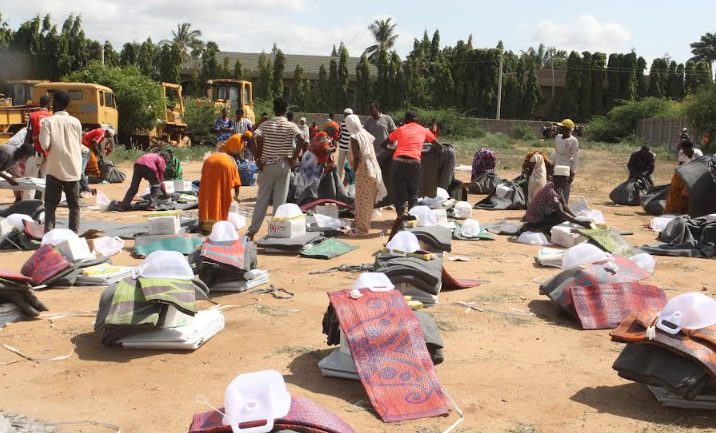
At least 1000 households affected by the recent floods in Garissa have received a donation of nonfood items from the Kenya Red Cross to ease their lives at the Internally Displaced Persons (IDP) camps as they wait for the floodwaters to subside and go back to their normal lives.
Those affected are mainly from Bulla Punda, Bulla Kamor, Bulla Sheikh, Bakuyu, and Ziwani villages and are camping at the Farmer Training Centre (FTC) and Hyuga and Police Training Centre internal displacement camps.
Speaking during the donation exercise at the Garissa Farmers Training Centre, Garissa County coordinator for the Kenya Red Cross Ahmed Daud called on the beneficiaries to maintain high hygiene and sleep under treated mosquito nets to avoid outbreaks of diseases in the camps.
“This is part of an ongoing exercise that we began earlier this week, and so far, we have reached 1000 households with non-food items. The non-food items package includes assorted household items like the kitchen set, blankets, mosquito nets, water purifiers, bar soaps, and collapsible jerricans,” Daud said.
“Currently in Garissa there is an outbreak of Dengue fever, so my call to all internally displaced persons is that, please always sleep under treated mosquito nets that we have just provided you with and take care of your hygiene because there could be outbreak of waterborne diseases like cholera during floods,” he added
At the same time, Daud called on more stakeholders to bring more assistance to the households who had not been reached through the little donations, urging that there was still a huge number of IDPs in dire need of assistance.
Abubakar Hamisi, one of the beneficiaries, told us that the donations were timely, especially the mosquito nets and blankets, as people had been suffering from cold at night and mosquito bites, which could bring diseases.
“We are grateful to the Kenya Red Cross because when we left our homes, they came to us and registered us in all the camps, and today they have brought donations for some assorted items,” Hamisi said.
Floods in Garissa and Tana River counties, especially along River Tana, started on May 28 following the March-April-May short rains, which increased water levels in upstream dams significantly, leading to the controlled release of water.
By Erick Kyalo