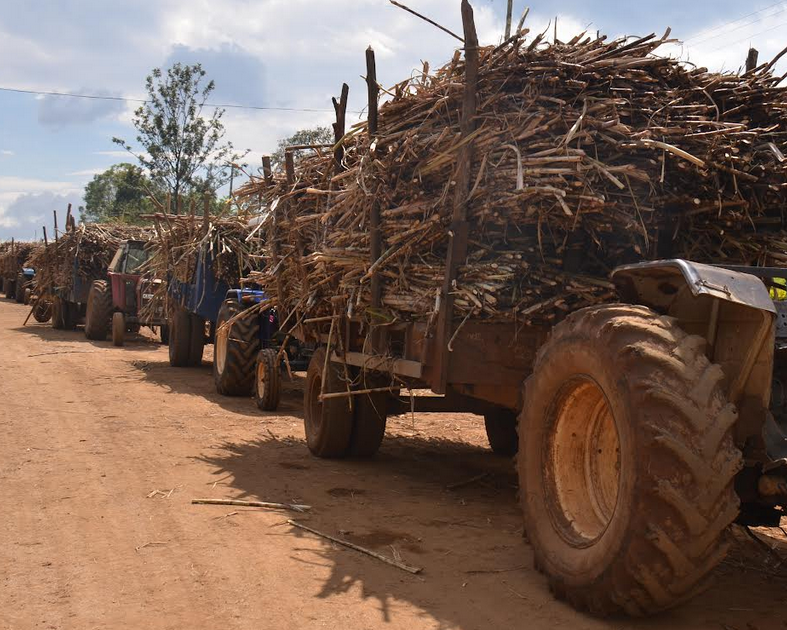
By 2008 Migori County, especially within Oyani Division in Uriri Sub-county, had seen a massive expansion of land under sugarcane, largely driven by the South Nyanza Sugar Company (Sony Sugar).
Research done in the area indicates that before commercial sugar expansion gained a swift upward motion, only 0.6 percent of household land in Oyani Division was used for sugarcane development and 27.1 percent was set aside for maize and other food crops like Millet, beans and sorghum.
The expansion period is significant to note because it marked the peak of land conversion to sugarcane development in Migori as a whole, with direct impacts on food crops, household relocation and long-term food security debates that continue today.
After commercialisation took hold around this period, sugarcane acreage jumped to 61.2 percent per household, while output increased from 1.8 percent to 97.8 percent tons.
The swift expansion trend also triggered a massive human relocation, affecting 81.3 percent of households in Onyani Division alone.
On the other hand, maize production immediately took a nosedive shift from 23.3 percent to 10.6 percent and beans from 16 percent to 8.5 percent, a trend that confirms the relocation had a general negative impact on food production within the region.
While the extensive sugarcane growth was intended to diversify Migori’s economy beyond fishing in Lake Victoria, the outcome, many years down the memory lane, however, has been very unfortunate to the County residents.
The allure of possible comfort from income generated through sugarcane production pushed farmers to dedicate more land to cane development, but a move that has now manifested as a negative investment in the life of the local population.
By the 1990s – 2000s, Sony Sugar Company, had started registering heavy losses annually, with farmers complaining of low prices and late payments. Despite the many years in cane farming, many of the 100,000 plus farmers in the region still live in poverty.
Many of the local people still live in ramshackle houses, no power to educate and take care of the health of their families, yet their vast family lands are covered by green carpets of sugarcane crop.
Mr. Collins Owino, a sugarcane farmer, regrets his move to abandoned growing maize on his entire ten-acre land and turned to sugarcane planting, an action he says, has made his home a perennial food deficit household.
“Before I embraced sugarcane growing, I was a serious producer of maize and beans in large scale. But now I do not produce even a single bag of maize because all my land is occupied with sugarcane, which is no longer bringing me dividends anymore,” remarked Owino in a recent interview.
He adds that his lifestyle has greatly changed from being rich as a maize grower a couple of years ago to a pauper as a sugarcane grower at the moment due to the peanut income he gets from Sony Sugar Company.
A similar tale is told by Mr. Richard Nyagudi, from Nyamilu village in Uriri Constituency who confirms his aborted dream of owning a high class car and a marvelous bungalow house from the proceeds of sugarcane sales.
“Today I literally buy maize, beans and other food Items from markets because I stopped producing myself after throwing myself whole in sugarcane growing” she said.
Mrs. Caroline Awino, another sugarcane producer from Kamagambo areas of Rongo Sub-County claims that the massive sugarcane growing in Migori has led to the many lifestyle diseases currently found with many of the local people.
The many maladies, like diabetes, low and high pressure, are as a result of the Western World junk foods people have massively embraced in recent years, following the current low indigenous food production witnessed in this region, she alleged.
“I still believe that the region’s low maize, beans, cassava, millet and sorghum production due to massive sugarcane planting has forced people to eat lots of scientifically produced food from the Western World, leading to the many lifestyle diseases affecting many people here,” she added.
Even with the sugar sector doing badly in transforming the lives of the people in Migori, many farmers are still hanging on the thin thread still lingering on the future survival of sugarcane production within the region.
Vast fertile lands still hold acres of lash of green sugarcane plants within the Awendo-based sugar-belt at the expense of the known popular food crops like maize and millet.
A serious advocacy by the local leadership to realise a total shift from cane growing to food crop planting has not been heeded in the recent years, leaving the region a perennial importer of various food items.
The local population still depends highly on food items brought from far-flung regions as far as Central, Rift and Eastern Kenya, yet Nyanza region and particularly, Migori boasts a fertile land and a favorable climate good for all kinds of food crops.
Agricultural experts from the region say that the region and, Migori in particular, is able to feed its people well from the locally produced food crops without importing any single food item from any part of Kenya.
“Migori can produce enough to feed its people and a surplus to export only if the vast fertile stretch of land can be put into good use, without leaving sugarcane to take a huge chunk of the entire land,” said Dr. Peter Rioba, an agriculture expert with a Non-governmental Organisation (NGO) operating in Nyanza region.
The fact that Migori County has put a lot of land under sugarcane and tobacco crops has made the region a food deficit area, with a lot of attention being given to cash crop investment.
“Food is all we need most to make us healthy and people who can engage in other productive works. Let us not engage in too much sugarcane growing at the expense of our food production,” he concluded.
By George Agimba