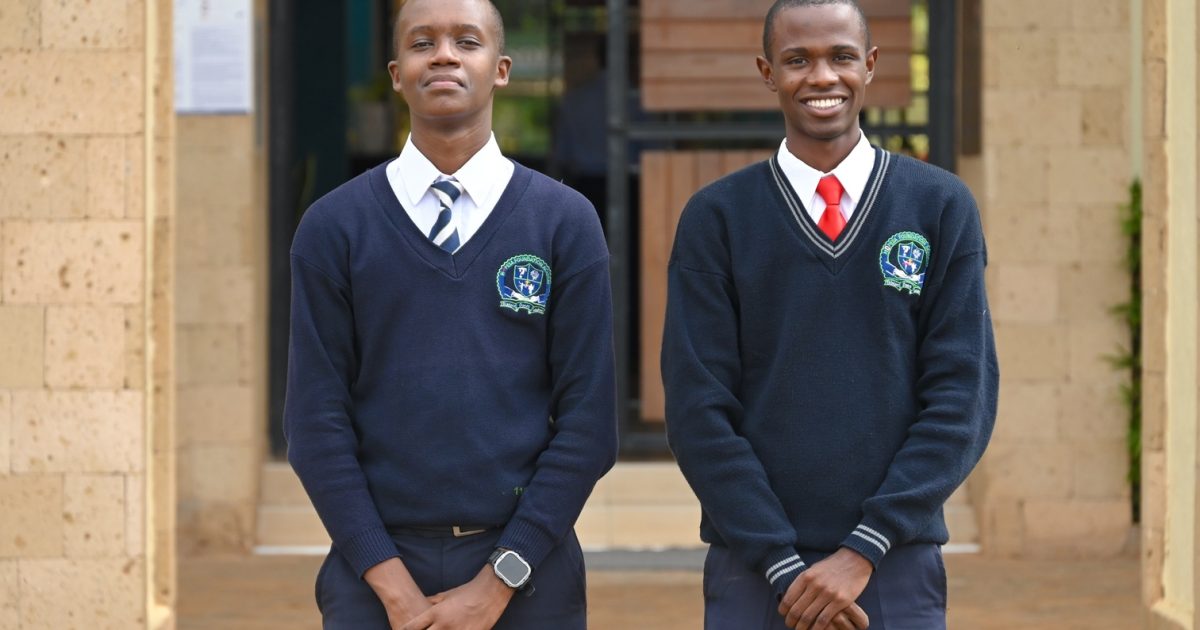
By turning farm waste into a green solution, two students from Kiambu County have won the Africa Region Earth Prize for their eco-friendly, budget-conscious exhaust filtration system that utilizes maize and coconut waste.
The M-PESA Foundation Academy students, Fredrick Njoroge Kariuki and Miron Onsarigo, developed the “HewaSafi” exhaust system after seeing loved ones suffer from pollution-related illnesses.
Now in its fifth year, the Earth Prize facilitated by the Switzerland-based Earth Foundation celebrates environmental innovation among students aged thirteen to nineteen.
“The problem of air pollution was very personal to us, which is why we began searching for a solution,’ noted Kariuki.
The project is deeply rooted in personal experience with Kariuki, who grew up in the industrial area of Nakuru, still relying on weekly medication for a chronic lung disease diagnosed when he was just ten years old.
Onsarigo also shares this passion, having grown up in Western Kenya, witnessing the severe illnesses and loss of life caused by polluted air.
With the World Health Organization (WHO) attributing 4.4 million annual global deaths to air pollution, vehicle emissions remain a critical health hazard.
The HewaSafi system tackles this by dividing exhaust into five compartments, each designed to strip away specific pollutants
The Filter is constructed from sustainable, locally available materials such as maize cobs, coconut shells, steel, and copper, complemented by recycled battery parts and a unique spirulina algae bioremediation layer that naturally breaks down and removes toxic pollutants from the environment.
To validate the system, the team partnered with a local matatu association to test their filters on five vehicles along Thika Road. The results were impressive, as the HewaSafi devices surpassed design goals, successfully stripping out ninety-three percent of microscopic airborne particulates, the fine hazardous matter that poses a major risk to lung and cardiovascular health. Beyond particulate reduction, the filters also achieved a forty-two percent drop in carbon monoxide and absorbed twenty-one percent of carbon dioxide.
“We recognize that greenhouse gases fuel climate change, and by successfully filtering carbon dioxide, we can curb the impact of these emissions on the atmosphere,” noted Kariuki.
Making clean air technology more accessible, the HewaSafi team designed a filter that costs sixteen thousand two hundred and eighty-eight shillings, a fraction of the fifty thousand shillings required for existing industry models.
According to Earth Prize judging panel Chair Agustín Ocaña Escobar, the project’s strength lies in its practicality, as the team did not just present an idea but instead presented a tangible technical pathway using materials that are locally accessible, including agricultural waste and algae.
“We chose to back this project because of its realistic approach and significant potential to improve lives, and we look forward to seeing how the team continues to evolve their work over the next year,” noted Escobar.
Selected from five African finalists, the HewaSafi team won the regional Earth Prize, securing $12,500 (Ksh 1.6 million) to scale their innovation. This financial boost, combined with the program’s dedicated mentorship, provides the team with the resources needed to overcome current development challenges and advance their clean-air solution.
The HewaSafi team has advanced as a contender for the global award, with the public voting period scheduled for May 18 to May 27, followed by the announcement of the international winner on May 29.
Scaling their dream, the students intend to produce one thousand two hundred units with the help of local artisans.
They are also in talks with the Matatu Owners Association to integrate the filters into two hundred of the eight thousand buses in their network.
Their long-term vision is to bring the HewaSafi solution to the rest of the continent using a scalable franchising model.
By Hellen Lunalo