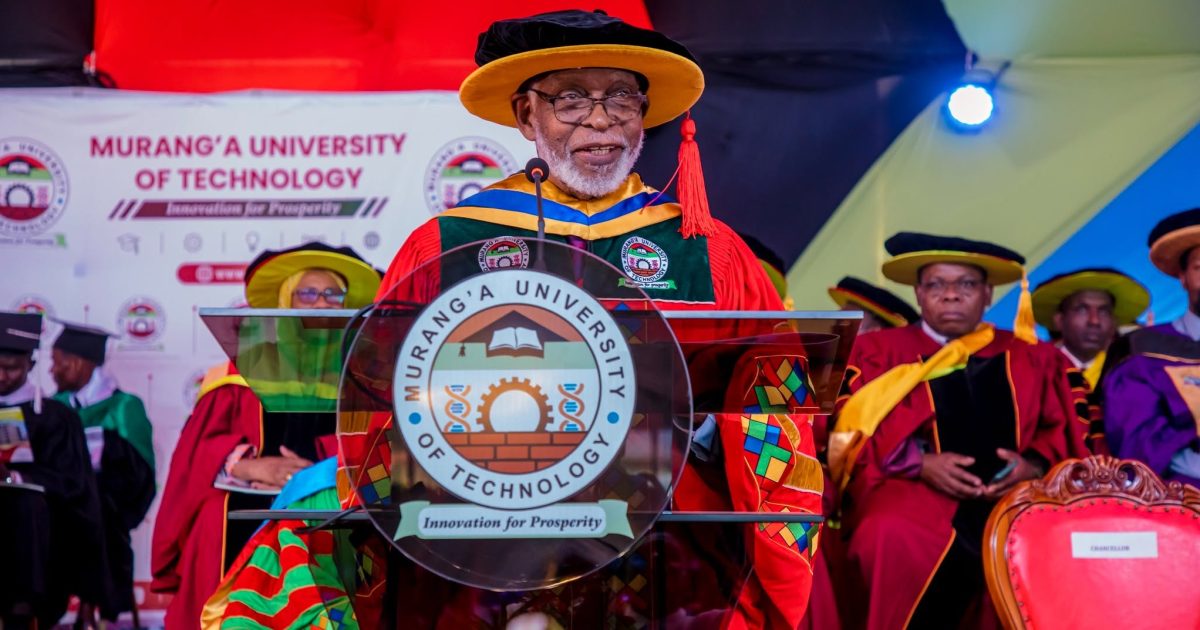
Murang’a University of Technology (MUT) Chancellor, Prof. Justin Irina, has appealed to the government and development partners to increase investment in digital infrastructure in universities to enable students and institutions of higher learning to remain competitive in an increasingly technology-driven world.
Speaking during the university’s 10th graduation ceremony on Friday, Prof. Irina said Kenya’s higher education sector is undergoing rapid transformation, with information and communication technology increasingly reshaping teaching, learning, research, and engagement with society.
He said universities must embrace digital transformation as a central component of their development, noting that the future of higher education will largely depend on the availability of reliable digital infrastructure and the ability of both staff and students to effectively use emerging technologies.
“The future of higher education will increasingly depend on strong digital infrastructure, reliable internet connectivity, and the capacity of staff and students to use emerging technologies effectively and responsibly,” Prof. Irina said.
He appealed to the government and development partners to support universities in expanding internet connectivity and strengthening technological infrastructure to facilitate teaching, learning, and research.
The Chancellor said the growing adoption of technologies such as artificial intelligence, digital learning platforms, and advanced data systems has made investment in ICT infrastructure no longer optional for universities seeking to remain relevant in the modern knowledge economy.
Irina further underscored the importance of research and innovation in addressing the country’s development challenges, saying universities have a critical responsibility to generate knowledge and practical solutions to emerging social and economic problems.
He commended Murang’a University of Technology for strengthening its laboratories and supporting faculty-led research across various disciplines.
“At a time when societies are facing complex challenges, including climate change, public health concerns, and food insecurity, universities must generate evidence-based knowledge and practical solutions that improve lives,” he added.
The Chancellor noted that universities should increasingly position themselves as centers of innovation by linking research with industry, government, and communities to ensure that academic knowledge translates into solutions that address real-life challenges.
MUT Vice Chancellor Prof. Dickson Nyariki said the institution has made significant progress in strengthening its digital capacity as part of efforts to improve service delivery and enhance the learning environment.
Nyariki observed that the university has expanded campus-wide internet connectivity through the deployment of a high-speed fiber-optic backbone, providing a stronger foundation for digital learning, research, and administrative operations.
“No modern university can hope to remain relevant and competitive without deliberate and sustained investment in information and communication technology,” he remarked.
The vice chancellor added that the university has upgraded its Enterprise Resource Planning systems into web-based platforms comprising 25 integrated modules, allowing for the digitization of key administrative functions.
He said the reforms have helped reduce bureaucratic bottlenecks, improve turnaround time, and enhance transparency and accountability in the management of student records and other institutional processes.
“The university is also progressively equipping lecture theatres and laboratories with modern audio-visual and computing equipment to support multimedia-based learning and practical instruction,” he noted.
Nyariki said the investment is particularly important for science, engineering, and technology programmes, where access to modern equipment and digital tools is critical in preparing graduates for the demands of the labour market.
“As we look to the future, this university remains committed to continuous investment in ICT infrastructure, recognising that the digital transformation of higher education is not a one-off project but an ongoing journey. ”.
He added that universities must continuously adapt to rapidly evolving technologies, including artificial intelligence and other frontier innovations that are already reshaping the global higher education landscape.
Nyariki maintained that sustained collaboration between the government, universities, the private sector, and development partners will be critical in closing the digital gap in higher education and ensuring Kenyan graduates acquire the skills needed to compete in an increasingly digital global economy.
By Bernard Munyao