A multi-agency crackdown on illicit brews, counterfeit alcohol and drugs has been launched in West Pokot County as the Government moves to address the growing social and health consequences associated with alcohol and substance abuse.
The exercise, being implemented under the Ministry of Interior and National Administration, is part of a nationwide 100-day Rapid Results Initiative (RRI) ordered by President William Ruto to intensify the fight against drugs, illicit and counterfeit alcohol.
The initiative is targeting all 47 counties and brings together the National Government Administration Officers (NGAO), National Police Service, National Authority for the Campaign Against Alcohol and Drug Abuse (NACADA), Kenya Bureau of Standards (KEBS), Anti-Counterfeit Authority (ACA), Kenya Revenue Authority (KRA), County Enforcement Officers and Public Health Officers.
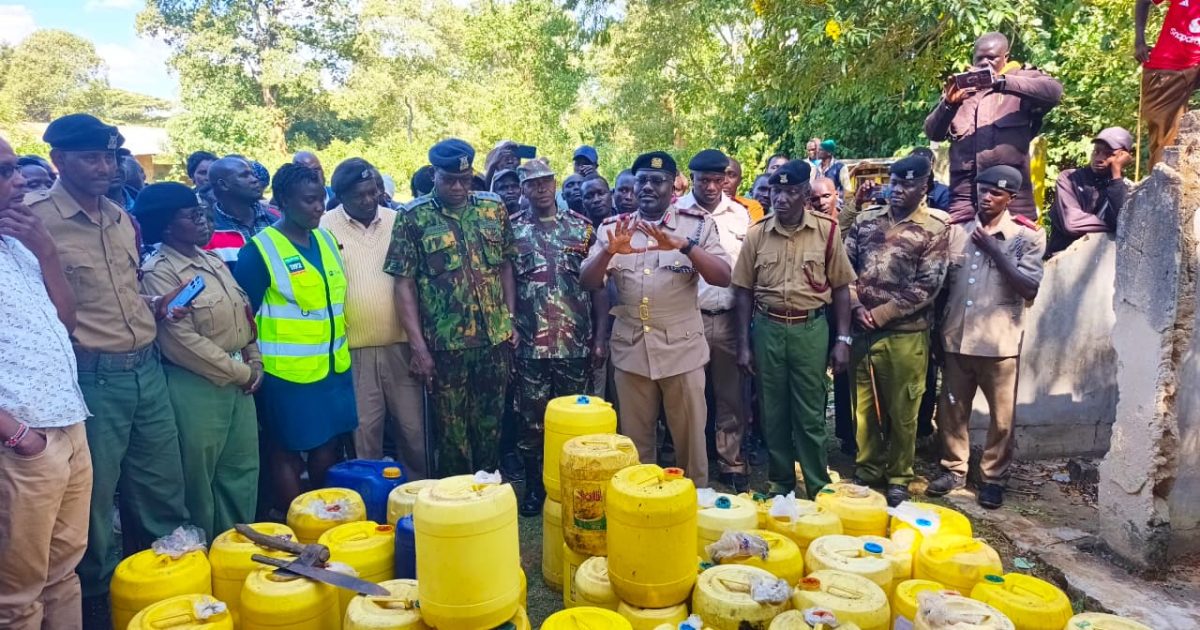
In West Pokot, West Pokot Sub-County Deputy County Commissioner Samuel Kiarie led a multi-agency team in launching the exercise during a public baraza at Kishaunet Centre in Kapenguria.
The launch was marked by the destruction of 1,800 litres of chang’aa and 500 rolls of bhang that had been confiscated during recent operations.
Kiarie said the destruction of the seized products in the presence of members of the public was deliberate, following concerns that some confiscated illicit alcohol had previously found its way back into the community.
“This is just the beginning. We are going to make rounds and implement this crackdown throughout the 100 days,” Kiarie said.
He said the Government was determined to ensure that the directive was implemented at the grassroots, with chiefs and other NGAO officers instructed to sustain operations within their respective administrative areas.
The crackdown comes at a time when residents and local administrators have raised concerns over the effects of alcohol and drug abuse, particularly among young people.
Kiarie said the exercise would not be limited to the destruction of illicit brews manufactured within villages but would also target businesses and premises selling unregulated or illegal alcoholic products.
He explained that the operation would be implemented in two phases, beginning with illicit brews manufactured in communities before extending to establishments selling second-generation alcohol, operating outside permitted hours and violating other regulatory requirements.
“Those selling second-generation alcohol in premises and those who do not observe the operational hours, including those operating beyond the permitted hours, will all be dealt with according to the law,” he said.
The DCC also called on village elders, chiefs and other National Government Administration Officers to remain vigilant and support the initiative, assuring them that the Government would provide the necessary support to carry out the operations.
A major part of the strategy is community involvement, with residents being urged to provide intelligence on manufacturers, suppliers, transporters and sellers of illicit alcohol and drugs.
Kiarie said information provided by members of the public would be handled confidentially.
“The community is very important in this fight because they are the ones with the information. Any intelligence information received will be treated with the utmost confidentiality,” he said.
The administrator acknowledged that products originating from neighbouring counties and neighbouring Uganda posed a significant challenge, noting that illicit alcohol and drugs could easily be moved across administrative boundaries.
He said he would engage administrators from neighbouring jurisdictions to ensure that the county does not become a market for products manufactured elsewhere.
The use of motorcycles to transport illicit products was also identified as an emerging concern. Kiarie said authorities would increase surveillance and investigate routes used to transport the products into the county.
Concerns about the integrity of enforcement officers also emerged during the public engagement, with residents alleging that some officers visit alcohol dens and collect money instead of enforcing the law.
Kiarie said such allegations would be taken seriously and warned officers against compromising the Government’s efforts.
“Any officer found coming in the way and compromising this fight will face administrative action. We will not allow individuals to undermine the exercise,” he said.
He added that the Government would investigate reports of officers receiving money from operators of illegal alcohol dens.
For residents, the crackdown offers hope of addressing some of the social problems they associate with alcohol and drug abuse.
Daniel Rotich, a resident of Kachepkai Village in Mnagei Ward, thanked the multi-agency team for launching the operation and said alcoholism had increasingly affected families and young people.
He said some youth had turned to crime in search of quick money to sustain their drinking and drug habits.
“Alcohol has brought many harmful effects to our residents, especially the youth. Some have turned to crime because they want quick money to drink alcohol and buy drugs,” Rotich said.
He said eliminating alcohol dens would therefore go beyond addressing alcoholism and could help tackle other social problems affecting communities.
The residents pledged to work with security agencies through community policing and promised to report illicit activities.
NACADA West Pokot County Coordinator Scola Komen said the problem of alcohol and drug abuse was not unique to West Pokot but a national challenge requiring concerted action.
She said NACADA had been operating in the county for the past two years and had continued working with Government agencies, communities and other stakeholders to address the menace.
“This is a countrywide challenge, and West Pokot is also affected. We are ready to work as a team during these 100 days, but we need the community to come on board,” Komen said.
She noted that the county has cases of bhang use and various forms of illicit brews, adding that the RRI would combine enforcement with public education on the harmful effects of alcohol and drugs.
Komen urged members of the public with information about manufacturers, suppliers or sellers of illicit alcohol and drugs to report through the NACADA toll-free number 1192.
The involvement of NGAO officers is expected to strengthen the initiative because chiefs, assistant chiefs and village elders are often the first Government representatives to interact with communities.
Through public barazas and sensitisation forums, the officers are expected to help residents understand the dangers associated with alcohol and drug abuse while encouraging them to participate in community policing.
The Kishaunet sensitisation exercise also provided an opportunity for NGAO officers to engage residents on Government programmes and service delivery at the grassroots.
For the residents, however, the message was clear that the success of the 100-day initiative will depend not only on arrests and destruction of illicit products but also on sustained community participation and accountability.
As the multi-agency team begins its operations across West Pokot, authorities say the crackdown will continue beyond individual raids, with surveillance, enforcement, public sensitisation and cross-border collaboration forming part of the broader strategy.
The Government’s expectation is that the 100-day initiative will deliver measurable results while laying the foundation for sustained action against alcoholism and drug abuse.
For communities already feeling the effects of the menace, the hope is that the destruction of the 1,800 litres of chang’aa and 500 rolls of bhang will be more than a symbolic gesture but it will mark the beginning of a sustained effort to reclaim families, protect young people and restore safer communities.
By Parklea Ivor