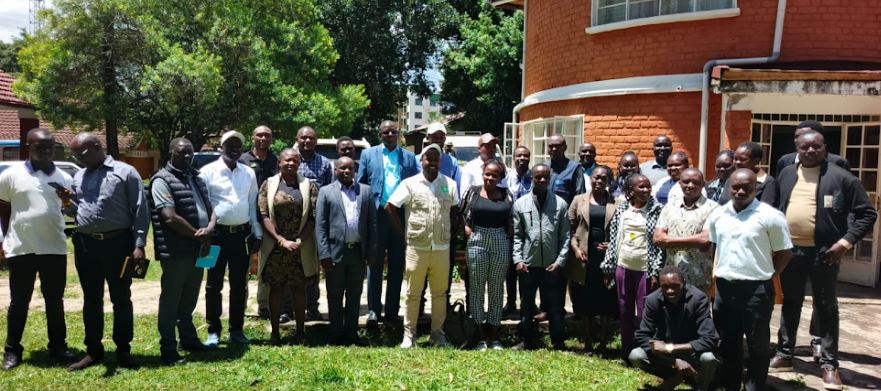
West Pokot County has renewed its commitment to tackling recurrent drought and improving community resilience after key government officials and development partners convened for a County Steering Group (CSG) meeting in Kapenguria.
The forum, chaired by County Commissioner David Saruni, focuses on strengthening coordination, mobilising partnerships and rolling out long-term strategies to cushion residents from the effects of climate shocks.
The meeting, organised by the National Drought Management Authority in collaboration with the county’s Department of Economic Planning, brought together key stakeholders to deliberate on drought mitigation and coordination strategies.
Speaking during the forum, Saruni said the meeting focused on sensitising members on the Ending Drought Emergencies (EDE) Two Common Programme Framework, a national initiative aimed at ensuring drought does not escalate into humanitarian crises.
He noted that the CSG plays a critical role as a coordination secretariat under NDMA, particularly in arid and semi-arid regions.
“The framework has been operationalised at the county level to strengthen coordination, enhance resilience and ensure drought does not translate into emergencies,” said Saruni.
The Commissioner said stakeholders reviewed key sectors affected by drought, including health, nutrition, agriculture, water resources and peace-building and a technical committee is expected to develop integrated plans to address the challenges.
Saruni emphasized the need for stronger collaboration between the county government, national government and development partners.
He called on donors to review county drought reports to identify gaps and fund priority interventions.
“West Pokot has many areas that require support, but publicity has been low. We urge partners to engage with our reports so they can identify areas for intervention,” he said.
On security, Saruni reported progress in the ongoing disarmament exercise, revealing that more than 300 illegal forearms have been recovered.
He credited local communities for supporting the initiative, noting that many residents are eager to end insecurity linked to illicit weapons.
“We will continue to remove illegal firearms from wrong hands to ensure peace and safety for our people and neighbouring counties,” he added.
He also urged residents to register for national identity cards and voter registration through the independent Electoral and Boundaries Commission ahead of next year’s general election.
Meanwhile, development partners used the forum to introduce new resilience programmes. Charles Eris of the Somali Lifeline Organization (SOLO) unveiled a European Union-Funded Project, supported by the Food and Agriculture Organization (FAO), targeting pastoral communities in Kacheliba Sub-County.
The initiative will focus on watershed protection, pasture development and improving access to water and fodder to boost livestock productivity and livelihoods. It will also incorporate peace-building efforts through cross-border dialogue and resource-sharing agreements.
The project forms parts of a wider regional programme covering the Karamoja Cluster across Kenya and neighbouring Uganda, aimed at enhancing climate resilience among pastoral communities.
County agriculture official Edwin Ritamoi also called on residents to embrace environmental conservation measures, stressing their importance in managing climate risks and sustainable livelihoods.
The meeting concluded with a renewed commitment from stakeholders to work jointly in tackling drought and improving resilience across West Pokot.
By Anthony Melly