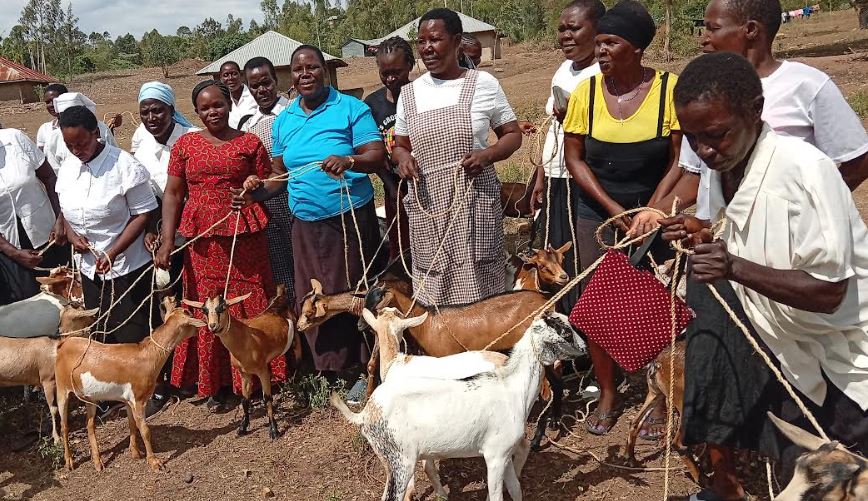
More than 30 widows in Nyalkinyi village within Homa Bay town sub-county have received goats through a livelihood support initiative by Plan International Kenya, aimed at improving household incomes and strengthening the economic resilience of widows in the community.
The non-governmental organisation, in collaboration with the Development Knowledge Link Africa (DEVLINK), donated about 40 goats to Nyalkinyi Widows Group members, with each woman going home with a goat to rear.
The donation is expected to provide both immediate assistance and a long-term source of income for the widows as they rear and multiply the animals within their households.
Everline Okoth, a community volunteer with Plan International said the Widows’ Group is an active community organisation whose members face significant challenges in making ends meet.
“These women struggle to make ends meet, and that is why I forwarded their names to Plan International for this support,” Okoth said.
She said the 40 goats would provide the women with an opportunity to establish a sustainable source of income.
Benard Orach, a representative from Plan International, said the donation was a recognition of the group’s efforts and unity.
“We are blessed to join the Nyalkinyi Widows Group, who have benefited through the two organisations. They have donated 40 goats to them,” Orach said.
He noted that the group had formally presented its request for the livestock as seed capital and was now beginning a new chapter in its economic empowerment journey.
Orach noted that the group includes families with children supported through Plan’s sponsorship programmes.
The coordinator said the initiative would benefit caregivers and families in the community, adding that the beneficiaries were expected to rear the goats and gradually expand their herds through breeding.
“We are looking forward to seeing the progress of this donation and how they will develop in the future,” he said.
Members of the group welcomed the donation, saying the goats would provide an important financial safety net, particularly when families face emergencies such as school fees.
Selfin Gwayo, a member of the group, thanked Plan International for the donation, saying it demonstrated commitment to improving the lives of vulnerable families.
“On behalf of our community, we would like to sincerely thank Plan International for the generous donation of 40 goats to our community. We are truly grateful for your kindness, support and commitment to improving the lives of families in our community,” Gwayo said.
Christine Omukuba, another member, said the support demonstrated the organisations’ commitment to support the financially vulnerable members of the community.
She said the beneficiaries were particularly happy because every widow would leave the event with a goat.
Omukuba reiterated that the goats would serve as an investment that would help families meet school-related expenses when other sources of income were unavailable.
“Sometimes our children are sent home for fees, and we cannot go asking people for money. These goats are a very important investment to us widows,” she said.
She added that once the goats reproduce, members could sell some of the animals to raise money for fees and other essential family needs.
The beneficiaries also appealed for continued support from Plan International, DEVLINK and other development partners, saying further livelihood initiatives could help vulnerable households become more financially independent.
By Sitna Omar