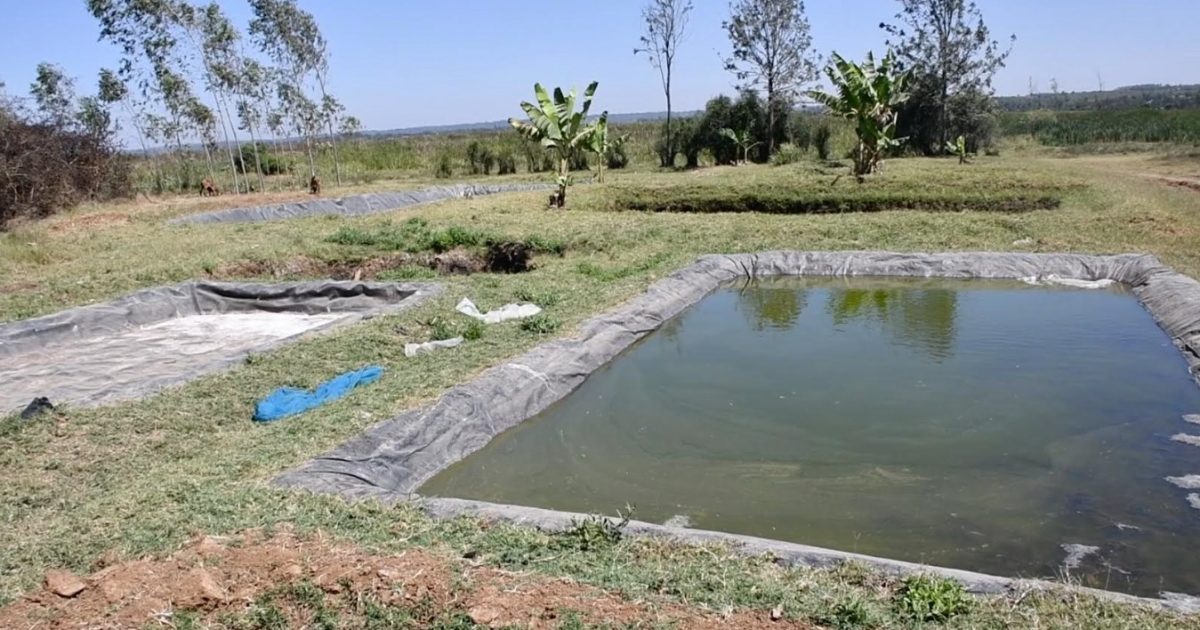
In Kanyibok Village, West Yimbo ward, Bondo Sub-county in Siaya, near the shores of Lake Victoria, abandoned flood-damaged farms are slowly being transformed into fish ponds.
What was once a stretch of waterlogged land where maize repeatedly failed now glistens under the afternoon sun with dozens of rectangular ponds lined carefully beside each other while new ones are being created.
Curious children often stand at the edges of these ponds, watching the frenzy as fingerlings dart through the water while a farmer moves around, carrying feed in a plastic bucket, scattering feed into the ponds.
Among them is 48-year-old Pamela Oduor, who never imagined she would one day become a fish farmer from farming maize and millet and an occasional fishmonger.
“For years we depended entirely on maize farming,” she says while scattering feed into one of the ponds. “But every rainy season the floods destroy everything.”
The persistent flooding affecting parts of Bondo and Rarieda sub-counties has increasingly forced families living near the lake basin to search for alternative sources of income.
Some residents migrated to urban areas, while others still carry out fishing by boats in the lake. But with declining fish stock in Lake Victoria and rising operational costs, many households remained economically vulnerable.
It is this situation that encouraged several local groups to experiment with small-scale aquaculture as an alternative livelihood. At first, only a handful of residents showed interest.
Many feared the ponds would simply overflow during heavy rains, while others believed fish farming required large amounts of money beyond the reach of ordinary families.
“We thought it was something done by big investors,” says Oduor. “Most people here had never even seen a fish pond up close.”
With support from agricultural officers and community-based organisations, interested farmers were taken through basic training on pond construction, water management and fish feeding practices. Today, the once idle land has gradually transformed into a busy network of ponds producing tilapia and catfish for nearby markets and hotels even in the far parts of Siaya that rely on fish supply.
At Pamela’s homestead she points to a pond that is ready for harvest, as the fish have grown to the required weight of 350 to 500 grams; this has taken about five to six months and she says one single standard fish pond measuring 100–300 square metres can fetch her upwards of Ksh 70,000 in gross revenue per harvest.
“You can typically harvest tilapia once or twice a year if you manage them well,” she says.
Pamela discloses that she usually stocks mono-sex males in most of her ponds; this, she further explains, is because males grow roughly 30% faster than females and reach market weight much quicker, which makes for shorter harvesting periods and more steady supply to her customers.
The catch attracts immediate buyers from nearby shopping centres, hotels and roadside traders who prefer pond fish because of its reliable supply and predictable edible weight.
Twenty-six-year-old Collins Onyango, who has been mentored by Pamela in aquaculture and is now a fish pond owner, says fish farming has given many young people a reason to remain in the village instead of migrating to towns in search of casual jobs.
“Some youths had already lost hope in farming because crops kept failing,” he says. “But now people are starting to see farming differently.”
Apart from income generation, residents like Pamela say the ponds have also helped improve food security within households.
Families that previously struggled to harvest enough maize now supplement their meals with fish, while some have started small vegetable gardens around the ponds using recycled water for irrigation.
Rows of sukuma wiki, onions and tomatoes now flourish beside the ponds, creating pockets of green across areas that once appeared abandoned after floods.
Extension officers in the region say integrated farming methods are becoming increasingly important as climate change continues affecting traditional farming patterns around the lake basin.
They note that unpredictable rainfall and prolonged flooding are likely to remain a challenge for communities living in low-lying areas.
In Mutundu village nearby, women groups have also begun exploring fish processing and preservation as a way of reducing post-harvest losses while awaiting markets for their fish.
Some smoke fish using improved energy-saving kilns, while others package fresh fish for sale in local markets and eateries.
For Pamela Oduor, the changes have slowly restored confidence among many families who previously viewed the floods only as a source of destruction.
“When the floods came, people only waited for relief food,” she says. “Now some families are trying to create opportunities from the same water that used to destroy crops.”
The venture, however, has not been without its share of challenges; rising cost of commercial fish feeds and pond liners continues to affect profit margins while some farmers struggle with access to quality fingerlings.
Transporting harvested fish to larger markets also remains difficult during rainy seasons when roads become muddy and impassable.
On weekends, visitors from nearby towns occasionally stop to observe the ponds while school children, by the intervention of their teachers, who are some aquaculture farmers themselves, organize small groups or classes to the ponds to learn how fish are raised.
As evening approaches, the water reflects the orange rays from the setting sun while frogs croak loudly from nearby reeds, ushering in the looming darkness that will soon blanket the villages of West Yimbo.
Women walk home carrying vegetables harvested near the ponds as fishermen prepare boats along distant sections of the lake shore.
For the residents in Kanyibok, the ponds represent more than a new farming activity; they have now become their lifeline and a sign of resilience and hope where once was destruction and despair.
They are becoming symbols of adaptation in a region where changing weather patterns have forced communities to rethink how they survive.
Standing quietly beside one of her ponds, Oduor watches ripples spread slowly across the water before turning back toward her homestead.
“The floods are still there,” she says softly. “But now we are learning how to live with them instead of fearing them every season.”
By Calvin Otieno