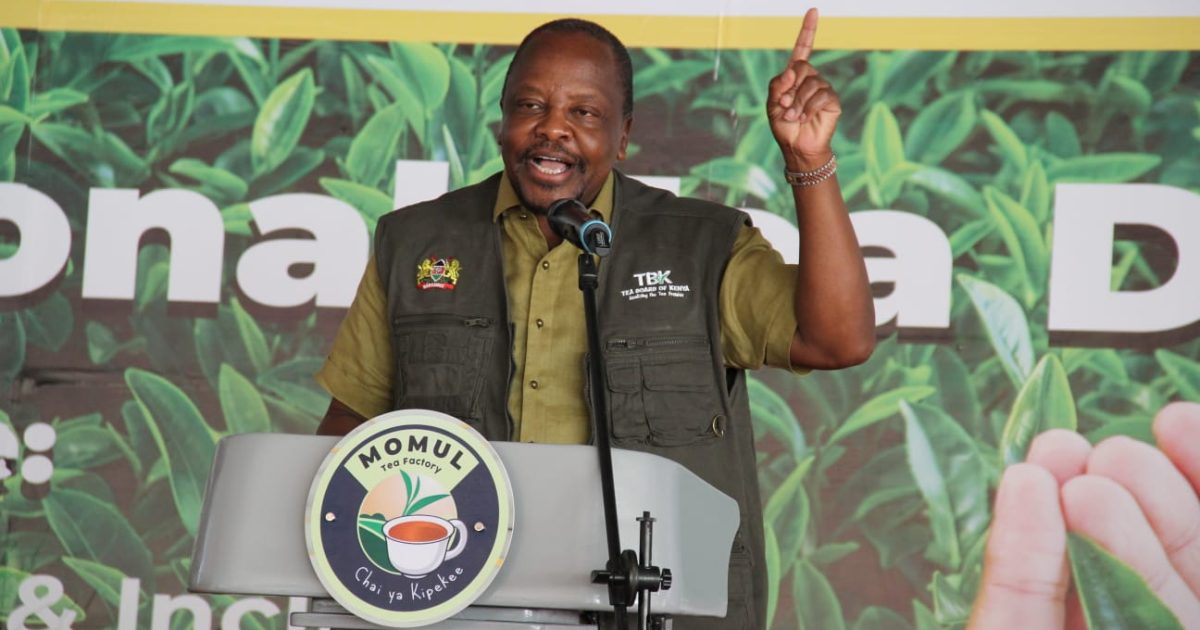
The government has stepped up reforms in the tea sector aimed at increasing farmers’ earnings through value addition, expansion of export markets, and aggressive global branding of Kenyan tea, Agriculture and Livestock Development Cabinet Secretary Mutahi Kagwe has said.
Speaking during the national celebrations to mark International Tea Day, whose theme was fostering growth and inclusion at Momul Tea Factory in Kericho County, Kagwe said the reforms were intended to transform the tea industry into a modern, sustainable, and globally competitive sector capable of creating more wealth for farmers and employment opportunities for young people.
The Cabinet Secretary said tea remained one of Kenya’s most strategic agricultural commodities, supporting millions of livelihoods directly and indirectly through farming, processing, transportation, marketing, and other related services while also remaining among the country’s leading foreign exchange earners.
“Kenya’s position as the world’s leading exporter of black CTC tea is a testament to the resilience, commitment, and hard work of our farmers and industrial players. Our tea continues to enjoy international recognition for its quality, flavor, and consistency, reinforcing Kenya’s reputation as a global leader in tea production,” said Kagwe.
He, however, noted that despite the sector’s strong performance, the industry continued to face major challenges, including declining prices in some markets, rising production costs, climate change, global market volatility, sustainability requirements, and overreliance on a limited number of export destinations.
Kagwe acknowledged traditional tea importers, including Pakistan, Egypt, Sudan, India, and Sri Lanka, for sustaining demand for Kenyan tea over the years, saying the government remained committed to strengthening partnerships with global consumers and buyers.
The CS said the government under President William Ruto was implementing reforms focused on enhancing tea farmers’ incomes by promoting value addition and diversifying export markets, particularly in Asia.
He revealed that Kenya had secured duty-free access for tea exports to China following bilateral engagements spearheaded by President Ruto, describing the Chinese market as a major breakthrough for the tea industry.
Kagwe said the government was encouraging investors to establish more tea packaging and processing facilities locally to ensure the country exports finished products instead of raw tea.
“Every time we export tea in sacks, we are exporting jobs to other countries. We need those jobs here in Kenya for our young people,” he said.
The Cabinet Secretary called for stronger policy measures to compel local value addition, saying increased processing and branding of tea locally would stimulate industrial growth and create employment opportunities for thousands of youths.
He further said the government was promoting climate-smart agriculture, environmental conservation, renewable energy use, water management, and sustainable land-use practices in tea-growing regions to safeguard the future of tea farming.
Kagwe commended tree-planting activities conducted during the celebrations, noting that they supported the government’s target of planting 15 billion trees by 2032 to combat climate change and restore ecosystems.
The CS also emphasized the need to involve more young people in agriculture, saying innovation, digital platforms, and agribusiness opportunities were key to making the tea sector attractive to the younger generation.
He praised universities and youth groups that participated in the celebrations through innovation forums and exhibitions aimed at repositioning tea farming as a profitable and modern economic activity.
On the proposed Tea Levy set for implementation in 2026, Kagwe defended the initiative, saying it was intended to provide sustainable funding for tea promotion, branding, research, quality assurance and market expansion.
He assured tea farmers and stakeholders that the levy would not impose unnecessary burdens on producers, explaining that the funds collected would be reinvested into strengthening the competitiveness of the tea sector.
Kagwe urged factory directors and other stakeholders opposed to the levy to seek dialogue with the government instead of engaging in prolonged court battles, noting that similar levies existed in other tea-exporting countries, especially in Asia, at even higher rates.
The CS stressed the need to protect Kenya’s geographical identity in international markets to prevent local tea from being rebranded abroad and losing its unique identity.
“We want consumers across the world to specifically identify and demand Kenya tea. That is why we must invest heavily in branding and promotion globally,” he said.
Kagwe further challenged tea factories and industry players to strengthen ethical sourcing, environmental stewardship, decent work standards, and human rights compliance to maintain global confidence in Kenyan tea.
He reiterated that current tea sector reforms were designed to ensure farmers received a larger share of tea revenues, noting that existing regulations require up to 79 percent of tea sales earnings to go directly to farmers.
The Cabinet Secretary also commended Momul Tea Factory for its leadership in modernization, innovation, and value addition, urging other tea factories across the country to emulate its operational model.
Kagwe said the government would continue engaging stakeholders as reforms take shape to ensure the tea industry remains sustainable, profitable, and globally competitive while delivering greater benefits to farmers and future generations.
The CS donated over 100,000 tea seedlings and another 100,000 avocado seedlings to farmers in Kericho.
Present at the function were the Kericho Senator Aaron Cheruiyot, Agriculture PS Paul Rono, Ambassador Florence Bore, KTDA National Chairman Enos Njeru, Kenya Tea Board CEO Willy Mutai, among others.
By Dominic Cheres and Darline Chepkorir