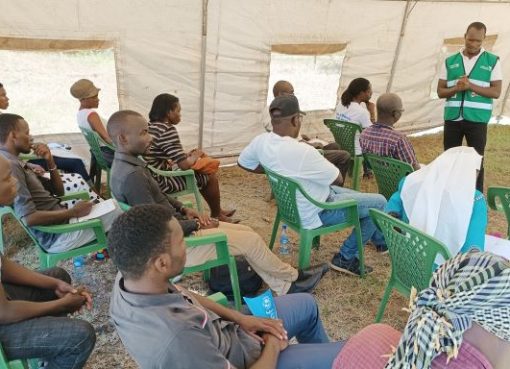
Embracing the Alternative Justice System (AJS) will reduce the backlog of cases in Kenyan courts and unlock billions of shillings held by financial institutions, due to protracted litigation tussles between various parties.
Presiding Judge of the Nakuru High Court, Dr Joseph Kiplagat Sergon, said the alternative Justice Systems (AJS), had become an integral part of solving cases in Kenya, adding that data from the Nakuru High Court and other local AJS pilot centers had established a remarkable 80 percent to 90 percent success rate for referred cases, each culminating in a legally binding, signed mediation agreement.
The Judge said with prison congestion, family wrangles, and business disputes escalating, Kenyans should resort to AJS whose positives he noted are that disputes that had been dragging in court for decades are always resolved in one or two sittings.
Speaking when he led the Nakuru County AJS team in a meeting with Deputy Governor, Dr David Kones, Justice Sergon stated that some legal disputes before judges revolving around assets and finances, do not help families, but only escalate wrangles in the family.
While indicating that the 4th National Alternative Justice Systems (AJS) Conference, will be held in Embu County from June 16 to June 19 Dr Sergon pointed-out that Nakuru become the first County to host an autonomous Alternative Justice Systems (AJS) Centre in Africa, after Chief Justice Martha Koome officially launched the facility in June, 2024.
“The center referred to as the ‘House of Reconciliation,’ provides residents with an accessible, affordable, and community-driven approach to resolving disputes outside formal courtrooms,” he pointed out.
He elaborated that the 4th National Alternative Justice Systems (AJS) Conference will bring together justice actors, practitioners, judicial officers, academics, policymakers, civil society actors, development partners, and all stakeholders in the access to justice ecosystem.
The conference will also be a platform to rally all sectors of Kenyan social, religious, judiciary, and cultural life to continuously and emphatically support the AJS mechanism and expand the pool of individuals and groups accessing justice in Kenya.
The AJS is a system that allows litigants in criminal and civil cases to resolve disputes outside the jurisdiction of the courts through healthy negotiations. The system is not only supposed to resolve cases but mend broken relationships, as parties in the cases are given chances to express themselves without restrictions.
Justice Sergon said, unlike the court system, the AJS ensures all parties win and get what they want.
The AJS is an umbrella which comprises arbitration, mediation, consent agreements and blood money compensation, to resolve disputes.
The Deputy Governor Dr Kones noted that the AJS has eased the burden of dispute resolutions, adding that it gives chances to people who had claimed but were scared to go to court and resolve the issues.
Dr Kones noted that only 21 per cent of Kenyans have access to the formal justice system, and the AJS was beneficial to the remaining 79 per cent.
The Deputy Governor was disheartened at how succession cases and family disputes had dragged on in courts for decades while kin suffered. ” I hope those cases are resolved through AJS and are removed from courts immediately,” he said.
The AJS module he pointed-out has a panel of at least three arbitrators who sit with opposing parties.
“The panelists include elders, Head of prisons facilities , lawyers, religious leaders, and court officials among others. As of now, the panelists sit in the court’s jurisdiction,” noted the Deputy Governor.
Those in the panel get the root cause of disputes by hearing opposing parties vent, disagree, and offer solutions themselves. The panel gives advice and recommendations only.
Unlike the court procedure that is strict, technical, complicated and rigid, the Deputy Governor said AJS has a vast way of resolving disputes. The AJS, he noted, ensures all parties win and reconcile after resolving disputes. The process is usually supposed to take six months.
The Deputy Governor underscored the important role played by AJS saying it brings reconciliation, restoration and transformation into the society.
He said those fighting succession battles in court cannot develop their land and buildings worth billions of shillings.
“Anyone who has a grievance must have a recourse. We want to encourage people to use the AJS mechanism to resolve cases,” he said.
by Esther Mwangi