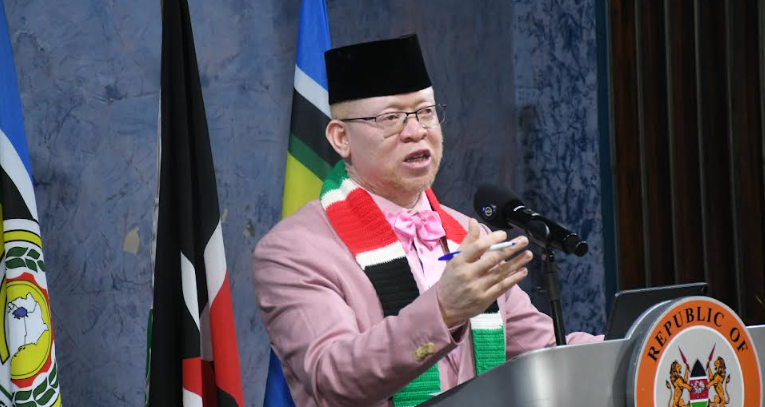
Government Spokesperson Isaac Mwaura has dismissed widespread claims surrounding the Finance Bill 2026, saying several reports circulating on social media are misleading and do not reflect the actual proposals before Parliament.
Speaking during a press briefing in Nairobi on Monday, Mwaura urged Kenyans to rely on the official version of the Bill published by the National Assembly and to participate in ongoing public consultations.
“There is no motor vehicle circulation tax, no tax on bread, and no tax on mitumba as has been alleged. Kenyans should focus on the official bill and submit their views through the public participation process,” he said.
Mwaura noted that the government seeks to strike a balance between raising revenue for development and reducing the country’s dependence on debt.
He highlighted several proposals in the Finance Bill aimed at improving tax administration and encouraging investment.
Among the proposed measures are tax exemptions on gratuity payments for employees on contracts of at least three years, removal of double taxation on trusts, and reforms to regulate the scrap metal sector through a five per cent withholding tax on buyers.
The government is also proposing simplified tax filing timelines, tax exemptions on pension benefits paid to beneficiaries of deceased pensioners, and incentives to attract foreign investors.
Mwaura said the bill seeks to enhance the duty-free allowance for arriving passengers from USD 300 to USD 2,000 and remove VAT on dialysis equipment to ease the cost of healthcare.
He added that excise duty on bottled water would be removed to make clean drinking water more affordable.
On education, Mwaura expressed concern over recent cases of unrest in schools, including the tragic fire at Tumishi Girls Academy that claimed the lives of 16 students and one parent.
He called for a national conversation involving parents, teachers, religious leaders, and policymakers to address the underlying causes of indiscipline among learners.
“We must ask ourselves whether we are parenting properly. There is a challenge that requires an honest conversation on discipline, morality, role modeling, and the responsibilities of parents and society,” he said.
The Spokesperson observed that incidents of school unrest, mob violence, and other forms of lawlessness point to a broader erosion of societal values.
“We seem to be losing our sense of humanity. Blaming each other will not solve the problem. We need to confront the issues affecting our young people and find lasting solutions,” he added.
Mwaura said the government remains committed to supporting families affected by the Utumishi Girls Academy tragedy.
He confirmed that each bereaved family would receive Sh200,000 as facilitation towards funeral expenses, while all medical bills for injured students would be settled by the government.
He said 72 injured students had already been discharged from the hospital, while the remaining patients had also recovered and returned home.
The government has further committed to covering mortuary fees, transportation costs, and other funeral-related expenses.
On public health, Mwaura assured Kenyans that the country remains free of Ebola despite heightened regional concerns following outbreaks in neighbouring countries.
“The government has intensified surveillance and preparedness measures. More than 77,000 travellers have been screened at 26 points of entry, and there is no confirmed Ebola case in Kenya,” he stated.
According to Mwaura, over 37 Kenyans are currently under quarantine as a precautionary measure, while 23 isolation facilities across the country remain on high alert.
He urged the public to remain calm, observe proper hygiene practices, and rely only on information issued through official government channels.
The Spokesperson also defended Kenya’s decision to support international health cooperation, saying the country has benefited significantly from partnerships with global health agencies and development partners.
“Kenya has enjoyed more than four decades of health cooperation with the United States and other partners. We also have a responsibility to contribute to global health security,” he said.
Turning to foreign relations, Mwaura outlined key gains from President William Ruto’s recent state visit to South Africa.
He said six memoranda of understanding were signed covering security cooperation, infrastructure development, maritime affairs, technical and vocational training, gender equality, and cultural exchanges.
The agreements, he noted, are expected to strengthen bilateral trade and regional integration while supporting implementation of the African Continental Free Trade Area (AfCFTA).
Mwaura further welcomed South Africa’s decision to lift duties on Kenyan tea, coffee, and spices, describing the move as a major boost for Kenyan farmers and exporters.
“The lifting of these duties will enhance market access for Kenyan products and help address long-standing trade imbalances between the two countries,” he said.
On the national budget, Mwaura said government spending remains aligned to the Bottom-Up Economic Transformation Agenda, with significant allocations directed towards agriculture, health, education, digital infrastructure and national security.
He noted that Sh20 billion has been allocated for fertiliser subsidies, Sh167 billion for health services, and Sh767 billion for education.
The government has also allocated resources towards preparations for the 2027 General Election, including voter registration and election technology systems to safeguard the integrity of the electoral process.
Mwaura reiterated the government’s commitment to transparency, public participation, and service delivery, urging Kenyans to engage constructively on national issues while relying on verified information.
“We must work together as a nation to address our challenges, support development, and safeguard the future of our children,” he said.
By Anita Kariuki and Doreen Kasung’wa