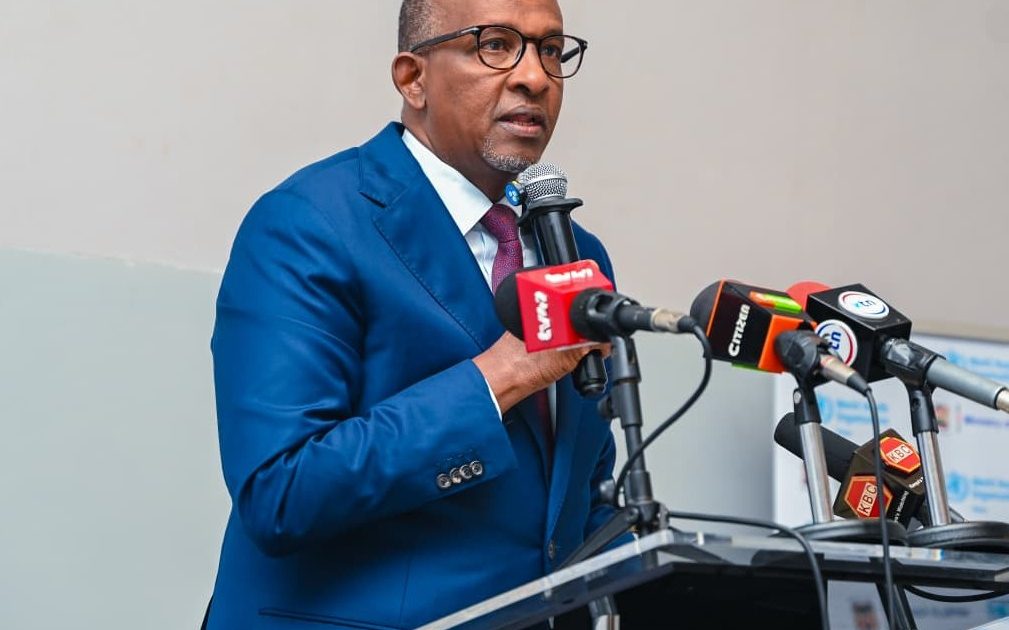
The Ministry of Health has assured Kenyans that the country has not recorded any confirmed case of Ebola virus even as it strengthens preparedness measures amid regional outbreaks.
Speaking during a media breakfast meeting on Ebola preparedness and response in Nairobi, Health Cabinet Secretary Aden Duale said Kenya remains vigilant due to its regional connectivity and cross-border movement of people and goods.
Duale emphasized that the government has intensified surveillance systems, contact tracing, screening at points of entry, laboratory readiness, healthcare worker training, and the establishment of isolation and treatment facilities to enhance response capacity.
He clarified that the setting up of isolation facilities, including reported developments in Laikipia, should not be misinterpreted as evidence of an outbreak.
“Preparedness facilities are not evidence of an outbreak. They are precautionary measures designed to ensure swift and effective response should a suspected or confirmed case arise,” he said.
The CS urged the media to play a responsible role in combating misinformation and disinformation, warning that inaccurate reporting could create unnecessary fear, stigma, and confusion among the public.
“We encourage media houses to verify information through official channels and support public education through factual and evidence-based reporting,” he said.
Duale reaffirmed the Ministry’s commitment to transparency, noting that regular updates would continue to be issued through official communication channels.
He also called on healthcare workers across the country to remain vigilant, maintain a high index of suspicion, and strictly adhere to infection prevention and control measures when handling patients.
County governments were urged to strengthen local preparedness systems, including surveillance, rapid response teams, healthcare worker training, and public awareness campaigns, with the CS noting: “every outbreak begins and ends at the community level.”
The CS further highlighted the role of development partners in supporting Kenya’s health security systems through investments in surveillance, laboratory strengthening, emergency response capacity, and training.
“Preparedness is not a sign that danger is at our doorstep. It is a demonstration of responsible leadership and effective planning,” Duale said.
He emphasized that Kenya’s health security depends on a ‘whole-of-government, whole-of-society ‘approach and reiterated the ministry’s commitment to safeguarding public health and ensuring the country remains ready to prevent, detect, and respond to any health threats.
Principal Secretary for the State Department for Public Health, Mary Muthoni said public health emergencies test a country’s unity and preparedness, urging all stakeholders to remain proactive rather than reactive. The PS noted that prevention remains the strongest defense against disease outbreaks.
Muthoni said Ebola continues to pose a serious threat on the continent, pointing to recent outbreaks in the Democratic Republic of Congo and Uganda as a reminder of the need for constant vigilance. She said Kenya remains on high alert, with strengthened disease surveillance and strict screening measures at all entry points, including airports, seaports, and land borders.
She further cautioned the media against the spread of misinformation, warning that it can undermine public health response efforts. “Misinformation spreads faster than any virus and creates fear that undermines public health efforts. Journalists therefore have a responsibility to report accurately, educate the public, and help build trust,” she said.
The PS urged the media to help communities understand prevention measures, recognize signs and symptoms of diseases, and appreciate how surveillance systems work to protect the public, while also countering misinformation before it spreads.
“Your words can save lives. Let us work together to ensure that truth leads the response,” she added.
Dr. Loice Ombajo from KNH emphasized the importance of preparing health facilities with adequate equipment, including PPE, to effectively manage patients.
She argued that instead of establishing many small facilities, the focus should be on strengthening larger, well-equipped centers that consolidate resources.
This approach, Dr. Ombajo noted, would help improve efficiency and better contain cases within healthcare facilities.
Since the Ebola virus was declared on May 15th, May 2026 in DRC, as of Thursday, June 11th, the confirmed cases were 635 in the DRC and 19 in Uganda with deaths cases standing at 127 in DRC and 2 in Uganda.
The Africa Centre for Disease Control (CDC) reclassified an additional 10 countries as high risk, and among them are Kenya, Tanzania, Ethiopia, Rwanda, Burundi, Somalia, the Central African Republic, Congo, Angola, and Zambia.
By Wangari Ndirangu