Experts have proposed strict implementation and enforcement of the existing land use policies to address continued land subdivision, climate change, and ageing farmer population, which they said is increasingly becoming a major threat to food security in the country.
Egerton University VC Prof. Isaac Kibwage indicated that various studies had confirmed a worrying trend of a decrease in food production despite increasing population and asked for speedy implementation of the land use policy that dictates that agricultural land should not be subdivided to below five acres to stop uncontrolled land subdivision.
While noting that it was time to identify and protect areas where land subdivision is rife to boost food production, the VC said the practice risks Kenya’s economic growth, as agriculture is the biggest contributor to the country’s Gross Domestic Product (GDP) and food security.
He said the existing agricultural policies should be research-driven to address the emerging challenge of uncontrolled land use.
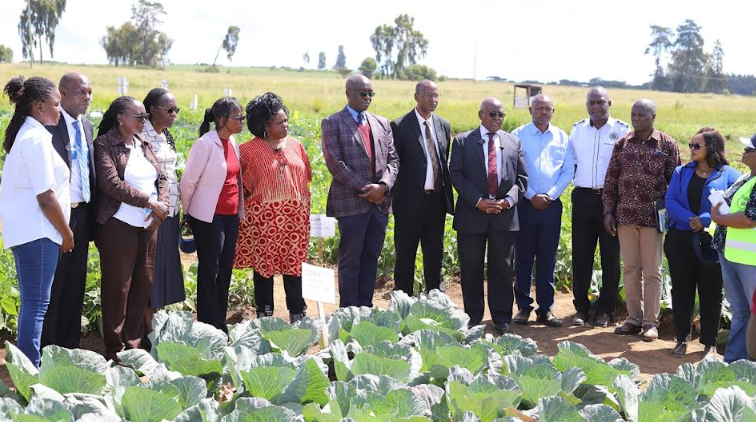
The VC made the remarks at the Njoro Main Campus during a 4K-Club revitalization forum consisting of representatives from national and county governments, academia, and agricultural industry stakeholders aimed at transforming agriculture into an attractive, technology-driven career for the youth.
Current trends where land-buying companies have invaded the agriculture-rich areas of Njoro, Molo, Gilgil, Mau Narok, and Naivasha, where they are buying vast farmlands and subdividing them into 50 by 100-foot plots, which cannot sustain agricultural activities, have raised concerns among experts.
Nakuru is one of Kenya’s breadbaskets, renowned for the production of potatoes, cabbages, carrots, wheat, and maize in areas such as Dundori, Ngorika, Rongai, Solai, Subukia, and Bahati.
A report compiled by the Tegemeo Institute of Policy Research and Analysis indicates shrinking farm sizes were impacting negatively on efforts to reduce poverty and food insecurity, especially given the limited employment opportunities generated by the country’s manufacturing and services industries.
In the report dubbed ‘Emerging Land Issues in Kenyan Agriculture and Their Implications for Food Policy and Institutional Reforms in Kenya,’ the policy research institute states that as a result of rapid population increase, land parcels in the areas of high agricultural potential are decreasing in size, affecting food production.
“The country’s population has increased significantly, growing from 11 million in 1970 to 39.5 million in 2011. At the current rate of growth, it will double in the next 27 years, to reach 81 million in 2039,” states the Policy Research and Analysis Institute.
The report went on to indicate that medium-scale farms in Kenya now controlled a paltry 0.84 million hectares, while the large-scale farms, both foreign and domestic, account for a mere 0.69 million hectares; the remaining 2.63 million hectares were controlled by smallholder farmers.
Prof. Kibwage emphasized the need to prepare a new generation of farmers as Kenya confronts an aging agricultural workforce and growing food security challenges.
He explained that the problem of young people not getting attracted to agriculture was historical.
“Agricultural and farming works have always been portrayed as retirement jobs, unprofitable and hard work jobs for rural and old people,” he added.
Statistics from the United Nations Development Programme (UNDP) show that the average age of a Kenyan farmer is 60 years.
The Don pointed out that the sector faces a massive generational skills gap, as the youth increasingly abandon agriculture for urban centers and continue to view farming as unattractive and financially unrewarding. This disparity, he stated, has raised concerns about the future of food production.
He welcomed the revival of the 4K-Club programme, a school-based initiative aimed at introducing young people to farming, adding that the initiative is not a return to traditional school gardens.
Instead, the VC observed that it combines agriculture with science, technology, and entrepreneurship, exposing students to innovations such as drones, smart irrigation systems, and digital farm management tools.
Egerton University has been partnering with stakeholders to promote 4K Clubs at various schools within Nakuru County in an initiative that aims to empower young learners with knowledge and skills in responsible crop protection and sustainable farming practices.
The institution is actively involved in training 4K Club patrons, members, and school heads on agricultural innovations and sustainable agronomic practices.
Prof. Kibwage noted that the clubs, once a cornerstone of agricultural and environmental education in schools, are a vital tool in fostering a generation that understands and actively participates in sustainable agricultural practices.
To realize this vision, Egerton University allocated a dedicated demonstration farm and tech hub facility to the 4K-Club initiative, coordinated by Dr. Miriam Kyule. The center introduces young minds to cutting-edge tools like agricultural drone technology and smart irrigation programming, the VC added.
Prof. Kibwage underscored the importance of reviving school farming programs, adding that the initiative by the university supports 4K Clubs, helping pupils learn practical farming skills and build a love for agriculture from a young age. It aims to inject fresh, technologically driven energy into school-age youth to directly combat the twin crises of aging farmer demographics and shrinking arable land.
He said making agriculture and farming more innovative will attract many young people, especially if it is linked to technology and digital skills that can be used to maximize agriculture profits.
“Using technology and technological innovation, integrating agricultural training into national curriculums, and focusing on youth issues in agricultural policy and government support would be key issues to bring more youth to the sector,” said the vice chancellor.
He emphasized that linkage to expert knowledge and linkage to existing practicing farmers may change the younger generation’s perception about agriculture.
Deputy VC in charge of Academics, Research and Extension, Prof. Bernard Aduda, noted that the institution has set aside a demonstration farm and innovation hub where students will gain exposure to emerging technologies, including drone-assisted crop monitoring, precision agriculture, and digital irrigation systems.
“We need practical ways of making agriculture attractive to young people,” said, Professor Aduda.
He also encouraged greater use of community media platforms, including Egerton University Radio, to help translate scientific research into practical information for farmers.
Deputy VC Administration, Finance, and Planning Professor George Muthaa said the revived 4K club programme could help bridge the gap between classroom learning and practical farming experience.
Prof. Muthaa indicated that with limited arable land, climate pressures, and a growing population, Kenya will need a new generation of farmers who are as comfortable using data and drones as they are working in the field.
The 4K Club programme, an acronym for “Kuungana, Kufanya, Kusaidia Kenya” (Unite, Act, Help Kenya), was popular in the 1990s but has dwindled in recent years due to shifts in educational priorities and resource constraints.
With the growing threat of climate change, stakeholders believe it is time to shore them up back into the education system.
According to Prof. Muthaa, climate change is no longer a distant issue; it’s a reality affecting every aspect of our lives.
He said there is need to empower the young ones with the knowledge and skills to tackle the challenges from an early age adding that enhancing capacity of 4K clubs could play a pivotal role in this effort.
By Esther Mwangi and Caroline Nyakio