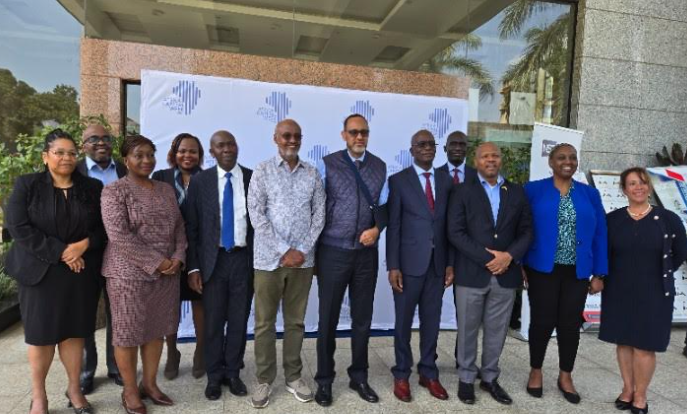
African countries have been urged to deepen and integrate their capital markets to mobilise long-term financing, attract private investment, and accelerate economic transformation across the continent.
The call was made on Monday during the launch of Africa Capital Week (AfCW) 2026 at the Kenya School of Monetary Studies in Nairobi.
The forum, which will be held from August 31 to September 4, 2026, seeks to bring together policymakers, regulators, investors, development finance institutions, and private sector leaders to explore solutions to Africa’s financing challenges and advance the continent’s economic sovereignty.
Speaking during the launch, Principal Secretary for Economic Planning Dr. Boniface Makokha said Africa must strengthen its financial systems and develop innovative financing mechanisms to support sustainable development and reduce dependence on external funding.
“Africa is not seeking sympathy; Africa is seeking investment. Africa is not a continent of risk. Africa is a continent of opportunity whose risks have too often been mispriced and misrepresented,” said Dr. Makokha.
He noted that Africa continues to face limited access to affordable long-term financing and an overpricing of sovereign risk, factors that increase the cost of funding development projects.
He added that Kenya’s economy grew by 4.6 per cent in 2025, with a nominal Gross Domestic Product (GDP) of about Sh17.58 trillion, underscoring the country’s resilience and investment potential.
Acting Director General of the Vision 2030 Delivery Secretariat, James Maina, said Africa possesses abundant resources, entrepreneurial talent, and investment opportunities but requires stronger partnerships and efficient capital markets to unlock sustainable growth.
He said Africa Capital Week would serve as a platform for transforming policy commitments into practical investments by connecting investors with bankable projects across the continent.
“Kenya’s Vision 2030 seeks to transform the country into a globally competitive and prosperous nation, and stronger capital markets are essential in mobilizing the resources required to achieve that vision,” said Maina.
Capital Markets Authority Chairman Ugas Mohamed said the inaugural forum would reinforce Kenya’s position as a regional financial hub while strengthening capital markets across Africa.
Held under the theme “Deepening Capital Markets to Advance Africa’s Economic Sovereignty,” the event is expected to attract more than 500 participants from Africa and beyond.
Mohamed said Kenya’s capital markets had recorded strong growth over the past year, with the NSE 20 Share Index rising by nearly 60 per cent and market capitalization increasing significantly, driven by improved macroeconomic stability and growing investor confidence.
He added that reforms such as the establishment of the National Infrastructure Fund, the Sovereign Wealth Fund, carbon market initiatives, and measures aimed at easing foreign participation in local markets would further strengthen Kenya’s investment landscape.
Principal Secretary for Public Investments and Asset Management, Cyrell Wagunda emphasised the need for stronger governance, transparency, and accountability to attract greater investment flows.
“The challenge before us is not simply capital availability. It is our collective ability to develop bankable projects, strengthen institutions and build investor confidence,” said Wagunda.
Kenya Association of Stockbrokers and Investment Banks Chief Executive Officer and President of the Africa Stockbrokers and Securities Dealers Association, Willie Njoroge, said limited access to African capital markets remains one of the continent’s biggest investment barriers.
“The challenge, in a nutshell, has been accessibility,” said Njoroge, who called for stronger linkages among African stock exchanges and innovative platforms to facilitate cross-border investments.
Africa Capital Week 2026 is expected to provide a platform for governments, investors, and businesses to forge partnerships, mobilize capital, and unlock opportunities in infrastructure, industrialization, technology, and other strategic sectors critical to Africa’s long-term economic growth.
By Nancy Omondi and Sharon Njeru