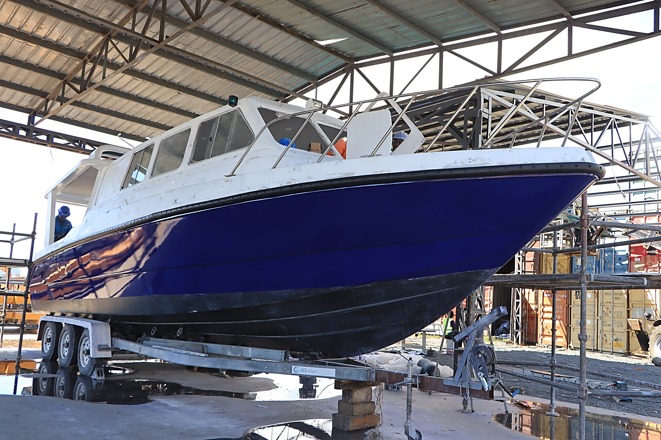
As thousands of delegates converge in Mombasa for the 11th Ocean Conference, the first time the global event is being held in Africa, Kenya Shipyards Limited (KSL) is showcasing an innovative Glass-Reinforced Plastic (GRP) boat, a locally manufactured solution poised to enhance maritime safety and transform the fishing industry.
The GRP boats are constructed from composite material made of plastic reinforced with glass fibres. They are durable, corrosion-resistant, lightweight, fuel-efficient, and easy to mold into efficient designs and require lower maintenance costs compared to traditional wooden boats.
The boats have a carrying capacity of up to three tonnes and can be insured. Owners can also obtain logbooks that may be used as collateral when seeking financing.
Initially introduced in the Lake Victoria region, the boats have been praised for improving productivity and enhancing safety due to their ability to withstand harsh weather conditions.
KSL Business Development Manager, Edward Omol, said Lake Victoria has long been associated with accidents involving unsafe and unstable wooden vessels.
“Most of the people who go out fishing are breadwinners. A life that is lost affects an entire household. We end up with widows, orphans and many other people who depended on that person,” said Omol.
“That is what drove us to come up with this solution so that we can have secure waters and a secure blue space,” he added.
The GRP boat represents a major shift from traditional wooden vessels that have dominated fishing communities for generations, from the Coast region to the lakeside.
Designed and manufactured by Kenyan marine engineers at KSL, the vessel incorporates advanced safety and performance features tailored to the conditions of Lake Victoria and other regional water bodies.
The boats feature an auto-recovery mechanism that helps them remain upright in rough waters, integrated buoyancy systems that make them virtually unsinkable, enhanced wave resistance and stability, and a range of lifesaving equipment, including life jackets and emergency flares.
Unlike wooden boats, which are susceptible to rot and frequent repairs, the GRP boats are built using fibreglass technology that offers exceptional durability and significantly lower maintenance costs.
KSL has built boats for various government agencies, including the Kenya Coast Guard Service, Kenya Navy, Kenya Ports Authority, Kenya Maritime Authority, National Police Service, Kenya Wildlife Service, Kenya Revenue Authority and Kenya Railways Corporation.
County governments that have procured the boats include Lamu, Kisumu, Siaya and Homa Bay. Buoyed by this success, KSL is now keen to market the vessels along the Coast and beyond Kenya’s borders.
KSL is leveraging the Ocean Conference to showcase the innovation to fishing communities operating along the Indian Ocean coastline, where rough seas and unsafe vessels continue to threaten livelihoods.
Omol affirmed that the boats can help improve maritime safety, increase fish catches through more reliable operations, and strengthen economic opportunities for coastal communities.
“This boat is safer, lighter, more profitable, environmentally friendly and easy to operate. More importantly, it is helping us create safe waters for everyone who depends on them,” he stated.
KSL Technician Francis Macelo explained that fibreglass boats were introduced because traditional wooden vessels deteriorate quickly and can sometimes sink, resulting in loss of life.
“With the GRP boat, even if an incident occurs on the water, the vessel remains afloat and can help save lives,” he said.
Macelo noted that fibreglass vessels can remain operational for decades with minimal structural maintenance.
“Fibreglass does not rot in water. You may only need to replace the engine over time, but the hull itself remains strong and reliable,” he said.
by Sadik Hassan