The Ministry of Agriculture is working on modalities to integrate policy briefs and research outputs into national planning frameworks, while advocating for increased budget allocations to research and development.
Agriculture Principal Secretary Dr. Kipronoh Ronoh observed that Kenya currently falls below the African Union’s Maputo Declaration target of allocating at least one percent of GDP to agricultural research, thus stronger investment is needed to retain scientific talent and strengthen institutions.
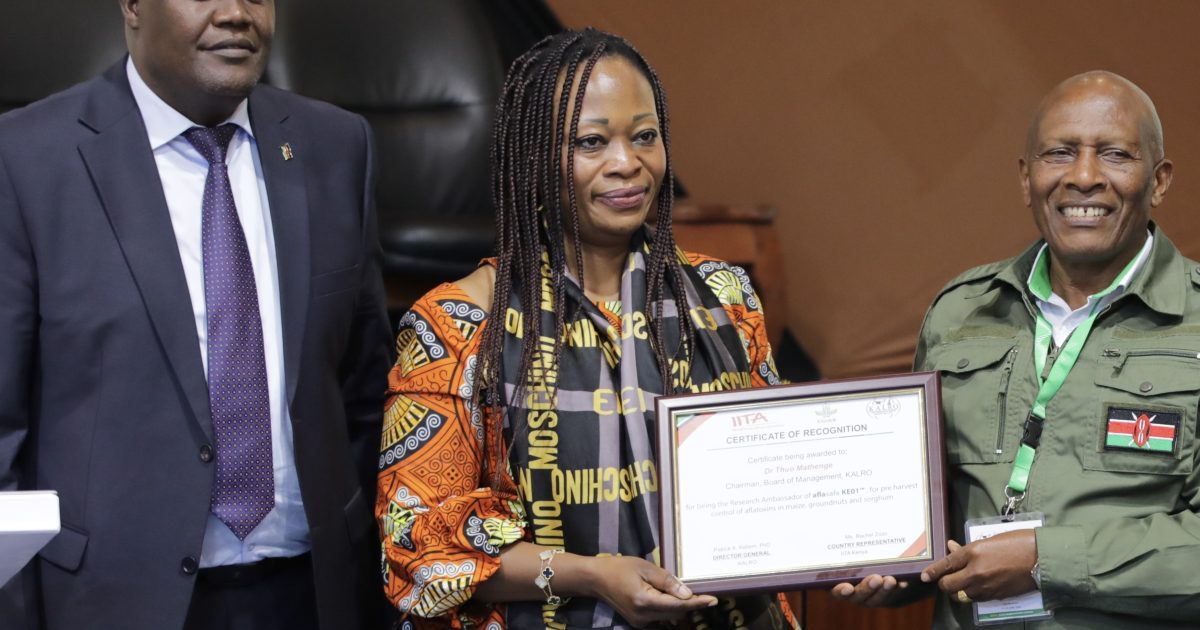
“A well-funded research institute is a national advantage,” he said, in a speech read on his behalf by the Kenya Agricultural and Livestock Research Organization (KALRO) chair, Dr. Thuo Mathenge, during the close out session of a one-week KALRO research and scientific conference.
The PS noted that Africa is capable of feeding itself through science, innovation, and investment in research, noting that Kenya is already making significant progress in transforming its agri-food systems.
Dr. Ronoh emphasized on the importance of aligning government with carbon-conscious and climate-smart agricultural practices.
“Increased productivity, expanded market access, and the fight against hunger cannot be achieved without sustainable systems,” the PS said.
The conference, themed, “Innovating towards resilient agri-food systems for climate action, food security, and sustainable livelihoods,” brought together scientists, policymakers, and development partners to explore solutions aimed at boosting agricultural productivity and addressing hunger.
Dr. Ronoh stressed the role of research institutions such as KALRO, noting that scientific evidence is increasingly informing policy decisions, including budget formulation and parliamentary processes.
“Scientists, you are the guardians of food security. Carry that responsibility with pride,” the PS said, urging farmers and agri-preneurs to work closely with researchers in shaping the agricultural research agenda.
KALRO Director General Dr. Patrick Ketiem called for accelerated adoption and scaling of agricultural innovations to bridge persistent gaps in food security, farmer incomes, and productivity.
He noted that while KALRO and other research institutions have developed numerous technologies and innovations across crop and livestock systems, many of these solutions have yet to reach farmers’ fields.
“The key question we asked ourselves is, why are these technologies not reaching farmers? This conference was meant to reflect, discuss, and chart a way forward,” he said.
He reported that more than 2,000 stakeholders participated in the conference, which also featured side events on food safety, regulatory frameworks, and agricultural transformation, citing one of the key outcomes as consensus on the need to fast-track the scaling of practical technologies capable of transforming farming communities.
Dr. Ketiem emphasized that KALRO has developed solutions targeting major challenges such as climate change, soil health, pests and diseases, and fertilizer recommendations but stressed the need for stronger partnerships to expand their reach.
“We are calling on stakeholders to support us in scaling these technologies. It is a collective responsibility to transform the agricultural landscape,” he said.
He noted that smallholder farmers, who make up about 80 percent of Kenya’s agricultural sector, require enhanced support in extension services, best agronomic practices, value addition, and storage systems.
Dr. Ketiem further urged pooling of resources from government, development partners, NGOs, and the private sector to scale innovations more efficiently and avoid duplication of efforts, saying such collaboration would ensure agricultural technologies deliver greater impact in job creation, food security, and youth employment.
The 2nd KALRO Scientific Conference & Innovation Expo took place June 15-19, 2026, and served as Kenya’s premier gathering for agricultural and livestock experts, focusing on advancing resilient agri-food systems and climate resilience.
By Wangari Ndirangu