Education stakeholders have raised concern over Kenya’s widening unemployment crisis, with about 1.2 million learners graduating annually from primary, secondary schools, colleges and universities against an estimated 100,000 jobs created each year.
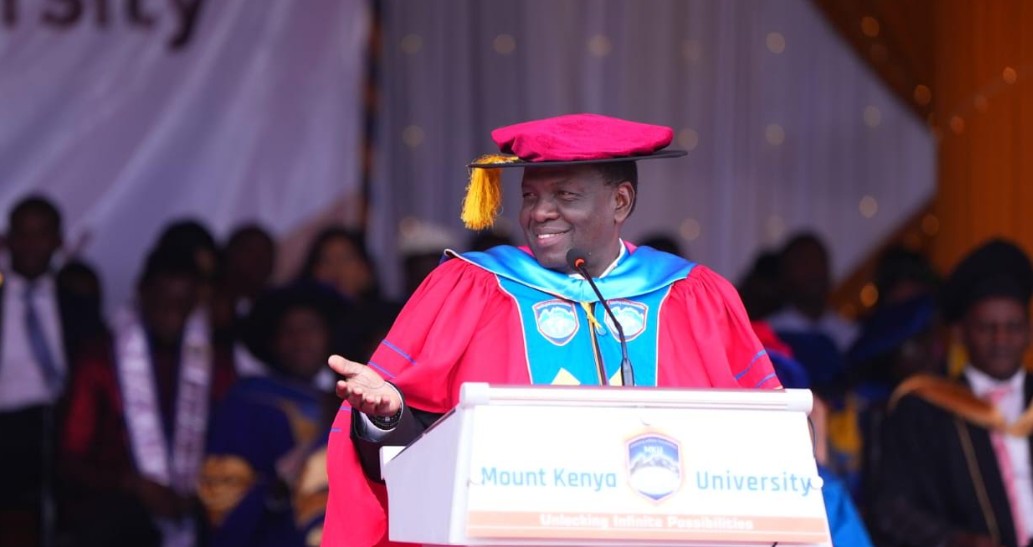
Speaking during Mount Kenya University’s (MKU) 29th Graduation Ceremony in Thika, Jubilee Holdings Ltd Chief Executive Officer and chief guest, Dr Julius Kipng’etich, said the gap leaves more than one million young people without formal employment every year.
Kipng’etich said the situation requires urgent government intervention through policies that accelerate economic growth, create employment opportunities and promote a stronger savings culture.
“The country is facing a serious unemployment crisis, churning out 1.2 million graduates annually in primary and secondary schools, as well as colleges and universities, against 100,000 jobs,” he said.
He challenged graduates to become innovative and entrepreneurial, saying reliance on formal employment alone could not address the growing number of young people entering the labour market.
Kipng’etich said the employment crisis was evident in the difficulties many graduates face in securing jobs, with some remaining unemployed for years after completing their studies.
He cited the Teachers Service Commission (TSC), saying some trained teachers had secured employment only 10 to 15 years after graduating, illustrating the intense pressure facing the labour market.
The Jubilee Holdings CEO also called for increased savings to provide capital for young people seeking to establish and expand businesses.
“Entrepreneurship requires capital,” he said, urging Kenyans to embrace a stronger savings culture to support investment and business development.
Kipng’etich further raised concern over education inequality, particularly in Northern Kenya, saying about 14 per cent of young people in the region had never joined secondary school.
He challenged Parliament to enact laws guaranteeing children access to education for at least 18 years, arguing that improved access would help address inequality and unlock opportunities for young people.
MKU Vice Chancellor Prof. Deogratius Jaganyi said the university was strengthening its academic programmes through curriculum reviews, integration of Artificial Intelligence (AI) and digital skills training to better prepare students for the changing labour market.
He said the university had also expanded its postgraduate programmes into emerging fields, including mental health, psychiatric studies and health records management, to respond to evolving societal and professional needs.
Jaganyi said institutions of higher learning must continue adapting their programmes to ensure graduates acquire skills relevant to the changing economy and workplace.
MKU Chancellor Prof. John Struthers urged young people to embrace innovation, adaptability and resilience to thrive in a rapidly changing world shaped by technological advancement and global connectivity.
He commended the university for strengthening global partnerships and investing in emerging technologies, including artificial intelligence, robotics, cloud computing, 5G and the Internet of Things.
By Muoki Charles