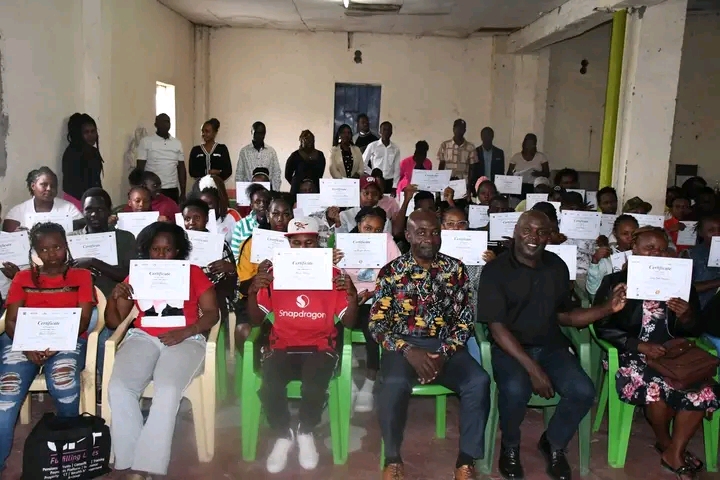
At least 540 youths from informal settlements in Nakuru County are poised to access employment opportunities courtesy of the Nyota Kenya Informal Settlements Improvement Project (KISIP II) Nyota initiative.
The beneficiaries who were trained on entrepreneurship and business growth opportunities after completing a three-month skills development programme under the programme were equipped with relevant competencies in business development and workplace experience critical in their operations.
The programme, which forms part of government efforts to ensure residents of informal settlements benefit not only from improved infrastructure but also from economic empowerment interventions that enhance employability and self-reliance comes at a time when Kenya is grappling with a growing youth population and rising demand for employment opportunities.
Through life skills training, on-the-job learning, business support and Recognition of Prior Learning (RPL), the programme seeks to prepare young people for the labour market while supporting those interested in starting or expanding businesses.
Speaking during the graduation ceremony, KISIP National Assistant Director, Thomas Nyamwaro said the programme was designed to complement ongoing investments in informal settlements by empowering youth with practical skills, positive attitudes and competencies required to participate effectively in economic and social development.
He noted that the programme is not only improving infrastructure in informal settlements, but also investing in young people by giving them knowledge and skills to take up the emerging economic opportunities in the country.
Nyamwaro reiterated that equipping young people with relevant skills increases their chances of securing employment, creating enterprises and contributing to the growth of their communities.
He challenged the youths to remain focused and leverage the skills acquired to create sustainable livelihoods through employment and entrepreneurship.
The KISIP Nyota Initiative aligns with Kenya’s Bottom-Up Economic Transformation Agenda (BETA), which identifies youth empowerment, job creation and support for Micro, Small and Medium Enterprises (MSMEs) as key pillars for economic growth.
According to the 2025 Kenya National Bureau of Statistics (KNBS) Economic Survey, young people account for the largest share of the country’s labour force, making skills development and job creation critical components of national development.
The World Bank has consistently identified skills development as one of the most effective pathways for reducing poverty and increasing productivity among young people. According to the global lender, targeted skills programmes improve labour market outcomes, increase earnings and strengthen social inclusion, particularly among vulnerable populations.
KISIP County Coordinator, Laban Ndwaru noted that the programme enhanced participants’ employability while promoting responsible citizenship, financial literacy and self-confidence.
He observed that many young people living in informal settlements face multiple barriers including limited access to quality education, inadequate skills and lack of employment opportunities.
Across Africa, youth unemployment remains a major development challenge despite the continent having one of the youngest populations globally. According to the African Development Bank (AfDB), about 10 to 12 million young Africans enter the labour market annually, yet only about three million formal jobs are created each year.
The Bank has repeatedly called for increased investment in technical and vocational training, entrepreneurship support and innovation-driven programmes to bridge the employment gap.
Nyota Initiative representative, Bernard Kibisu urged the graduates to embrace lifelong learning and continuously improve their skills to remain competitive in the changing labour market.
He encouraged beneficiaries to utilize the knowledge gained through the programme to establish enterprises, seek formal employment and contribute to community development.
Kibisu also urged the youth to use the skills as a foundation for greater opportunities and embrace innovation while adapting to the rapidly changing world of work.
He further highlighted the availability of affirmative action funds and youth enterprise support programmes aimed at helping young entrepreneurs start and expand businesses.
According to the Ministry of Youth Affairs, Creative Economy and Sports, youth-owned enterprises contribute significantly to employment creation and local economic development when supported through financing, mentorship and market access.
KISIP II, which is being implemented in several counties across Kenya, seeks to improve living conditions in informal settlements through enhanced infrastructure, land tenure security and socio-economic empowerment initiatives.
For the 540 youths in Nakuru, the programme represents more than a certificate award. It provides an opportunity to transition from vulnerability to productivity through skills acquisition, entrepreneurship and active participation in economic development.
As Kenya continues to urbanize, stakeholders believe that investing in young people living in informal settlements will be critical in reducing poverty, promoting inclusive growth and building resilient communities capable of contributing to the country’s long-term development goals.
By Jefther Simeon Afuyo and Esther Mwangi