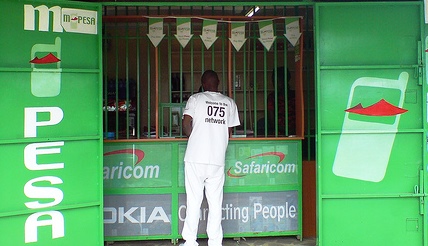
M-Pesa is a leading mobile phone-based financial service in Kenya that allows users to deposit, withdraw, transfer money and pay for goods and services using their mobile devices, without needing the traditional bank account.
Launched in 2007 by the giant Telco, Safaricom, the name M-Pesa combines “M” for mobile and “Pesa” (Swahili for money).
Kenyans transact an average of Sh110 billion daily on M-Pesa. This translates to more than Sh1,300 being processed per second, with the platform routinely handling over 60 million transactions every day across the country
Equally Kenyans borrow roughly Sh1.4 billion to over Sh3.8 billion daily through M-Pesa-linked platforms. The vast majority of this comes from the Fuliza overdraft service, which is used for everyday expenses like food, rent, and school fees.
Over the last decade alone, trillions of shillings in mobile loans have been poured directly into the hands of ordinary citizens and small traders, thus replacing formal commercial banks as the primary source of immediate capital for the Kenyans.
While law enforcement battles the digital criminal wave, the tangible benefits of the platform continue to drive the legitimate economy forward.
Along Oginga Odinga Street in Kisumu city, Millicent Anyango, who runs a wholesale fish distribution business supplying various hospitality joints across the lakeside region, describes the platform as an absolute lifeline.
Anyango explains that the ability to access instant mobile loans through micro-savings facilities has completely eliminated the rigid bureaucratic hurdles of traditional banking halls.
For an independent trader, the capacity to pull an emergency micro-loan or use an automated overdraft facility to secure a fresh catch from the beaches of Dunga or any other in the middle of the night keeps her supply chain moving.
The trader emphasizes that without this immediate access to digital credit, small-scale traders would remain at the mercy of predatory informal lenders who charge astronomical interest rates.
Yet, this seamless migration away from physical cash has created an unintended paradox. As paper money vanishes from the streets, reducing traditional highway robberies, it has opened a highly sophisticated, invisible frontier for criminal syndicates.
The morning sun over the Kondele interchange in Kisumu illuminates a landscape defined by rapid commercial movement, where almost every exchange of goods is sealed by a mobile transaction tone. In Kisumu County, the digital wallet has evolved from a convenience into the very infrastructure of daily survival.
The same device that empowers a trader to scale up their business has become a conduit for digital exploitation, catching both local law enforcement and vulnerable residents in a complex web of modern fraud.
A senor police office ta Kondele Police Station who declined to be named for protocol reasons explains that traditional physical muggings have dropped sharply because criminals know people no longer walk around with bulky wallets.

Instead, criminals have re-tooled, moving their operations entirely into the digital space, resulting in an influx of distraught victims reporting emptied mobile accounts every single week to the police station and other police stations in the country daily.
According to the senior law enforcement officer, the tactics used by these modern syndicates rely heavily on psychological manipulation rather than technical hacking.
He points out that the station frequently receives complaints regarding organized syndicates operating both locally and from notorious correctional facilities in the country.
To combat this rising tide of cyber-enabled theft, the police officer states that his desk has partnered with corporate security teams and mobile network providers to trace signal towers and block flagged lines.
Furthermore, the station has deployed plainclothes intelligence officers across major mobile money hot spots in Kondele and Manyatta, alongside stepping up grassroots sensitization barazas to enlighten the residents, particularly elderly traders, how to protect their personal identification numbers and data.
In the neighboring estate of Nyalenda, Peter Omondi, a local carpenter, speaks with bitter experience about the severe disadvantages of mobile lending and the devastating impact of digital fraud.
Omondi narrates that the ease of acquiring quick mobile loans often leads to a subtle form of financial bondage, where daily compounding interest fees quietly swallow up the thin profits of a workshop.
The system, he notes, is entirely rigid, employing cold algorithms that automatically slash credit limits or trigger blacklists the moment a repayment deadline is missed due to a slow business season, permanently damaging a worker’s long-term credit rating over minor balances.
Omondi’s financial struggles were pushed to a breaking point when he fell victim to a highly coordinated mobile money scam that cost him his entire life savings.
He recalls receiving a frantic call from an individual claiming to be an official customer care agent, speaking with authoritative clarity and utilizing an altered caller identity that mirrored the official corporate helpline.
The caller claimed that Omondi’s account was about to be permanently suspended due to an ongoing compliance audit and smoothly guided him through a series of phone commands under the pretense of updating his registration data.
Within three minutes of hanging up, Omondi watched in absolute horror as a succession of automated messages confirmed that Sh120,000; money he had painstakingly put aside to buy a high-grade timber sawing machine; had been systematically drained through unauthorized transfers and instant mobile loan drawdowns.
By the time he rushed to the nearest agent, the funds had been withdrawn at a distant terminal, leaving him with an empty wallet and a mountain of digital debt he did not spend.
This devastating technique is just one branch of a larger criminal tree that utilizes simple text instructions to exploit the public. One of the most widespread tactics plaguing Kisumu residents is the ubiquitous “tuma kwa hii namba” (send to this number) scam.
In this scenario, fraudsters blast thousands of random text messages to unsuspecting citizens, timed perfectly to coincide with standard market hours, claiming that a previous transaction failed or requesting an urgent payment to a different line.
Unwary buyers, caught up in the rush of daily business, often send cash to these ghost accounts without double-checking the names, only to discover the error after the fraudster has switched off the SIM card.
Beyond identity theft and accidental transfers, the lakeside city is dealing with other emerging forms of mobile financial crime, such as SIM-swap fraud and the extortion of mobile money agents.
In a SIM-swap scheme, criminals collude with compromised insiders within the telecommunications sector to replicate a victim’s active phone card onto a blank chip, effectively hijacking their network signal and intercepting all one-time authorization pins to clear out funds from accounts.
Concurrently, mobile agents themselves are being targeted by criminals who present fraudulent national identification documents or use sophisticated chemical sprays that disorient agents during transactions, allowing the thieves to execute major deposits without paying the physical cash equivalent.
When analyzed broadly, the core advantages of M-Pesa centres on its revolutionary impact on financial inclusion and economic velocity. By transforming a basic mobile handset into a fully functional bank account, the platform has integrated millions of informal workers into the formal monetary system.
It has removed the physical friction of distances, allowing urban workers to remit money to rural folks instantly, and dramatically lowered transaction costs compared to earlier days when there were no systems of instant money transfers.
Businesses can now optimize their financial records through automated merchant tills, which reduces the internal leakages associated with employee theft and streamlines daily accounting transactions across multiple branches.
Conversely, the disadvantages of the system reflect the high cost of digital dependency in a society lacking comprehensive safety nets. For low-income earners, the steady shaving away of transaction, transfer, and withdrawal fees operates as a highly regressive financial burden.
The total digitalization of cash means that when major network disruptions, server failures, or fiber optic cuts occur, the entire economy of Kisumu plunges into immediate paralysis, stranding commuters and blocking food markets entirely. Luckily, due to technical advancement, this is a very rare occurrence.
This total reliance, paired with a general lack of digital literacy among the elderly and rural populations, has ultimately transformed a brilliant tool of economic empowerment into a vulnerable frontier, where a lifetime of hard work can be ‘taken away’ by a voice on the other end of a phone line.
By Mabel Keya – Shikuku and Tonny Brian